
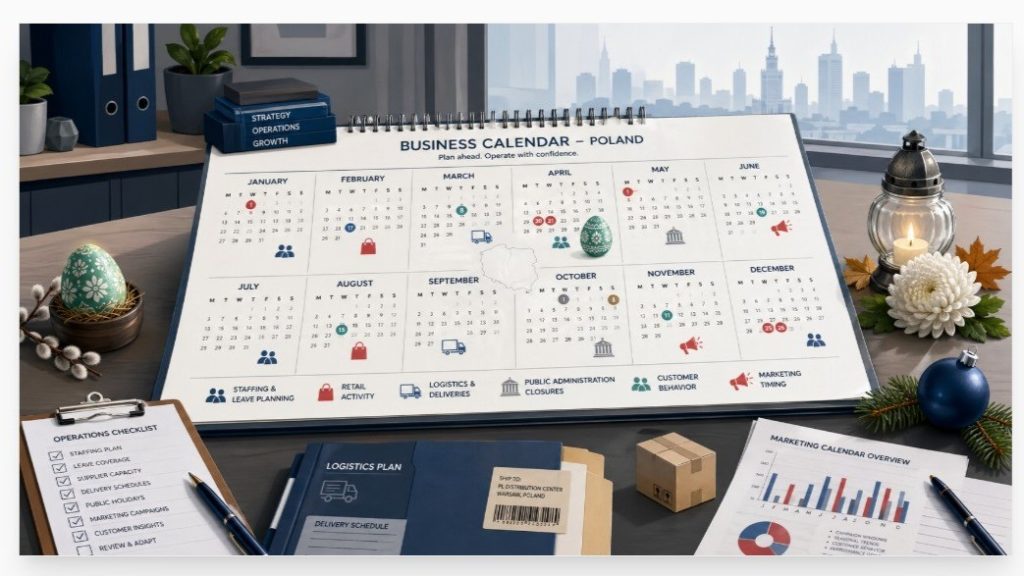
Polish holidays are not only cultural markers. For companies operating in Poland, they are part of the country’s business rhythm. Public holidays affect staffing, retail activity, logistics schedules, public administration, customer behavior, marketing calendars, and the tone of corporate communication. A foreign company that understands this rhythm can plan more effectively and build goodwill, but they that ignore it may create operational friction or appear poorly attuned to the local market.
The Polish calendar combines Catholic traditions, national history, family customs, and civic commemorations. Some holidays are solemn and reflective, such as All Saints’ Day and Independence Day, others are family-centered, especially Easter and Christmas. Some are not statutory holidays but still carry social or marketing relevance, such as International Women’s Day, Children’s Day, Mother’s Day, and Flag Day. The commercial value lies in knowing the difference between legal closure, cultural importance, and campaign relevance.
For foreign investors and operators, holiday awareness should be treated as a planning discipline rather than a decorative cultural note. Public holidays influence when employees take leave, when customers are available, when shops may close, when suppliers slow down, and when marketing messages can either resonate or misfire. In Poland, where relationships, respect, and local credibility still matter, the calendar can become a useful guide to how business should be paced.
Market Landscape
Poland has a well-established set of statutory public holidays. Under official labor guidance, Sundays and public holidays are generally days off work, with work permitted only in specified exceptional circumstances. Public holidays include New Year’s Day, Epiphany, Easter Sunday and Easter Monday, May 1, May 3, Pentecost, Corpus Christi, August 15, All Saints’ Day, Independence Day, Christmas Eve, Christmas Day, and the second day of Christmas. The Ministry of Family, Labour and Social Policy also confirms that Christmas Eve became a public holiday from 2025, adding a day that had long been culturally central even before becoming formally work-free.
Several of these holidays have direct operational effects. Easter Monday, May 1, May 3, Corpus Christi, August 15, November 1, November 11, and the Christmas period are especially important for scheduling. Public offices, schools, many private businesses, banks, and administrative services may be closed or operate with limited availability. Retail is also affected. Polish law restricts trade on Sundays and public holidays, with only a limited number of trading Sundays allowed each year. The official guidance states that retail work is generally prohibited on public holidays and most Sundays, subject to statutory exceptions.
The cultural weight of certain holidays is just as important as the legal calendar. Easter remains one of the most important family and religious periods in Poland, with Easter Sunday and Easter Monday recognized as public holidays. Good Friday, while culturally significant for many, is not a general statutory day off for most workers. This distinction matters for companies scheduling deadlines, customer communications, or internal events around Easter week.
The May holiday period also has a distinct business rhythm. May 1 is Labor Day, May 2 is Flag Day, and May 3 is Constitution Day. May 2 is not generally a statutory public holiday, but many employees use vacation time to create a longer break between the two public holidays. Companies should anticipate lower availability during this period, especially when the dates fall close to a weekend.
All Saints’ Day on November 1 is another major cultural marker. Families visit cemeteries, light candles, and remember deceased relatives. It is not an appropriate moment for aggressive commercial messaging. Independence Day on November 11 has a different tone, centered on Polish statehood, sovereignty, and national identity. Brands and foreign companies should approach both dates carefully, with respect rather than opportunism.
Christmas is the most important family period of the business year. The formal addition of Christmas Eve as a public holiday from 2025 aligns the legal calendar more closely with social practice. In reality, business activity often slows well before December 24 and may remain subdued through the end of the year, depending on the sector. Companies that plan deliveries, signings, product launches, or major decisions during this period should build in additional time.
Opportunities and Challenges
- Holiday planning can reduce operational disruption. Public holidays affect staffing, suppliers, government offices, retail activity, and customer availability. Companies should integrate the Polish holiday calendar into production schedules, customer-service coverage, logistics planning, and contract deadlines.
- Marketing campaigns need cultural judgment. Holidays can create powerful moments for brand communication, but tone matters. Christmas, Easter, All Saints’ Day, and Independence Day should not be handled as generic promotional windows. The strongest campaigns tend to be restrained, locally informed, and connected to authentic values rather than heavy sales messaging.
- Retail and e-commerce require special attention. Trading restrictions on public holidays and most Sundays can affect store operations, staffing, fulfillment timing, customer-service availability, and campaign execution. E-commerce companies should also account for courier schedules, warehouse staffing, and return-processing delays during holiday periods.
- Employee engagement can benefit from cultural awareness. Internal recognition around holidays and social occasions can support morale, especially when handled sincerely. International Women’s Day, Children’s Day, and Christmas are often relevant moments for internal communication, family-oriented gestures, or community involvement.
- Community engagement can strengthen local credibility. Polish holidays create opportunities to support local schools, charities, cultural organizations, veterans’ groups, religiously affiliated initiatives, or municipal events. The key is to choose partnerships that match the company’s values and avoid using solemn commemorations as superficial brand exposure.
- Foreign companies must avoid over-Americanizing the calendar. Campaigns built around imported commercial moments may work in some segments, but they should not displace locally meaningful dates. Polish customers and employees are more likely to notice when a company respects the Polish calendar than when it simply copies a global campaign template.
Partnering and Strategy
Companies expanding into Poland should begin by creating an annual operating calendar that distinguishes between statutory public holidays, culturally important observances, retail-restricted periods, school breaks, and industry-specific slowdowns. This calendar should be shared across HR, operations, sales, logistics, finance, and marketing. A holiday calendar is not only useful for communications teams. It is a practical management tool.
HR should use the calendar to plan staffing, leave requests, employee communications, and coverage requirements. This is especially important around Easter, the May holiday period, All Saints’ Day, Independence Day, and Christmas. Employers should also understand when work on public holidays may or may not be permitted, and should seek appropriate labor-law advice where continuous operations, shift work, logistics, retail, hospitality, or customer support are involved.
Marketing teams should treat Polish holidays as context, not just campaign triggers. Christmas campaigns can work well when they emphasize family, generosity, tradition, or community. Independence Day messaging should be respectful and connected to Polish history or civic identity. All Saints’ Day is generally a moment for quiet reflection rather than commercial activation. Easter can support family-oriented and food-related messaging, but it should still respect the holiday’s religious and cultural meaning.
Operational teams should build buffers around public holidays. Port activity, customs brokers, public offices, notaries, banks, suppliers, and carriers may all experience slower response times. Even when private companies remain open, decision-makers may be unavailable. Foreign executives should avoid interpreting delayed replies during these periods as lack of interest.
Partnerships can be especially valuable. Local advisers, HR providers, municipal contacts, community organizations, charities, and cultural institutions can help foreign companies understand which holidays matter in a specific region or sector. A factory in southern Poland, a retail brand in Warsaw, a B2B services firm in Kraków, and a logistics company near Gdańsk may all face different calendar pressures and community expectations.
A few practical principles are worth applying:
- Plan launches and deadlines around the calendar. Avoid major commercial pushes immediately before or during key holidays unless the timing is culturally appropriate and operationally realistic.
- Localize greetings and internal communication. Polish-language holiday messages, used thoughtfully, can strengthen employee and partner relationships.
- Separate solemn holidays from promotional moments. Not every holiday should become a sales campaign.
- Build holiday effects into logistics and service-level planning. Delivery promises, support coverage, and fulfillment windows should reflect Polish public holidays and retail restrictions.
- Use community engagement selectively. Choose initiatives that create genuine local value rather than short-term visibility.
For foreign companies, the broader lesson is simple. Poland’s holiday calendar is a map of national values, family priorities, public memory, and business availability. Companies that understand it can communicate more naturally, schedule more intelligently, and build deeper trust.
How Expand2Poland Can Help
- Polish holiday and operating-calendar planning
- Cultural briefings for leadership and market-entry teams
- HR and workforce planning support for holiday periods
- Culturally sensitive marketing and communications guidance
- Partner identification with local community organizations and advisers
A well-planned holiday strategy helps companies avoid disruption while showing genuine respect for Polish culture. Contact Expand2Poland to build a market-entry and operating plan that fits the way business and life actually move in Poland.
The information provided in this article is for general informational and educational purposes only and does not constitute legal, financial, or tax advise.