
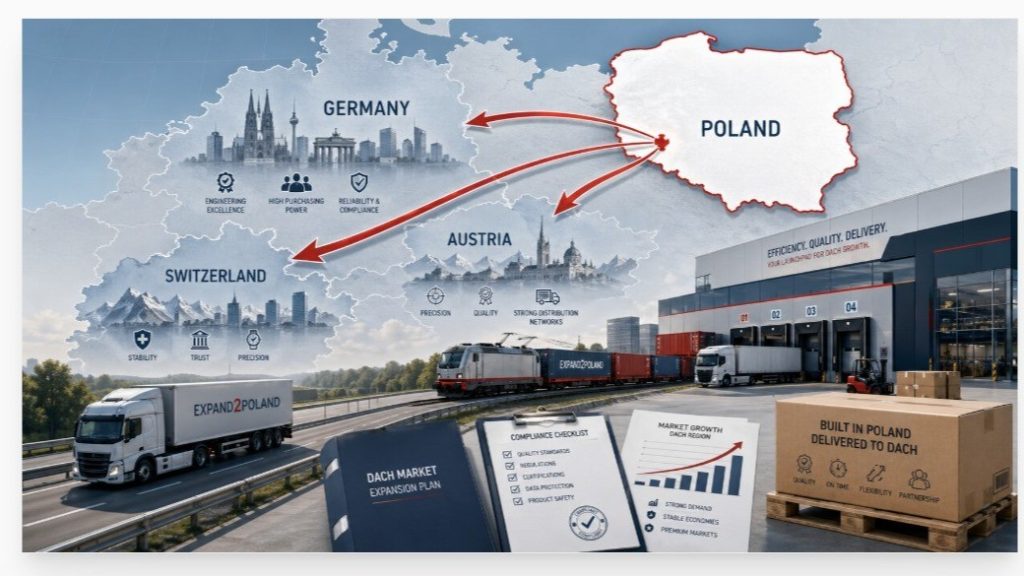
Germany, Austria, and Switzerland represent one of Europe’s most attractive but demanding commercial regions. High purchasing power, sophisticated buyers, mature distribution channels, and deep industrial ecosystems make the DACH markets a natural target for companies expanding from Poland. For Polish producers, foreign investors operating in Poland, and international companies using Poland as a regional base, the DACH region offers a compelling growth path. It is close, wealthy, highly integrated with Central European supply chains, and commercially familiar in many sectors.
Poland’s connection to Germany is especially important. Polish-German trade is not a marginal cross-border relationship; it is one of the core commercial linkages in Europe. According to Polish Economic Institute data cited by Trade.gov.pl, Poland became the fourth-largest recipient of German exports in January-November 2024, with German supplies to Poland reaching EUR 87 billion and Poland accounting for 6% of German exports. That position reflects years of supply-chain integration, subcontracting, industrial cooperation, and dense business relationships between the two countries.
Yet DACH expansion should not be treated as a simple extension of selling in Poland. Germany, Austria, and Switzerland are connected by language and business culture, but they are not one identical market. Germany is large, federal, highly competitive, and process-driven. Austria is smaller but affluent, relationship-oriented, and closely tied to Central and Southeastern Europe. Switzerland is wealthy and highly specialized, but it sits outside the EU customs union, creating additional import, tax, and regulatory considerations. Switzerland’s own federal guidance emphasizes that the EU is a customs union with no duties between member states, while Switzerland is not an EU member state and customs procedures differ by country.
For companies based in Poland, the opportunity is therefore strong but not automatic. Poland can be an excellent platform for DACH sales, but only when the strategy combines cost-efficient operations with German-language capability, product compliance, local trust, reliable logistics, and disciplined after-sales support.
Market Landscape
Poland’s role as a bridge into DACH markets rests on three foundations: geography, industrial integration, and EU market access.
Geographically, Poland is close to Germany and well positioned for road, rail, and warehouse-based distribution into Central Europe. The absence of internal customs duties between EU member states makes sales from Poland into Germany and Austria operationally simpler than sales into third-country markets. The EU customs union removes customs duties on goods traded between member states, which supports cross-border movement for goods already in free circulation within the EU.
Commercially, Poland is already embedded in German and Austrian supply chains. Polish manufacturers, engineering firms, software providers, logistics companies, subcontractors, and industrial service providers often work with DACH-based customers. This gives Poland-based companies an advantage: they are not entering a completely unfamiliar commercial corridor. In many sectors, the buyer relationships, certification expectations, and procurement logic already exist. The challenge is moving from subcontractor or production partner status into a more strategic sales position.
Germany remains the main prize. Its market size, industrial base, and purchasing power make it attractive for everything from machinery, components, furniture, food, packaging, logistics, construction products, IT services, and B2B outsourcing to consumer goods and e-commerce. Austria offers a smaller but high-value opportunity, particularly for companies that can serve premium niches, industrial customers, regional distributors, or Central European headquarters functions. Switzerland is often more difficult to enter, but its price levels and specialized demand can make it highly attractive for companies with quality, technical differentiation, or professional services credibility.
Digital commerce has made initial entry easier, especially for consumer products and specialized B2B goods. EU VAT rules also provide a more manageable framework for cross-border consumer sales within the EU through the One Stop Shop system. Under OSS, companies selling goods or services to consumers across the EU can register once, file one return, and pay VAT through a single online portal in the EU country of identification, while applying VAT based on the customer’s country.
Compliance, however, remains a serious entry barrier. Germany, for example, has strict packaging registration obligations. The ZSVR states that companies commercially distributing packaged goods in Germany must register with the LUCID Packaging Register before commencing distribution, and failure to register can result in a distribution ban. Since 12 August 2026, foreign companies without a German branch that sell empty packaging or packaged products directly to end users in Germany must appoint a German-based authorized representative for extended producer responsibility. They must still complete their own LUCID registration and record the representative’s details.
This is where many Poland-based exporters underestimate the market. DACH customers may appreciate competitive pricing, but they rarely tolerate weak documentation, unclear service terms, poorly localized materials, or inconsistent delivery performance. A successful Poland-to-DACH strategy must therefore look less like opportunistic exporting and more like disciplined market entry.
Opportunities and Challenges
Poland-based cost efficiency can support DACH competitiveness
A Poland-based operating model can provide cost advantages in production, engineering, support, warehousing, and fulfillment. Those advantages can be commercially powerful when selling into higher-price DACH markets. Companies can use Poland to maintain competitive cost structures while positioning their products or services to meet German-speaking customer expectations.
The risk is competing on price alone. DACH buyers, especially in B2B and regulated categories, often place significant weight on reliability, technical documentation, certifications, warranties, sustainability performance, and service continuity. Cost efficiency should support the value proposition, not replace it.
German-language trust is often decisive
English may work in many corporate settings, particularly with international buyers and technical teams. For sales, customer support, documentation, returns, and ongoing account management, German-language capability can be decisive. This applies even more strongly in Austria and Switzerland, where buyers may expect a more localized approach despite the shared language base.
Localization should go beyond translation. Product names, claims, packaging, legal notices, warranty language, instructions, and customer-service scripts need to be adapted to German-speaking expectations. Poor German or overly literal translation can quickly signal that a company is not fully prepared for the market.
E-commerce lowers barriers but raises compliance exposure
Marketplaces, direct-to-consumer websites, and cross-border fulfillment centers allow Poland-based companies to test DACH demand quickly. This is especially useful for consumer goods, specialty products, replacement parts, furniture, home goods, cosmetics, apparel, and niche industrial supplies.
Speed should not come at the expense of compliance. VAT, consumer rights, product labeling, packaging registration, returns, data protection, and platform-specific requirements all need attention. Germany’s LUCID packaging regime is a good example: even small online sellers may face obligations if they place packaged goods on the German market.
Switzerland requires a different operating lens
Germany and Austria are EU member states. Switzerland is not. For Poland-based companies, this changes the commercial model. Shipping into Switzerland can involve customs clearance, Swiss VAT considerations, import documentation, product-specific rules, and different consumer expectations. The Swiss market can be highly attractive, but it should not be grouped mechanically with Germany and Austria from an operational standpoint.
A practical strategy may start with Germany and Austria, then move into Switzerland once the company has stronger German-language operations, better documentation, and a clearer understanding of cross-border servicing.
Brand trust takes longer than market access
Legal access to a market is not the same as commercial acceptance. DACH buyers often want proof: references, certifications, delivery history, financial stability, case studies, and responsive support. Polish companies with strong production capabilities may still need to invest in credibility assets before they can compete with established German, Austrian, or Swiss suppliers.
This is especially true for higher-value B2B sales. A distributor may test a product quickly, but a corporate buyer may require months of evaluation. A strong Poland-based company should therefore plan for a longer trust-building cycle.
Partnering and Strategy
Companies using Poland as a base for DACH expansion should begin with market segmentation, not broad regional ambition. Germany, Austria, and Switzerland should be assessed separately by customer type, price sensitivity, regulation, channel structure, and service expectations. A product that fits German industrial distributors may not be positioned correctly for Swiss premium buyers or Austrian mid-market customers.
Channel choice is the next major decision. Some companies should begin with B2B distributors or wholesalers that already serve German-speaking customers. Others may benefit from marketplace testing, direct e-commerce, local sales agents, or a small representative office. Larger B2B companies may need direct key-account management supported by Polish production, technical, and fulfillment teams.
A few strategic priorities are especially important:
- Localize before scaling – German-language websites, technical documentation, packaging, customer support, and commercial proposals should be prepared before aggressive sales outreach begins.
- Build compliance into the launch plan – VAT treatment, OSS eligibility, packaging obligations, product labeling, warranty terms, consumer rights, and data-protection requirements should be reviewed early.
- Use Poland for operational strength, not only low cost – The strongest position combines Polish manufacturing, engineering, logistics, or service capability with DACH-level reliability and communication.
- Select logistics partners with returns capability – Cross-border sales often fail because reverse logistics and after-sales handling are weak. German-speaking customers expect returns, repairs, replacements, and service issues to be handled clearly and efficiently.
- Treat Switzerland as a separate expansion track – The Swiss market may justify entry, but customs, VAT, pricing, and distribution need a separate plan from Germany and Austria.
Intellectual property and brand protection should also be reviewed before a serious DACH launch. A company that is ready to scale in Germany should not discover late that its brand name, packaging, or product design creates avoidable conflict. Early trademark screening, domain strategy, and distributor-contract discipline can prevent expensive corrections later.
The broader strategic lesson is straightforward. Poland can be a strong commercial bridge into DACH markets, but not because proximity alone guarantees sales. The advantage comes from combining Poland’s operational base with the quality, language, documentation, and service standards expected by German-speaking customers.
How Expand2Poland Can Help
- DACH market-entry assessment from a Poland-based operating model
- Channel strategy for Germany, Austria, and Switzerland
- German-language localization and commercial positioning support
- Logistics, fulfillment, and reverse-logistics partner identification
- Coordination with tax, VAT, packaging, and regulatory advisers
Expanding from Poland into DACH markets can be a powerful growth path when the strategy is disciplined from the start. Contact Expand2Poland to evaluate your route to Germany, Austria, and Switzerland and build a practical plan for cross-border sales.
The information provided in this article is for general informational and educational purposes only and does not constitute legal, financial, or tax advise.