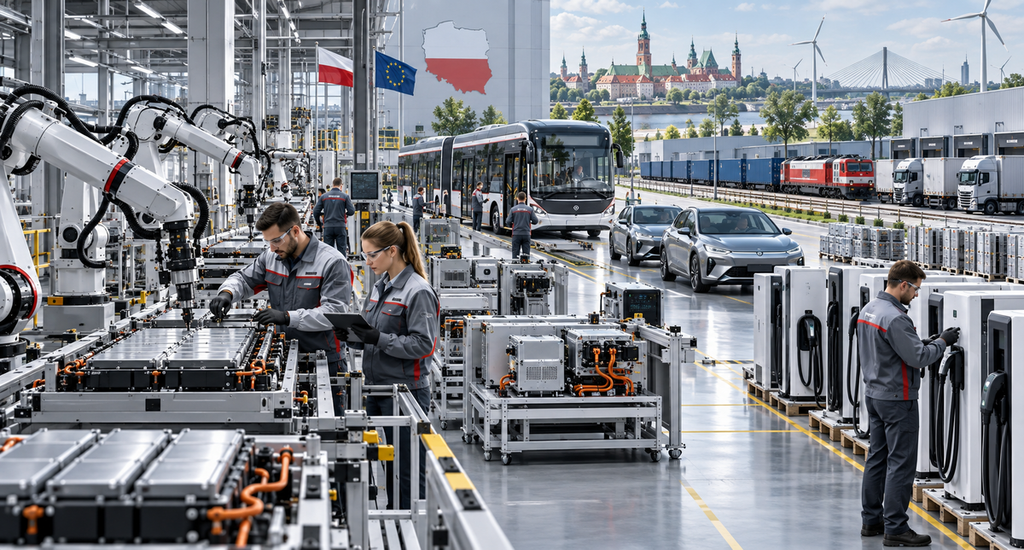
Europe’s shift away from internal combustion engines is changing the map of manufacturing. New demand is exploding for battery cells and modules, bus platforms, power electronics, charging hardware, thermal systems, and the software that orchestrates everything from energy usage to fleet routing. Poland is increasingly visible in this new value chain, not because it is chasing hype, but because it has the industrial “muscle memory” and the supply-chain geography that electrification rewards.
Poland already sits inside the EU single market, on the logistics spine of Europe, with deep manufacturing talent and a fast-maturing technology ecosystem. It also hosts some of the continent’s most consequential battery and energy-storage investments, including major capacity in and around Wrocław and Gdańsk.
But an EV story is never just “build a plant and hire engineers.” The winners will be the companies that treat Poland as a systems play: manufacturing plus compliance, procurement plus recycling, hardware plus software, and scale plus resilience. This article breaks down what’s actually happening on the ground, where the opportunity is shifting, and what smart entrants do differently.
Market landscape: where Poland fits in the EV stack
Poland’s electric mobility footprint is best understood as a layered ecosystem rather than a single industry.
1) Battery and energy-storage manufacturing is anchoring the cluster. Large global players have invested heavily in Poland to supply Europe with cells, modules, and storage systems, making the country an increasingly strategic node for electrification supply. Reuters has described Poland’s battery operations (notably around Wrocław) as among Europe’s largest. Meanwhile, the energy-storage cluster in Gdańsk remains a critical industrial node, though the landscape is shifting. The ownership landscape has changed materially since Northvolt’s Swedish bankruptcy filing in March 2025. Lyten announced completion of its acquisition of the Northvolt Dwa battery-energy-storage manufacturing facility in Gdańsk in October 2025. Investors should assess the ownership, operating status and transaction terms of each specific asset rather than treating former Northvolt facilities as one continuing investment program.
2) Electric buses and commercial e-mobility create a “practical electrification” advantage. Poland has a reputation in electric buses and fleet solutions, segments where Europe is electrifying fast because total cost of ownership and public procurement targets push adoption. Multiple industry sources have cited Solaris as a leading electric bus manufacturer in Europe.
3) Power electronics and software are the multiplier. Even when battery materials are imported, value can still be captured locally through inverters, battery management systems, thermal management, embedded software, cybersecurity, and fleet analytics. Poland’s IT ecosystem is large and export-oriented, which makes it easier to integrate software development with hardware operations, especially for charging optimization and energy management platforms.
4) EU regulation is forcing “clean” supply chains, and that changes investment math. The EU’s Battery Regulation introduces requirements that pull manufacturing toward traceability, declared carbon footprint methodologies, and recycled content targets over time. That matters because it elevates recycling, second-life systems, quality documentation, and supplier due diligence from “nice to have” to core competitive capability.
Highlight: The EV “value chain” is shifting from parts to proof
In the next phase of European electrification, it’s not enough to make components. You must also prove origin, compliance, sustainability, and reliability, at scale. That’s where many otherwise-capable entrants get stuck.
Opportunity zones: where new entrants can still win
Poland is not only a place to replicate what’s already being built elsewhere. Some of the best openings sit in the “connective tissue” between manufacturing, regulation, and operations.
Battery recycling, repair, and second-life systems
Europe is pushing toward meaningful battery recycling capacity, and the Battery Regulation sets recycled-content targets for key materials (with targets beginning in the early 2030s and rising later). For investors, this creates a practical corridor of opportunities:
- Pre-processing and logistics (collection, disassembly, safe transport, black mass handling)
- Diagnostics and repair (especially for fleets)
- Second-life storage for industrial sites and renewables balancing
- Recycling partnerships that help manufacturers meet recycled-content and traceability expectations
Charging and grid-adjacent hardware
Mass EV adoption stresses local grids. That pushes demand for:
- Smart chargers and load management
- Transformer and switchgear upgrades
- On-site energy storage integration
- Software that coordinates fleet charging with power pricing and availability
The hardware is only half the story, the defensible value is often in system integration and optimization software.
Lightweight materials and specialized components
Poland’s manufacturing base can support specialized sub-assemblies and materials work, particularly when paired with EU customers who need faster lead times and tighter supplier collaboration than long-distance sourcing allows.
Industrial automation for EV production lines
As labor shortages and wage pressure rise across Europe, automation becomes a competitive requirement. The opportunity isn’t only robots, it’s also:
- Quality systems and machine vision
- Traceability tooling for compliance
- Predictive maintenance and uptime analytics
Challenges that matter in practice
Poland’s EV upside is real, but ignoring the friction points is how projects miss budgets and timelines.
Imported materials and upstream concentration risk. Even with strong local manufacturing, battery supply chains remain exposed to global pricing, refining concentration, and geopolitical risk. That’s why recycling and diversified sourcing are becoming strategic and not merely “green.”
Permitting, environmental obligations, and documentation burden. Battery and chemicals-adjacent operations bring tighter scrutiny. The compliance effort is manageable, but it must be designed early, especially if you want bankable ESG credentials and stable relationships with EU customers.
Competition for engineering and operations talent. Poland offers a strong talent base, but the best teams have options. Companies that win here tend to be the ones with credible career paths, modern tooling, and clear product missions, not just “a new factory.”
Regulatory acceleration around batteries. Carbon footprint declarations and recycled content targets are not abstract policy debates; they will influence procurement decisions and supplier eligibility.
Highlight: What surprises foreign investors most
It’s rarely “labor cost” or “rent.” The real surprise is how fast compliance, traceability, and security requirements become customer requirements, especially when you sell into regulated EU supply chains.
Partnering and Strategy: How to build a resilient EV footprint in Poland
The best entries into Poland’s electric mobility ecosystem usually follow a sequence that reduces risk while preserving optionality.
Start with a precise wedge. Instead of announcing a broad “EV manufacturing expansion,” choose a focused entry product: a component family, a subsystem, or a contract manufacturing scope you can execute with high quality. Early wins build credibility with suppliers, regulators, and future hires.
Design for compliance from day one. Treat compliance and traceability as part of your product, not admin. Build documentation workflows into the factory process: supplier onboarding, material traceability, QA logging, cybersecurity controls, and audit-ready reporting. This aligns naturally with where EU battery rules are heading.
Use Poland’s logistics as a competitive lever. Many companies nearshore not just for cost, but for cycle time and reliability. A Poland footprint can enable fast delivery to Germany, Scandinavia, and broader EU markets, especially for components that need frequent engineering changes.
Build a “dual talent” model. Winning teams often blend manufacturing operations leadership with software and data capability. That mix is especially powerful for charging systems, fleet solutions, and automation, where product value is increasingly software-defined.
Plan for scale, but don’t over-commit early. Hybrid strategies are common: start with contract manufacturing or a smaller assembly line, then scale to a larger dedicated facility once demand, quality metrics, and staffing stability are proven.
How Expand2Poland can help
Expand2Poland supports electric mobility companies that want to build in Poland with speed and confidence, without stepping into avoidable regulatory or partner-selection traps. Typical engagements include:
- Market entry design: defining the right “wedge” (component, subsystem, or service line) and mapping where Poland fits best in your EU supply chain.
- Partner and supplier matchmaking: introductions to credible manufacturers, integrators, universities, and specialized advisors aligned to your technical needs and risk profile.
- Site and ecosystem selection: choosing locations based on labor availability, logistics access, permitting realities, and long-term scalability.
- Incentives and funding navigation: identifying relevant national/EU support mechanisms and structuring projects so they qualify and remain audit-ready.
- Compliance and operating model readiness: helping you translate EU expectations (traceability, documentation discipline, security posture) into day-to-day factory and engineering workflows.
- Scale execution support: governance, KPI frameworks, and rollout planning so your Poland footprint can expand without quality drift.
The information provided in this article is for general informational and educational purposes only and does not constitute legal, financial, or tax advise.