
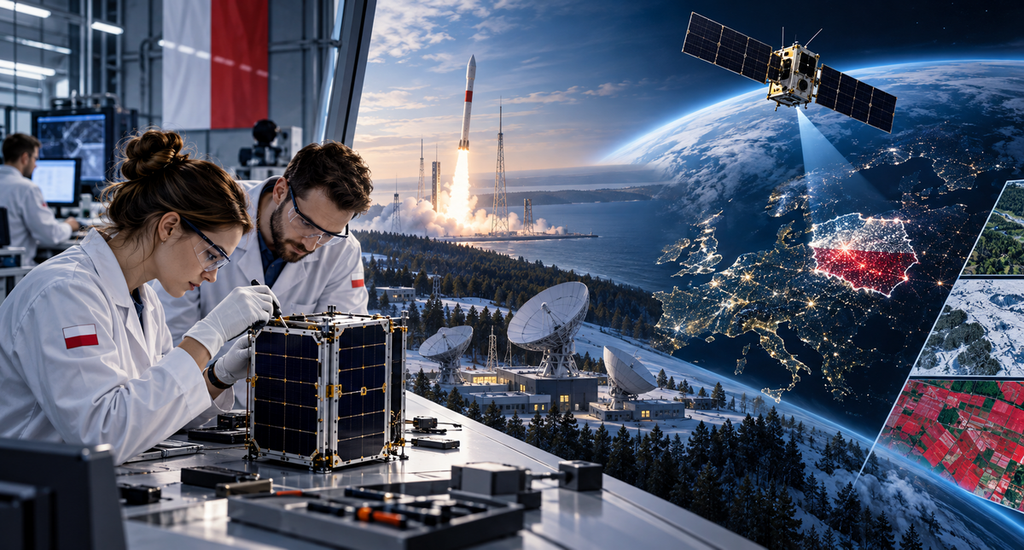
Space has stopped being a “flags and superpowers” story. Today, satellites power everyday systems such as navigation, disaster response, climate monitoring, communications, supply chain visibility, and the companies building these capabilities are increasingly spread across Europe’s emerging innovation hubs. Poland is one of the more interesting examples: not because it is trying to outspend larger players, but because it is assembling the ingredients that make a space-tech economy durable; engineering talent, strong research institutions, EU-linked funding pathways, and a growing set of private firms that understand how to turn prototypes into products.
For investors and entrepreneurs, Poland’s space-tech opportunity is less about a single “moonshot,” and more about participating in a value chain that is expanding in multiple directions at once: small satellites and payloads, ground infrastructure, Earth-observation analytics, and dual-use technologies that sit at the intersection of commercial demand and national resilience. The upside is real, but so are the constraints. Space-tech is regulated, capital-intensive, and deeply dependent on trust, compliance, and long production cycles.
This article maps Poland’s emerging space-tech ecosystem, where partnerships are forming, which business models tend to be most investable, and how foreign and domestic players can collaborate without tripping over security, export controls, or governance risk.
A growing ecosystem and why it matters now
Poland’s presence in European space activity is anchored by participation in European Space Agency programs and national coordination through Polish Space Agency. That institutional foundation matters because it creates continuity: multi-year roadmaps, stable research collaboration, and pathways for local teams to work on internationally relevant missions rather than isolated experiments.
What’s changing now is the “commercial layer.” Poland is seeing a gradual but meaningful expansion of private space-tech efforts, often emerging from university teams, applied research labs, and engineering firms that previously served adjacent sectors such as aerospace, defense, telecommunications, industrial electronics, and advanced manufacturing. The result is a space ecosystem that is still early, but increasingly connected to real markets.
Rather than trying to compete head-on with the largest satellite manufacturers, the Polish ecosystem is building strength in segments where teams can win through engineering quality, cost efficiency, and specialization, especially in the smallsat era, where faster build cycles and narrower mission scopes reduce barriers to entry.
Where Poland is building capability
Small satellites and CubeSat-class missions
The CubeSat and small-satellite segment is often the “entry ramp” into space-tech because it offers faster iteration, lower costs, and higher tolerance for experimentation. In Poland, this area has been fueled by university programs and research collaborations that produce early flight heritage and train engineers in real mission environments.
The commercial opportunity shows up when these capabilities move beyond educational missions and become repeatable products: standardized satellite buses, modular subsystems, or specialized payloads (for example, sensors optimized for a narrow Earth-observation purpose). Investors often underestimate how valuable “repeatability” is here. A company that can reliably deliver one subsystem at quality for power management, onboard computing, attitude control, can become a supplier into multiple missions.
Earth observation analytics and “vertical intelligence”
Earth observation is not only a satellite business; it’s increasingly a data business. Poland’s strong agricultural footprint and interest in environmental monitoring create natural demand for remote sensing services for precision agriculture, forestry monitoring, infrastructure planning, and risk analytics for insurance and utilities.
The most investable pattern tends to be verticalized analytics, where a company solves a specific, operational problem instead of selling generic imagery dashboards. Farmers and logistics operators rarely want “satellite data” in the abstract. They want answers for yield forecasts, soil moisture alerts, vegetation stress detection, route disruption risk, or early indicators of flood impact.
For entrepreneurs, the strategic question becomes: can you build a product that plugs into existing workflows (farm management platforms, ERP systems, utility asset management tools) rather than forcing customers to adopt an entirely new interface?
Ground segment and communications tooling
Ground segment capability for ground stations, antennas, signal processing, and control software is sometimes overlooked because it doesn’t look as glamorous as launching hardware. It is however often more predictable as a business. It also benefits from Poland’s broader engineering base in telecom and software.
This is where partnerships can scale quickly: an international satellite operator expanding capacity in Europe may not want to build every ground component from scratch. A Polish company with strong engineering and secure operations can become a long-term provider, especially if it can deliver reliability, compliance, and continuous improvement.
Robotics, propulsion, and enabling technologies
Space robotics and propulsion R&D is inherently longer-cycle and higher risk, but it can be strategically important, especially when paired with European research networks. In practice, many of these initiatives start in applied labs and later spin out into companies focused on niche components, testing systems, or mission-specific tooling.
For investors, the key is distinguishing between “interesting research” and a path to commercialization. The best bridge is often dual-use application: robotics and sensing technologies that also serve terrestrial industrial automation, inspection, or safety systems.
Investment and partnerships: what actually works in practice
Foreign involvement in Polish space-tech most commonly succeeds through partnerships that respect how the ecosystem is structured today; distributed, research-linked, and relationship-driven.
Joint ventures and applied R&D partnerships are common when a foreign firm brings proven technology or market access, and a Polish partner brings engineering capacity, cost efficiency, and local institutional connectivity. EU-linked funding programs often strengthen these partnerships by reducing early-stage risk, while Poland’s tax and investment regimes can support R&D-heavy activities (including mechanisms such as IP-focused relief and special economic zone incentives).
A second pattern is supplier development: setting up a Polish production or engineering footprint for satellite components, electronics, or testing services. This can be attractive when a company needs to diversify its supply chain inside the EU and reduce bottlenecks.
A third pattern is data collaboration, where a foreign analytics company teams with Polish domain expertise (agriculture, energy, logistics) to build specialized products. This often creates faster revenue than hardware-first approaches, but it depends on strong product design and customer access.
It’s also worth noting that broader European industrial investment trends can spill into space-tech. Investors from Germany and the United Kingdom have been active in industrial sectors including aerospace. That activity doesn’t automatically translate into space investment, but it does mean Poland is already on the map as an engineering and manufacturing partner, which reduces “country risk” for first-time entrants.
Regulatory reality: space-tech is commercial, but not casual
Space-tech sits close to national security because capabilities like remote sensing, secure communications, and advanced navigation have obvious strategic applications. That means investors should treat regulatory diligence as a core workstream, not a last-minute checkbox.
A few themes matter most:
FDI screening and strategic infrastructure – Certain satellite or communications-related activities can trigger foreign direct investment screening, especially if the target is categorized as critical to infrastructure or societal function. Investors from outside the EU/EEA/OECD should plan for potential notification requirements and timing impacts.
Export controls and sensitive technology – Even when a product is commercial, components and software can fall under export control frameworks depending on performance characteristics and end-use. Companies must design compliance into procurement, hiring, documentation, and contracting, especially when collaborating across borders.
IP protection and collaboration governance – Space partnerships often blend university research, government-linked programs, and private capital. IP ownership can become messy if it isn’t defined early. The best partnerships are explicit about foreground IP (created during the project), background IP (pre-existing), licensing terms, publication rights, and what happens when a project ends.
Building a resilient “space-tech play” in Poland
The strongest strategies tend to follow a simple logic: start with a clear market problem, choose the lowest-risk technical path that solves it, and build credibility through deliverables.
A pragmatic entry path often looks like this:
- Start in the value chain, not at the top – Instead of building a full satellite platform, focus on one subsystem, payload capability, ground software module, or data product that can plug into existing missions and customers.
- Prioritize flight heritage or operational proof – In space-tech, credibility compounds. A small delivered component, a validated analytics product, or a ground-segment deployment can unlock larger contracts later.
- Use “dual-use” thoughtfully – Dual-use is not a marketing word; it’s a commercialization strategy. If your technology also solves terrestrial industrial problems, you reduce dependency on slow space procurement cycles.
- Treat compliance as a product feature – The more regulated the customer (telecom, infrastructure, defense-adjacent), the more they value suppliers who can prove governance maturity.
How Expand2Poland Can Help
Expand2Poland supports space-tech investors and operators who want a realistic path from opportunity to execution, without learning Poland’s ecosystem the hard way. Typical support includes:
- Partner and ecosystem mapping: identifying credible research institutions, engineering teams, and private companies aligned with your technical niche and commercialization goals.
- Market-entry structuring: shaping partnerships (JV, supplier agreements, R&D collaboration structures) with clear governance and IP rules from day one.
- Incentives and funding navigation: guidance on how to approach EU-linked support mechanisms and Poland-based R&D incentives in a way that stands up to diligence.
- Operational setup: connecting you with local legal, tax, and operational partners to build a compliant footprint and execute partnerships efficiently.
The information provided in this article is for general informational and educational purposes only and does not constitute legal, financial, or tax advise.