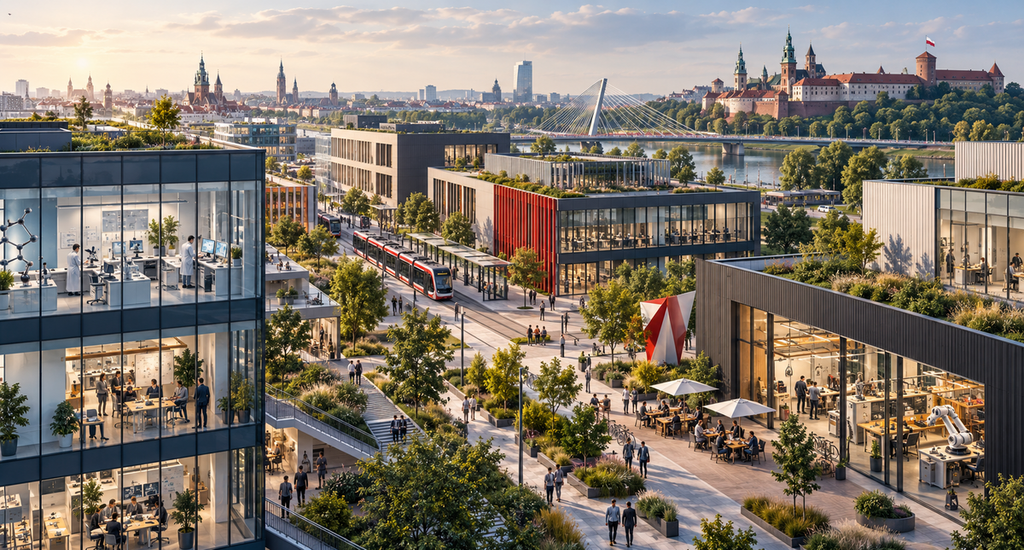
Innovation districts, dynamic clusters where research institutes, startups, corporations, and creative industries converge, are transforming how cities stimulate economic development. By concentrating talent, ideas, and investment within well-connected urban zones, these districts accelerate knowledge transfer and create fertile ground for entrepreneurship.
Poland has emerged as a regional leader in this model. With a strong technical education base, strategic EU funding, and supportive municipal policies, cities such as Kraków, Warsaw, Gdańsk, and Poznań are cultivating innovation districts that rival their Western European counterparts. These ecosystems blend academic excellence with commercial agility, providing both domestic and foreign companies with a platform for experimentation and scale.
This article explores the structure of Poland’s innovation districts, the opportunities and challenges they present, and how companies can successfully integrate into these thriving ecosystems.
Market Landscape: Poland’s Innovation Ecosystem
From Industrial Zones to Knowledge Hubs
Poland’s innovation districts grew from a deliberate effort to modernize regional economies after the country’s transition to a market economy. What began as special economic zones (SEZs), later replaced by Polish Investment Zones (PIZs), aimed at attracting manufacturing investment has evolved into technology parks and science clusters focused on high-value research and innovation.
Today, the country hosts more than 80 science and technology parks, complemented by startup accelerators, university incubators, and private co-working spaces. These environments encourage cross-sector collaboration and help bridge the gap between research and commercial application.
Kraków: The Pioneer of Polish Innovation
The Kraków Technology Park (KTP) is widely regarded as the cornerstone of Poland’s innovation landscape. Established in 1997, it supports companies across IT, electronics, life sciences, and creative industries. Tenants benefit from tax exemptions under the Polish Investment Zone, advanced digital infrastructure, and dedicated startup acceleration programs.
Its proximity to AGH University of Science and Technology and Jagiellonian University ensures a steady supply of engineers, researchers, and entrepreneurs. Over time, KTP has become a living example of the “quadruple helix” model, where academia, industry, government, and society work together to drive innovation.
Warsaw: The Capital of Connected Innovation
Warsaw, Poland’s largest business hub, has developed a multi-layered innovation ecosystem that blends corporate R&D centers with startup incubators.
- The Warsaw Technology Park and Industry Park host companies in robotics, fintech, clean energy, and logistics automation.
- The Cambridge Innovation Center (CIC Warsaw) and Venture Café Foundation support startups and global firms with flexible workspaces and international networking.
- Proximity to the Warsaw University of Technology and SGH Warsaw School of Economics fosters collaboration between researchers and entrepreneurs.
This combination of academic excellence, multinational presence, and capital market access, via the Warsaw Stock Exchange, makes the city an ideal environment for scaling innovation.
Poznań and Central Poland: Science Meets Industry
The Poznań Science and Technology Park (PPNT), one of Poland’s first university-linked business incubators, specializes in chemistry, biotechnology, and IT. It has successfully commercialized academic research through joint ventures and spin-offs, illustrating how university-industry cooperation fuels long-term competitiveness.
Similarly, Łódź, a former textile powerhouse, has reinvented itself as a center for digital and creative industries, using innovation districts to attract tech firms and revitalize its urban core.
The Tri-City Cluster: Coastal Innovation
In the north, the Gdańsk Science and Technology Park (GPN-T) and Olivia Business Centre anchor a growing innovation corridor across Gdańsk, Gdynia, and Sopot. These districts focus on ICT, renewable energy, logistics, and maritime technologies. The presence of Gdańsk University of Technology and a strong logistics base at the nearby port allow startups and corporates to prototype and deploy industrial innovations efficiently.
Rising Regional Players
Smaller cities such as Rzeszów, Lublin, and Olsztyn are developing specialized clusters that leverage local strengths; aviation, agritech, and green energy respectively. These emerging districts often offer lower real estate costs, strong university ties, and generous local incentives, making them attractive for early-stage investors and mid-sized companies.
Opportunities and Challenges
Opportunities
1. Cluster Synergies – The close proximity of complementary businesses, research institutes, and service providers enhances productivity and shortens development cycles. Collaboration within districts fosters knowledge spillovers, enabling firms to innovate faster.
2. Shared Resources and Infrastructure – Innovation districts often provide shared laboratories, fabrication facilities, meeting rooms, and testing equipment. These assets reduce startup costs and enable small enterprises to operate with the same sophistication as larger competitors.
3. Incentives and Support Mechanisms – Municipalities and regional authorities offer tax reductions, grants, and preferential lease terms to attract innovative firms. Many parks operate under the Polish Investment Zone (PIZ) framework, granting corporate tax exemptions of up to 50% of qualifying investment.
4. Networking and Ecosystem Events – Regular events, hackathons, pitch nights, and industry conferences create networking opportunities, visibility for new ventures, and early access to investment.
5. Access to Academic and Technical Talent – Universities near innovation districts supply not only skilled graduates but also R&D collaboration through joint research, internships, and co-developed prototypes. These ties sustain talent pipelines and improve recruitment efficiency.
Challenges
1. Uneven Development – While flagship districts in Warsaw and Kraków attract international attention, smaller regional parks may lack the same funding or ecosystem maturity, leading to uneven growth.
2. Talent Competition – High demand for engineers, data scientists, and researchers has intensified wage competition, especially from foreign firms establishing R&D hubs in Poland.
3. Infrastructure and Cost Pressures – Rapid urban development can inflate office rents and strain transport and housing systems.
4. Access to Capital – Although venture capital activity is increasing, early-stage startups still face challenges securing financing domestically and often rely on foreign investors.
5. Bureaucratic Complexity – Applying for innovation grants or incentives involves detailed documentation and compliance with both national and EU regulations, an area where expert guidance is often essential.
Strategies and Partnerships
Identify the Right District
Each Polish innovation district has its own specialization. Companies should evaluate:
- Sector alignment (e.g., IT, biotech, clean tech, aerospace).
- Proximity to relevant universities and research partners.
- Available infrastructure and laboratory capabilities.
- Incentive programs and rental conditions.
This strategic fit determines the quality of collaboration and return on investment.
Establish Local Presence and Integration
Setting up a satellite R&D office, project team, or innovation lab allows foreign companies to integrate into local ecosystems while maintaining control over intellectual property. Engaging local talent early helps bridge cultural and operational differences.
Regular participation in community activities, such as innovation fairs or open days, builds credibility and fosters trust with local partners.
Leverage Funding and Incentives
Innovation districts are often eligible for co-financing under national or EU programs supporting R&D and sustainability. Combining municipal grants with EU funding (for example, Horizon Europe or FENG) can significantly reduce development costs.
Companies should prepare comprehensive business plans demonstrating innovation potential, employment impact, and regional contribution when applying for these benefits.
Collaborate with Academia and Startups
Partnerships between corporations, startups, and research institutions are key to staying ahead of technological change. Companies can:
- Sponsor university research chairs or joint laboratories.
- Host hackathons to identify startup partners.
- Offer internships and training that align with company technologies.
These collaborations create symbiotic relationships: corporations gain agility, startups gain resources, and universities gain real-world relevance.
Engage Municipal and Regional Stakeholders
Local governments and development agencies act as critical facilitators within innovation districts. Maintaining open communication with these stakeholders helps secure permits, grants, and infrastructure support. Building long-term partnerships with city administrations ensures stability and visibility in the community.
The Broader Impact
Poland’s innovation districts are more than real estate developments, they are engines of regional transformation. By linking education, technology, and entrepreneurship, they:
- Attract high-value foreign investment.
- Retain local talent that might otherwise migrate abroad.
- Stimulate job creation in both high-tech and supporting sectors.
- Promote sustainable, knowledge-based urban development.
For investors and multinational corporations, these hubs represent a strategic entry point into Central Europe’s expanding innovation economy. For Polish startups, they offer the networks and infrastructure necessary to scale globally.
How Expand2Poland Can Help
Expand2Poland assists international companies and investors in navigating Poland’s innovation landscape.
Our partner network can help with:
- Site and sector analysis to identify suitable innovation districts.
- Advisory on incentive programs and grant applications.
- Partner introductions with universities, accelerators, and municipal agencies.
- On-the-ground support for R&D setup, staffing, and integration into local ecosystems.
By combining regional knowledge, industry insight, and practical experience, Expand2Poland ensures that your expansion into Poland’s innovation clusters is both efficient and strategically aligned.
The information provided in this article is for general informational and educational purposes only and does not constitute legal, financial, or tax advise.