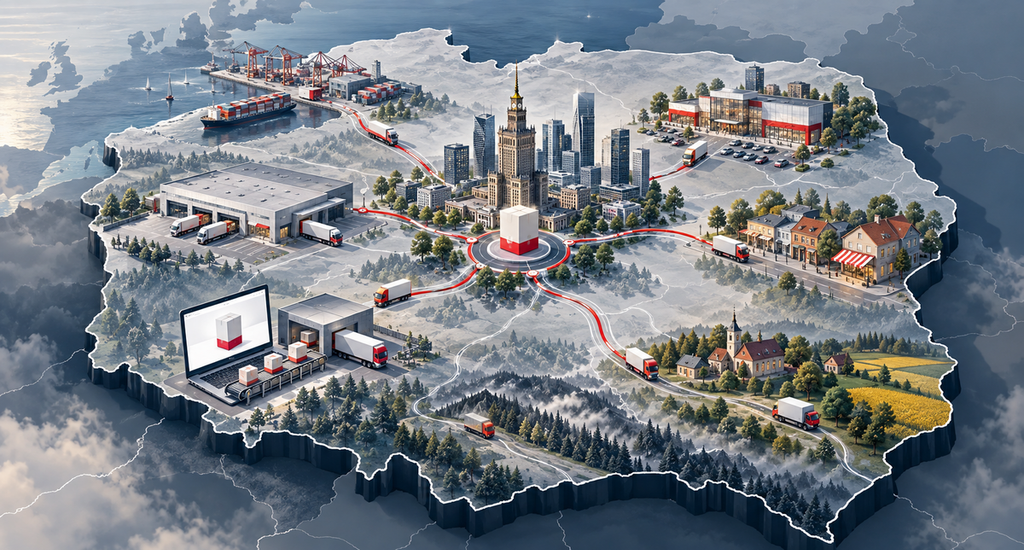
Distribution channels in Poland include retail chains, independent outlets, distributors, online marketplaces and direct sales. An effective multi-channel strategy assigns each route a clear purpose based on how your customers discover, evaluate and purchase the product.
More channels do not automatically mean better market coverage. Every additional route creates costs, responsibilities and possible conflicts. Start with customer fit and channel economics before expanding the mix.
Understanding Poland's sales landscape
Retail chains and independent stores
Retail formats include supermarkets, hypermarkets, discount stores, convenience outlets and specialist retailers. They differ in customer mission, assortment, purchasing arrangements and supplier expectations.
For example, Biedronka and Lidl are associated with discount retail, while Żabka is a convenience format. These examples should not be grouped as if they all serve the same purpose or follow the same purchasing process.
Assess the formats relevant to your category. Ask about listing requirements, packaging, delivery, promotions, payment terms and ongoing service. Access to a chain is not evidence that a product will sell profitably.
Independent and specialist outlets may offer a more targeted route for some products. Their reach, ordering practices and support requirements should also be verified.
Ecommerce and marketplaces
Marketplaces such as Allegro can provide an established selling environment, while your own store allows more control over brand presentation and the customer relationship.
Both require attention to product information, pricing, availability, payment, fulfillment and returns. Social media can contribute discovery and traffic; do not assume every social platform provides the same checkout or sales functionality.
Our ecommerce guide for Poland examines these operational choices.
Distributors, wholesalers and B2B sales
A distributor or wholesaler may provide access to customers and local operating knowledge. Verify the categories and accounts it actually serves, the resources it will commit and how performance will be reviewed.
Direct B2B selling can suit products that need technical explanation, integration or ongoing support. It requires a defined target-customer profile and disciplined follow-up. See building a B2B sales pipeline in Poland.
Geographic coverage
Customers and commercial activity are spread across multiple locations. The U.S. International Trade Administration's distribution guide highlights the importance of assessing regional coverage and suitable partners. Poland distribution and sales channels
Use actual sales and customer research to compare areas. Avoid assuming income, tastes or purchasing behavior from a city label alone.
Opportunities from a coordinated channel mix
Reach different buying situations
Customers may use different channels for discovery, initial purchase and repeat orders. A mix can help if each route serves a genuine need and the operation can support it.
Learn from direct customer contact
Your own store or sales team can provide useful feedback. Partner-led channels may offer other insights, but access to data depends on the relationship and applicable rules.
Balance reach and control
Retail and distribution partners can bring coverage; direct channels can provide closer control of presentation and service. Compare these benefits against margins, operational effort and contractual commitments.
Seven steps to build a multi-channel strategy in Poland
1. Research the customer and category
Identify where buyers already shop, what information they need and how competitors reach them. Separate consumer and business purchasing patterns rather than applying the same approach to both.
2. Define the role of each channel
Assign a purpose: national reach, specialist credibility, demand testing, service delivery or repeat purchasing. Avoid adding a route that duplicates effort without a clear contribution.
3. Model channel-level economics
Include partner margin, commissions, advertising, listing or promotion costs where applicable, payment fees, delivery, returns and support. Compare contribution after those costs, not revenue alone.
4. Select and evaluate partners
Shortlist partners using relevant category experience, customer access, service capability and financial standing. Establish whether they have competing commitments and how your product would be prioritized.
Use our guide to finding business partners in Poland to organize the search and evaluation.
5. Agree commercial and operational responsibilities
Define ordering, stock, payment, returns, warranties, promotional activity and data-sharing arrangements. Have legal advisers review exclusivity, territory and competition-law implications.
Do not assume you can require partners to sell at fixed or minimum resale prices. Pricing arrangements and restrictions need appropriate legal review.
6. Coordinate marketing and partner support
Provide accurate product materials and relevant training. Make sure campaign activity matches availability and that customer-facing information is consistent across channels.
For a new brand or product, see launching products in Poland.
7. Review performance and adapt
Measure sales, margin, stock availability, returns, service issues and partner activity. Compare results with the intended role of each channel.
Expand a route because it works commercially, not because it creates a larger contact list or more product listings.
Common challenges in multi-channel selling
Channel conflict
Customers may see different assortments, service levels or prices. Explain the role of each route and investigate conflict early. Any contractual controls must comply with applicable law.
Inconsistent customer information
Outdated specifications or unclear warranties can undermine trust. Assign responsibility for maintaining product materials and correcting errors across partner and direct channels.
Operational fragmentation
Orders, stock, returns and support may sit in separate systems. Plan how the business will reconcile them and how a customer issue will be resolved regardless of purchase route.
Over-expansion
Adding channels before demand and economics are understood can consume resources without creating sustainable sales. A focused first phase makes problems easier to identify.
An illustrative phased approach
A specialist consumer brand might test a limited marketplace assortment and a small group of relevant retailers, then review demand, margins and returns before expanding. A technical B2B supplier might start with direct account development and add a distributor only where local coverage is needed.
These are illustrative approaches, not reported client results or forecasts. The appropriate sequence depends on the product and operating capacity.
Preparing for the next stage
Review changing buyer behavior, platform conditions and partner performance regularly. New sales formats are worth testing only when they support the customer journey and business model.
A strong strategy remains coordinated: product availability, marketing, service and measurement should work together.
Frequently asked questions
Should I use a distributor or sell directly in Poland?
Compare customer access, product complexity, margin, control and your capacity to provide local support. A distributor is valuable when its capabilities match a defined need, not simply because it has a broad contact list.
How many sales channels should I launch at once?
Use the number you can support and measure reliably. A smaller initial mix often provides clearer learning before the additional complexity of wider expansion.
How Expand2Poland can help
Expand2Poland's market entry strategy service can help compare route options. Our partners and suppliers service can support relevant partner research and introductions, while business development support can help with target accounts and follow-up.
Book a consultation to discuss the channel mix that fits your products and target customers.
This article is general business information, not legal advice or a guarantee of sales performance.