
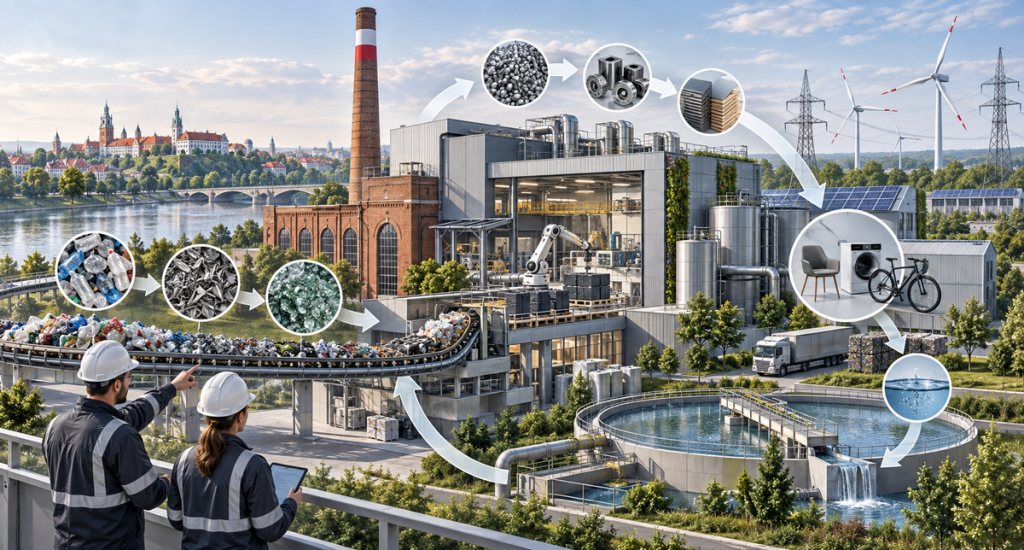
Poland’s sustainability transition is often described as a difficult departure from coal, heavy industry, and resource-intensive production. That description captures only part of the story. The same industrial base that makes decarbonization challenging also creates a substantial market for technologies that reduce energy use, recover materials, extend product life cycles, and modernize aging infrastructure.
Cleantech in Poland is therefore developing around practical economic needs rather than environmental ambition alone. Manufacturers want lower energy costs and less material waste. Grid operators need greater flexibility as renewable generation expands. Property owners face pressure to improve building efficiency. Retailers and consumer-goods companies must adapt to new packaging and producer-responsibility requirements. Municipalities need better systems for waste collection, heating, transport, and resource management.
The result is a market in which sustainability is becoming closely tied to productivity, energy security, regulatory readiness, and industrial competitiveness. Foreign investors can participate as technology providers, project developers, manufacturers, strategic partners, or sources of growth capital. The strongest opportunities will emerge where environmental performance produces a clear operational or financial benefit.
Market Landscape
Poland’s energy transition has accelerated considerably. Renewable energy exceeded half of the country’s installed electricity capacity by the end of 2025, driven primarily by the rapid expansion of photovoltaic generation. More than 1.6 million renewable micro-installations were connected to the grid, demonstrating the scale of distributed generation among households and smaller businesses.
Installed capacity should not be confused with actual electricity production. Solar and wind generation remain weather-dependent, while coal continues to play a substantial role in the energy system. This gap between renewable capacity and dependable output creates a significant commercial need for storage, grid modernization, demand management, and flexible generation.
Offshore wind is expected to become another major element of Poland’s energy transition. Projects under development in the Baltic Sea are creating demand for engineering, construction, port infrastructure, maintenance services, digital monitoring, electrical equipment, and specialized components. Poland’s first large offshore projects are also encouraging manufacturers and service providers to evaluate whether they can participate in the emerging supply chain.
Energy storage is moving higher on the investment agenda. Public programs have supported both large-scale battery systems and household installations, while grid constraints are increasing the value of technologies that can absorb excess renewable electricity and release it when needed. Opportunities extend beyond battery manufacturing to include control systems, power electronics, forecasting software, safety technologies, installation, maintenance, and energy-management platforms.
The circular economy is developing through a combination of EU policy, Polish regulation, industrial cost pressure, and changing customer expectations. Poland adopted a national roadmap for moving toward a circular model, with priorities that include sustainable production, more efficient use of resources, bioeconomy development, and new business models based on reuse and repair.
Packaging is becoming one of the most visible areas of change. Poland’s deposit-return system began operating in October 2025, covering selected plastic bottles, cans, and reusable glass bottles. The country is also restructuring its extended producer responsibility framework as EU packaging rules place greater emphasis on recyclability, material reduction, recycled content, and producer financing of waste management.
A broad public-funding environment supports this transition. Poland’s EU cohesion strategy for the 2021–2027 period includes €76.5 billion across regional development, social, cohesion, just-transition, and related funds. Green infrastructure, renewable energy, building modernization, innovation, and circular-economy projects are among the areas supported through EU and national instruments.
Tax incentives can further improve project economics. Companies conducting qualifying research and development may be able to use Poland’s R&D relief and IP Box framework, while eligible new investments can receive income-tax exemptions through the Polish Investment Zone. The availability and value of support depend on the project, location, company size, eligible costs, and applicable state-aid rules.
Where the Opportunity Is
Renewable Energy and Grid Flexibility
The growth of solar and wind generation is creating a second market around system integration. Poland needs technologies that make renewable electricity more predictable, manageable, and commercially useful.
Battery storage is one part of this opportunity. Additional demand is emerging for energy-management systems, demand-response platforms, smart metering, forecasting tools, power-quality equipment, and software that coordinates generation, storage, and consumption.
Industrial users are especially important. Manufacturers facing volatile electricity prices may invest in on-site generation, storage, power-purchase arrangements, and digital controls that reduce peak demand. Technology providers capable of combining equipment with financial modeling and operational support will be better positioned than vendors offering isolated products.
Building Efficiency and Heat Modernization
Poland has a large stock of residential, commercial, industrial, and public buildings that require modernization. Insulation, ventilation, heating controls, energy-management software, heat pumps, and efficient building materials all have room to expand.
The opportunity extends beyond individual devices. Property owners increasingly need integrated retrofit strategies that combine energy audits, financing, installation, monitoring, and performance verification. Companies able to demonstrate measurable savings can compete on business value rather than environmental messaging alone.
District heating also presents a significant modernization challenge. Many Polish cities rely on centralized heating networks that must gradually reduce their dependence on coal and improve efficiency. Heat storage, waste-heat recovery, renewable heat, industrial heat pumps, and intelligent network management can become important components of this transition.
Circular Manufacturing and Secondary Materials
Poland’s industrial scale creates large flows of metals, plastics, textiles, chemicals, construction materials, packaging, and organic by-products. Much of the commercial potential lies in turning these flows into usable inputs rather than treating them solely as waste-management obligations.
Advanced sorting, mechanical and chemical recycling, material tracking, and quality-control technologies can improve the availability of secondary raw materials. Construction products made from recovered materials, recycled polymers, remanufactured components, and refurbished equipment may also gain ground as companies seek to lower resource costs and document their environmental performance.
Industrial symbiosis offers another practical model. Waste heat, water, packaging, chemicals, or production residues from one facility can sometimes become inputs for another. These arrangements require reliable volume data, quality standards, logistics, and commercial agreements, but they can reduce both procurement and disposal costs.
Repair, Refurbishment, and Product Life Extension
Circularity does not begin with recycling. Greater value is often preserved by repairing, upgrading, reselling, or remanufacturing products before their materials are recovered.
Poland’s engineering skills, manufacturing workforce, and comparatively competitive operating costs support refurbishment activities in electronics, machinery, automotive components, appliances, furniture, and industrial equipment. Foreign manufacturers may use Poland as a regional repair or remanufacturing center serving customers across the EU.
Product-as-a-service and leasing models can reinforce this opportunity. When manufacturers retain responsibility for equipment throughout its life cycle, they have stronger incentives to design durable products, recover components, and maintain long-term customer relationships.
Packaging, Collection, and Waste Technology
The deposit-return system and evolving producer-responsibility rules will require investment across collection, reverse logistics, sorting, data management, packaging redesign, and recycling capacity.
Retailers, beverage producers, logistics operators, packaging companies, and municipal waste organizations will need systems capable of tracking materials and financial obligations. Reverse-vending equipment, digital settlement platforms, reusable packaging, lightweight materials, and packaging designed for automated sorting all offer potential areas for investment.
Policy changes also introduce uncertainty. Companies entering this market must monitor implementation schedules, fee structures, reporting rules, and the interaction between Polish requirements and EU packaging legislation. Regulatory readiness can become a competitive advantage, particularly for suppliers helping producers reduce future compliance costs.
Opportunities and Challenges
- Grid constraints can support innovation but delay deployment. Renewable projects may face connection limitations, curtailment, or lengthy development processes. Storage, flexibility, and local energy-management solutions can address part of the problem, although investors must examine grid access before committing capital.
- Circular products must compete on quality and price. Environmental benefits rarely compensate for inconsistent materials or unreliable performance. Recycled and refurbished products need strong quality assurance if they are to move beyond niche applications.
- Public funding can improve returns but adds complexity. Grants, tax incentives, and preferential financing can make projects viable, but application rules, procurement requirements, state-aid limits, and reporting obligations must be incorporated into planning.
- Regulation creates demand and execution risk at the same time. New packaging, waste, energy, and reporting rules expand the market for compliant solutions. Timelines and implementation details can change, making regulatory monitoring essential.
- Partnerships are often necessary for commercialization. Cleantech projects frequently combine technology, infrastructure, financing, permitting, and operational expertise. Few companies possess all of these capabilities internally.
Strategies and Partnerships
International companies should begin by identifying where their technology solves a measurable Polish business problem. Lower energy costs, reduced downtime, compliance savings, recovered materials, and longer asset life are more persuasive than broad sustainability claims.
Pilot projects can provide an effective entry point. A manufacturer may test waste-heat recovery at one facility. A real estate owner may modernize a limited building portfolio. A packaging company may trial a reusable format with one retailer. Focused pilots allow companies to validate performance, adapt to Polish operating conditions, and build local references before scaling.
Partner selection should reflect the full delivery chain. Depending on the project, useful counterparts may include utilities, industrial groups, municipalities, research institutes, engineering firms, technology integrators, recycling operators, property owners, or energy-service companies.
Investors should also evaluate the funding structure early. Grants and tax incentives should support a viable commercial model rather than compensate for weak demand. Projects need a credible route to profitability even when public support is delayed, reduced, or unavailable.
Localization remains equally important. Equipment must fit Polish technical conditions, documentation may need to be provided in Polish, and implementation partners must understand local permitting, grid, waste, construction, and environmental procedures. A technology proven elsewhere in Europe may still require substantial adaptation before it can be deployed effectively in Poland.
How Expand2Poland Can Help
- Polish cleantech and circular-economy market assessment
- technology and industrial partner identification
- green funding and investment-incentive mapping
- regulatory and market-entry coordination
- pilot development and commercialization strategy
Poland’s transition is creating opportunities across energy, manufacturing, buildings, packaging, and resource recovery. Contact Expand2Poland to identify where your technology or investment strategy can create measurable value in the Polish market.
The information provided in this article is for general informational and educational purposes only and does not constitute legal, financial, or tax advise.