
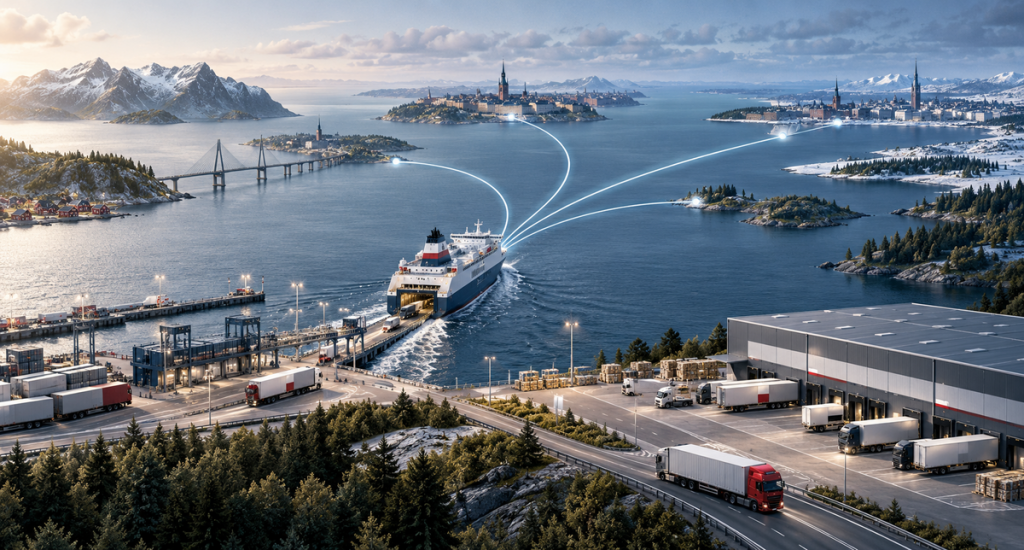
The Nordic region offers an attractive next step for companies operating from Poland. Sweden, Denmark, Norway, and Finland are affluent, digitally mature, and commercially sophisticated markets with strong demand for quality products, reliable service, sustainable sourcing, and efficient fulfillment. For Poland-based producers, distributors, e-commerce brands, and industrial suppliers, the region is close enough to serve operationally, but demanding enough to require a serious market-entry strategy.
Poland’s location gives it a practical advantage. Baltic ports connect directly into Swedish and Finnish freight networks, while road and ferry routes through Germany and Denmark offer additional access to Scandinavia. For companies already manufacturing, warehousing, or sourcing in Poland, the Nordics can therefore become a logical extension of the operating model rather than a completely separate export project.
Even so, the Nordics should not be treated as one uniform market. Sweden, Denmark, Finland, and Norway share certain regional characteristics, including high purchasing power, strong digital adoption, and demanding consumer expectations. Commercially, however, each country has its own language, distribution structure, tax rules, packaging obligations, product expectations, and service norms. Norway requires particular care because it is part of the European Economic Area but not part of the EU customs union. The EEA Agreement extends much of the EU internal market to Norway, Iceland, and Liechtenstein, but it does not cover the EU customs union or common trade policy.
For companies expanding from Poland, the opportunity is therefore not simply to ship north. It is to build a Nordic sales and logistics model that combines Polish cost efficiency with Nordic standards for quality, transparency, sustainability, delivery reliability, and customer support.
Market Landscape
Poland’s Baltic logistics network gives companies several routes into the Nordic region. The most established flows are into Sweden and Finland. TT-Line operates the Świnoujście–Trelleborg freight route, describing Świnoujście as a main corridor from Central and Eastern Europe to Scandinavia, with up to 12 departures per week on its route information page. Unity Line also operates cargo ferries from Świnoujście to Ystad and Trelleborg, giving shippers additional options into southern Sweden.
Gdynia provides another important connection. Stena Line’s Gdynia–Karlskrona route supports freight movement between Poland and southern Sweden, while Polferries lists cargo routes from Gdańsk to Nynäshamn and from Świnoujście to Ystad. These links are commercially useful because they place Polish exporters close to Swedish distribution networks and, from there, onward movement toward Stockholm, Malmö, Gothenburg, Norway, and Denmark.
Finland is also directly reachable from Poland. Finnlines operates a Hanko–Gdynia ro-ro service six times per week, carrying lorries, trailers, breakbulk, project cargo, containers, and other rolling cargo. The company also notes broader network connections across the Baltic and North Sea areas, including Poland-Finland and Poland-Sweden services.
Denmark is different. For many shippers, the most practical route may be road transport through Germany and Denmark, Swedish ferry access followed by onward movement across the Øresund region, or maritime routing through broader Baltic and North Sea freight networks. The right choice depends on cargo type, customer location, delivery window, and whether the company is serving Denmark alone or using Denmark as part of a wider Nordic platform.
The regulatory picture is also mixed. Sweden, Denmark, and Finland are EU member states, so goods already in free circulation in the EU can move between Poland and those countries without internal customs duties. The EU customs union applies common tariffs to goods imported from outside the EU and removes customs duties internally among EU member states.
Norway requires a separate approach. Although Norway participates in the EEA internal market, goods shipped from Poland to Norway still require import procedures, and Norwegian guidance states that VAT-registered enterprises must calculate and report import VAT, while customs declarations are required when goods are purchased from abroad. For e-commerce, Norway’s VOEC scheme requires foreign providers of low-value goods and remotely deliverable services to collect and pay VAT when applicable, with special rules for goods valued below NOK 3,000 per item.
Opportunities and Challenges
- Polish cost advantages can support Nordic value positioning. Companies operating from Poland can often produce, assemble, warehouse, or support customers at lower cost than Nordic competitors. The strongest opportunity is not to sell as the cheapest supplier, but to combine competitive pricing with reliable quality, good documentation, and strong service.
- Direct Baltic routes can improve speed and predictability. Ferry and ro-ro connections from Świnoujście, Gdańsk, and Gdynia create practical options for serving Sweden and Finland. For certain cargo types, especially trailers, ro-ro, components, furniture, consumer products, and industrial inputs, direct sea routes can be more efficient than longer road-heavy alternatives.
- Nordic customers expect clarity, not improvisation. Buyers in the region tend to value transparent delivery timelines, clear returns processes, precise product information, and responsive customer support. A Poland-based company can gain trust quickly if it communicates professionally and delivers consistently. Poor localization, weak after-sales handling, or unclear responsibility for returns can damage credibility early.
- E-commerce is attractive, but compliance is not optional. Selling online into Sweden, Denmark, and Finland may be simplified by the EU VAT One Stop Shop, which allows companies selling goods or services to EU consumers to register once, file one return, and pay VAT through a single EU portal while applying the VAT rate of the customer’s country. Norway requires separate consideration because it uses the VOEC system for certain B2C goods and is outside the EU customs union.
- Packaging and producer responsibility rules matter. Nordic markets place serious emphasis on sustainability and waste management. Sweden’s packaging producer responsibility rules require companies that bring packaging into the Swedish market to register with the Swedish Environmental Protection Agency before packaging is introduced and to participate in a producer responsibility organization. Denmark also requires companies subject to packaging producer responsibility to register in the national producer register before placing covered products on the Danish market.
- Product safety and labeling standards are becoming stricter across Europe. The EU General Product Safety Regulation applies from December 2024 and covers non-food products sold offline and online, aiming to ensure that products sold in Europe meet safety standards and can be removed quickly when unsafe. Poland-based companies selling into Sweden, Denmark, or Finland need to build product-safety compliance into their market-entry process.
- Norway can be profitable but operationally different. Norway’s high purchasing power can make it attractive, especially for quality goods and specialized products. Import VAT, customs declarations, VOEC obligations, carrier handling, and customer expectations around landed cost need to be managed carefully. A consumer who faces unexpected VAT, duties, or customs fees at delivery may be unlikely to buy again.
Partnering and Strategy
Companies expanding from Poland to the Nordics should begin by segmenting the region rather than choosing a single “Nordic” strategy. Sweden may be the natural first step because of direct ferry links, market size, and geographic proximity to Poland. Finland may be attractive for industrial, ro-ro, and specialized cargo flows through Gdynia-Hanko services. Denmark can work well for products suited to road logistics, design-sensitive consumer categories, or wider Scandinavian distribution. Norway should be approached with a separate import, VAT, and customer-service model.
Route selection should follow commercial logic. A product moving to southern Sweden may fit ferry routes from Świnoujście to Ystad or Trelleborg. Shipments to central Sweden may benefit from Gdańsk-Nynäshamn or Gdynia-Karlskrona depending on the destination and carrier network. Cargo for Finland may fit the Gdynia-Hanko ro-ro service. Denmark may call for road transport through Germany and Jutland, Swedish routes with onward movement, or broader North Sea and Baltic freight options.
A few practical priorities can make the difference between a workable Nordic expansion and a frustrating one:
- Localize product information and customer support. English may be accepted in many B2B settings, but consumer-facing materials, instructions, warranty language, and support channels should be adapted where appropriate.
- Design the returns model before launch. Nordic e-commerce customers expect reliable returns. A low-cost outbound shipment can become commercially unattractive if reverse logistics are slow, expensive, or unclear.
- Separate EU and Norway compliance workflows. Sweden, Denmark, and Finland fall within the EU customs framework. Norway does not. The difference should be reflected in VAT handling, shipping terms, checkout design, and landed-cost communication.
- Choose logistics partners with Nordic experience. The best partner is not always the cheapest carrier. Experience with ferry schedules, ro-ro documentation, customs interfaces for Norway, returns processing, and Nordic customer expectations can protect service quality.
- Build sustainability claims carefully. Nordic buyers often respond well to credible environmental positioning, but claims need to be specific, documented, and defensible. Packaging design, transport emissions, recyclable materials, and supplier standards may all influence buyer perception.
Poland can provide the operating base, but Nordic expansion requires market discipline. Companies that combine Polish production or distribution advantages with Nordic-grade communication, compliance, and service will be better positioned than those relying on price and proximity alone.
How Expand2Poland Can Help
- Nordic market-entry assessment from a Poland-based operating model
- Logistics route analysis across Sweden, Denmark, Norway, and Finland
- Partner identification with carriers, distributors, fulfillment providers, and local advisers
- VAT, customs, packaging, and product-compliance coordination
- Localization support for Nordic-facing sales and customer communication
Expanding from Poland into the Nordics can be a strong next step for companies with the right products, logistics model, and compliance discipline. Contact Expand2Poland to assess your Nordic opportunity and build a practical route to market from your Polish base.
The information provided in this article is for general informational and educational purposes only and does not constitute legal, financial, or tax advise.