
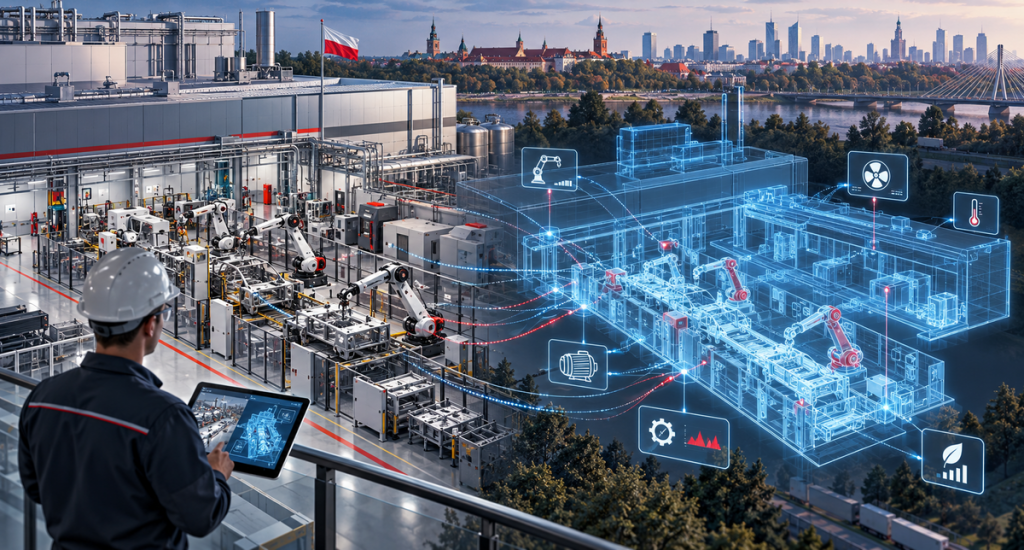
Digital twin technology is moving from innovation language into practical business strategy. At its core, a digital twin is a live or semi-live virtual model of a physical asset, process, building, production line, infrastructure network, or urban system. Its purpose is not simply to create a polished 3D visualization. The real value comes when the model is connected to operational data and used to simulate scenarios, predict failures, test changes, reduce downtime, improve energy performance, or support better investment decisions.
For Poland, this technology is especially relevant. The country has a strong manufacturing base, a growing technology workforce, expanding industrial automation, improving connectivity, and a policy environment increasingly focused on digital transformation. Poland also has research and innovation institutions that can support applied technology projects, including the Łukasiewicz Research Network, whose Wrocław-based PORT institute focuses on technological innovation in areas such as health, biotechnology, and materials engineering.
The business opportunity is not limited to large industrial groups. Digital twins can support manufacturers, logistics operators, utilities, real estate owners, construction firms, healthcare infrastructure managers, and city authorities. For foreign investors, Poland offers a practical environment for implementation: enough industrial complexity to justify the investment, enough engineering capability to support delivery, and enough cost discipline to make return on investment central from the start.
Still, the market should be approached with realism. Not every dashboard is a digital twin. Not every BIM model becomes a live operational model. Not every sensor project produces actionable insight. The companies that succeed in Poland will be those that connect the technology to a clearly defined business problem, rather than introducing digital twins as a fashionable layer on top of weak data and unclear objectives.
Market Landscape
Digital twin adoption in Poland is still uneven, but the underlying conditions are improving. The country’s industrial economy creates natural demand for simulation, asset monitoring, predictive maintenance, production optimization, and energy-efficiency tools. Automotive suppliers, machinery producers, logistics firms, utilities, real estate owners, and infrastructure operators all face the kind of operational complexity where digital twins can create value.
Poland’s broader digital ecosystem also supports the trend. The European Digital Innovation Hubs network describes EDIHs as one-stop shops that help companies and public administrations address digital challenges, and its technology categories include digital twins, IoT, simulation engineering, modeling, robotics, cybersecurity, big data, cloud services, and cyber-physical systems. These are the same enabling technologies that sit underneath most serious digital twin projects.
Connectivity is becoming more relevant as well. Poland completed the auction of 700 MHz and 800 MHz spectrum in March 2025, with the Ministry of Digital Affairs describing the 700 MHz band as important for 5G expansion, including lower-quality service areas, roads, and railway lines. The same announcement stated that operators will be required by 2030 to improve quality and speed for 99% of households, with a minimum download speed of 120 Mb/s.
For digital twin adoption, stronger connectivity matters because many use cases depend on reliable data flows from assets, sensors, machines, vehicles, buildings, and field equipment. A factory digital twin can sometimes operate largely within a private industrial network. A logistics, energy, or urban twin often needs broader communications infrastructure, especially when assets are distributed across multiple sites.
International technology activity also reinforces Poland’s positioning. Google and Poland signed a memorandum in 2025 to develop AI use in energy, cybersecurity, and other sectors, while Google described Poland as its biggest engineering hub, employing more than 2,000 people. This kind of investment does not automatically translate into digital twin adoption, but it strengthens the broader talent and AI environment that advanced simulation and operational analytics require.
Opportunities and Challenges
- Manufacturing twins can reduce downtime and improve process discipline. Poland’s industrial base creates strong potential for digital twins of production lines, machines, robots, and plant layouts. These models can help manufacturers test process changes, detect bottlenecks, train operators, and support predictive maintenance before failures disrupt production.
- Energy and utilities can use twins to manage more complex systems. As Poland modernizes power generation, grids, heating systems, and renewable assets, digital twins can help model performance, forecast maintenance needs, and balance supply and demand. The strongest opportunities are likely to sit where physical infrastructure, sensor data, and operational decision-making need to be connected more tightly.
- Construction and real estate can move beyond static BIM models. Building information modeling is useful during design and construction, but the larger opportunity is to connect building models with live data on energy use, occupancy, equipment performance, indoor conditions, and maintenance. For office, logistics, residential, and public-sector assets, this can support lower operating costs and better sustainability reporting.
- Urban digital twins can improve planning, but cities need governance capacity. Municipalities can use digital twins to test traffic changes, model flood risk, assess air quality, plan infrastructure, and coordinate public services. The barrier is rarely visualization alone. Cities need data governance, interdepartmental coordination, procurement capability, cybersecurity controls, and a clear view of who will use the model after launch.
- Data quality is the central constraint. Digital twins depend on reliable data from sensors, ERP systems, CAD files, maintenance records, IoT devices, geospatial systems, and operational platforms. Many Polish facilities, especially brownfield industrial sites, may have fragmented systems and inconsistent records. A digital twin project often begins as a data-cleanup and integration project before it becomes a simulation project.
- Cybersecurity and access control must be designed from the start. A digital twin can expose sensitive information about production capacity, energy assets, critical infrastructure, building systems, or logistics flows. Companies should treat cybersecurity, permissions, network segmentation, and vendor access as part of the architecture, not as a later compliance review.
Partnering and Strategy
Companies considering digital twin projects in Poland should begin with a specific operational problem. The best first use case is rarely the most ambitious one. A narrower pilot, such as one production line, one logistics facility, one building, one energy asset, or one district-level planning problem, can create a more credible path to value than an enterprise-wide program launched too early.
The first strategic question should be commercial, not technical: what business outcome must improve? Possible targets include lower downtime, reduced energy consumption, better asset utilization, faster product design, lower maintenance cost, improved worker training, more accurate capacity planning, or better regulatory reporting. Once the outcome is clear, the company can determine which data, models, sensors, software platforms, and partners are actually necessary.
A practical digital twin roadmap usually includes several steps:
- Audit existing data and systems. ERP, MES, SCADA, CAD, BIM, GIS, maintenance platforms, IoT devices, and spreadsheets should be mapped before technology selection begins.
- Start with a high-value pilot. The pilot should be narrow enough to manage, but important enough to prove value. A low-impact demonstration may look successful technically while failing commercially.
- Choose partners by integration capability, not software branding alone. Digital twin projects usually require IoT integration, data engineering, simulation knowledge, domain expertise, cybersecurity, and change management. Few vendors are equally strong in all areas.
- Design for interoperability. Open standards, clear APIs, and portable data structures reduce the risk of locking the company into a single vendor or creating a model that cannot scale across sites.
- Train decision-makers, not only technical teams. A digital twin creates value only when managers, engineers, operators, planners, and maintenance teams use its outputs in real decisions.
Partnerships in Poland can include technology vendors, systems integrators, universities, research institutes, EDIHs, automation providers, telecom operators, cloud platforms, and sector specialists. The right mix depends on the use case. A manufacturing twin may require automation and MES expertise. A building twin may need BIM, energy, and facilities-management partners. An urban twin may require geospatial data, municipal coordination, and public-sector procurement experience.
The strongest business cases will also include a clear scaling model. A successful pilot should not remain an isolated innovation project. Companies should define early whether the model can be replicated across plants, buildings, fleets, warehouses, or infrastructure assets. Without that path, digital twin projects can remain impressive demonstrations with limited strategic impact.
How Expand2Poland Can Help
- Digital twin feasibility assessment for Poland-based operations
- Technology and integration partner identification
- Pilot-project planning and business-case development
- Funding and incentive pathway review
- Support with market entry, localization, and implementation strategy
Digital twin technology can help companies in Poland move from reactive operations to more predictive, data-driven management. Contact Expand2Poland to assess where digital twins can create measurable value in your Polish operations and build a practical path from pilot to scale.
The information provided in this article is for general informational and educational purposes only and does not constitute legal, financial, or tax advise.