
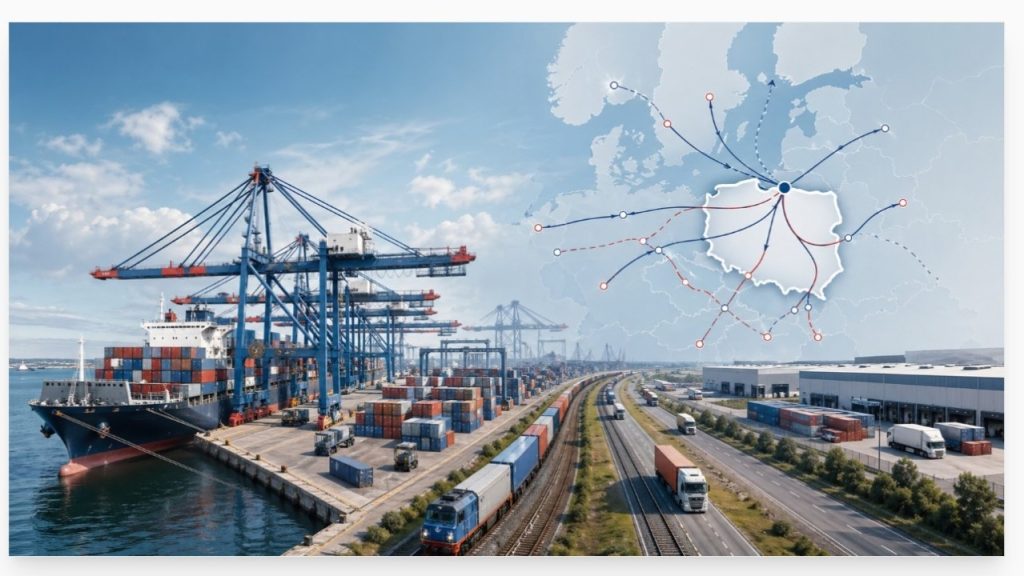
Poland’s maritime position is becoming more strategically important as companies rethink European distribution, supply-chain resilience, and access to Northern and Central European markets. The Baltic Sea gives Poland a direct connection to Scandinavia, the Baltic states, the North Sea trading system, and long-haul ocean services. At the same time, Poland’s inland geography connects those maritime flows to Warsaw, Poznań, Wrocław, Upper Silesia, Czechia, Slovakia, Germany, and the wider EU market.
For companies evaluating Poland as a logistics base, the opportunity is no longer limited to serving the domestic market. Poland’s ports increasingly support a broader distribution logic: goods can enter through the Baltic, move inland by road or rail, and reach industrial clusters, retail networks, e-commerce warehouses, and cross-border customers across Central Europe. This gives Poland a stronger role as both a maritime gateway and an inland logistics platform.
The Port of Gdańsk is central to this shift. In 2024, it handled 77.4 million tons of cargo and 2.25 million TEU, with container traffic rising by nearly 10%. In 2025, the port reported 80.4 million tons of cargo and almost 2.8 million TEU, reflecting continued growth in general cargo and containers. The Baltic Hub Container Terminal, already the largest container terminal on the Baltic Sea, handled 2.7 million TEU in 2025 and expanded its annual capacity to roughly 4.4 million TEU after the launch of its third deepwater quay.
Market Landscape
Poland’s maritime system is not built around one port alone. Gdańsk is the flagship deepwater container and energy gateway, but Gdynia and Szczecin-Świnoujście play important complementary roles. Gdynia is a universal port with strong container, ro-ro, general cargo, grain, and short-sea shipping activity. It handled 974,586 TEU and 26.9 million tons of cargo in 2024, then exceeded 1 million TEU for the first time in 2025 while recording strong ro-ro growth.
Szczecin-Świnoujście adds another layer to the system, especially for ferry traffic, bulk cargo, fuels, LNG, and western Polish access. The port authority reported 32.3 million tons of transshipments in 2024 and pointed to the development of offshore wind, green infrastructure, and new investments as priorities. Its location near Germany and the Baltic approaches gives it a different strategic profile than Gdańsk and Gdynia.
The inland connectivity story is equally important. Poland’s Baltic ports sit on the Baltic Sea-Adriatic Sea corridor, which runs from Gdańsk, Gdynia, Szczecin, and Świnoujście through Poland toward Czechia, Slovakia, Austria, Hungary, Slovenia, Croatia, and Italy. The corridor includes more than 10,000 kilometers of rail, more than 5,500 kilometers of road, 12 seaports, 5 inland waterway ports, and 28 rail-road terminals. For shippers, this means the value of Poland’s ports depends not only on quay capacity, but also on how effectively cargo moves inland.
Port investment is moving in the right direction. The T3 expansion at Baltic Hub added a 717-meter deepwater quay, a 36-hectare container yard, and 1.5 million TEU of additional annual capacity, increasing the terminal’s ability to handle large ocean vessels and higher container volumes. Gdynia is also investing in intermodal capability, including a logistics-center intermodal terminal project co-funded by the EU’s Connecting Europe Facility.
This creates a stronger commercial proposition for companies using Poland as a maritime distribution base. Goods can arrive through deepwater container services in Gdańsk, short-sea and ro-ro networks in Gdynia, or western Baltic and ferry-linked flows through Szczecin-Świnoujście. From there, companies can choose port-adjacent warehousing, inland logistics parks, or rail-road distribution models depending on cargo type, customer location, and cost structure.
Opportunities and Challenges
- Port-adjacent distribution can reduce lead times for Baltic and Central European markets – Warehousing near Gdańsk, Gdynia, or Szczecin-Świnoujście can make sense for companies importing containerized goods, spare parts, consumer products, industrial inputs, or temperature-sensitive cargo. The strongest cases usually involve predictable volumes, regional customer density, and a need to shorten the time between vessel arrival and inland dispatch.
- Intermodal logistics is becoming more important than port access alone – A port strategy that relies only on trucking may miss the value of rail-road integration. The Baltic-Adriatic corridor and Poland’s growing terminal network create opportunities to combine sea, rail, and road more effectively, especially for recurring container flows, heavier cargo, and longer inland distances.
- Gdańsk strengthens Poland’s deepwater container position – Baltic Hub’s ability to handle the world’s largest container vessels, combined with the T3 expansion, gives Poland a stronger role in direct ocean services and transshipment patterns. This can reduce dependence on some traditional North Sea gateways for selected flows, although route economics will still depend on carrier networks, final destination, and total landed cost.
- Gdynia and Szczecin-Świnoujście create specialized options – Gdynia’s ro-ro, short-sea, and general cargo profile makes it relevant for rolling cargo, Scandinavia-linked services, and diversified maritime logistics. Szczecin-Świnoujście is important for western Poland, ferry services, fuels, LNG, bulk cargo, and emerging offshore-wind-related activity. A company should not assume that Gdańsk is always the optimal port simply because it is the largest.
- Maritime decarbonization will affect costs and partner selection – The EU Emissions Trading System has applied to maritime transport since 2024 for large cargo and passenger ships calling at EU ports, while FuelEU Maritime applies from 2025 and requires reductions in the greenhouse-gas intensity of energy used on board. These rules will influence carrier costs, fuel choices, emissions reporting, and port-service expectations.
- Digital visibility and capacity planning are becoming competitive necessities – Higher cargo volumes, larger vessels, and tighter delivery expectations increase the need for real-time tracking, predictive scheduling, terminal visibility, and coordinated inland transport. Companies using Polish ports should plan for technology-enabled logistics management rather than treating port routing as a purely transactional freight decision.
Partnering and Strategy
Companies should begin by comparing total supply-chain performance, not just port handling rates. A lower port or terminal cost may not help if inland transport is slower, warehouse capacity is poorly located, or the route creates unreliable delivery windows. The right analysis should include ocean service frequency, terminal capacity, customs and documentation requirements for non-EU flows, inland rail access, trucking availability, warehousing options, port congestion risk, and customer proximity.
A practical Baltic trade strategy usually starts with three questions. First, which port best fits the cargo profile? Containers, ro-ro, bulk, LNG, ferry cargo, cold chain, and project cargo each point to different port capabilities. Second, where should inventory sit after arrival? Port-adjacent warehousing may be useful for rapid redistribution, while inland logistics parks may be better for serving Poland, Czechia, Slovakia, Germany, or the Baltic region from a central point. Third, what level of visibility and control does the company need? High-value or time-sensitive cargo requires stronger tracking, exception management, and reliable inland partners.
Partnerships are essential. Port authorities, terminal operators, freight forwarders, rail intermodal providers, customs brokers, warehouse operators, and local carriers all shape execution quality. Companies entering Poland’s maritime ecosystem should avoid choosing partners only by price. Service reliability, technology capability, experience with the relevant cargo type, and ability to manage disruptions are often more important over time.
Environmental compliance also needs to be built into planning. Maritime emissions rules may not be controlled directly by cargo owners, but they will influence freight rates, service choices, carrier selection, and customer sustainability reporting. Companies with strong ESG or supply-chain reporting obligations should ask carriers and logistics partners how they track emissions, manage FuelEU Maritime exposure, and support lower-carbon transport options.
The wider strategic point is clear. Poland’s ports are becoming more than entry points for cargo. They are infrastructure assets that can support regional distribution, manufacturing supply chains, e-commerce flows, energy security, and Baltic-Nordic trade. The companies that benefit most will be those that design port strategy together with inland logistics, warehousing, technology, and compliance.
How Expand2Poland Can Help
- Baltic port and route assessment
- Port-adjacent and inland warehousing strategy
- Partner identification across terminals, forwarders, carriers, and intermodal providers
- Logistics cost and service-model comparison
- Support with Poland-based maritime distribution planning
Poland’s Baltic ports can give international companies a stronger route into Northern and Central Europe when the logistics model is built carefully. Contact Expand2Poland to evaluate whether Gdańsk, Gdynia, or Szczecin-Świnoujście should become part of your European distribution strategy.
The information provided in this article is for general informational and educational purposes only and does not constitute legal, financial, or tax advise.