
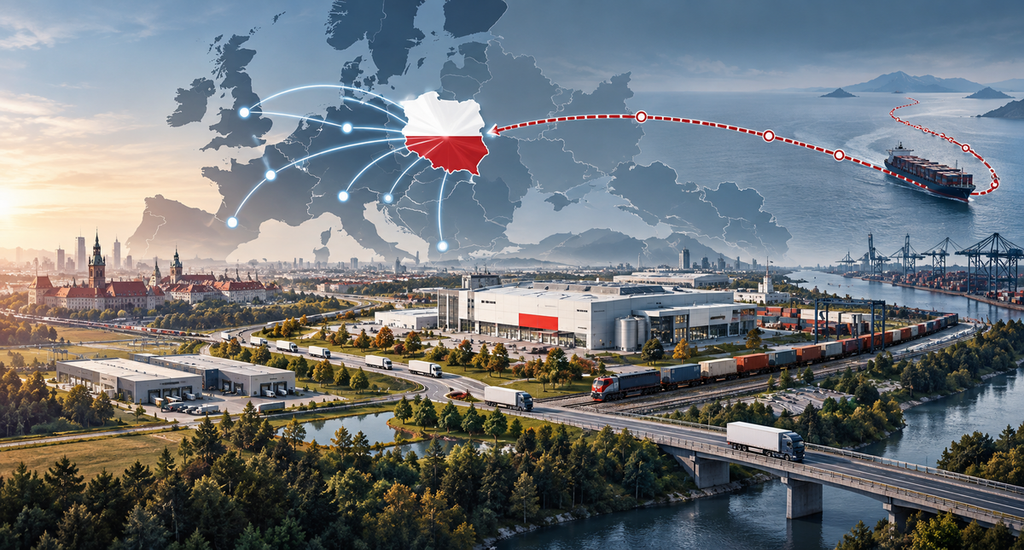
Nearshoring to Poland means bringing production or supply activities closer to European customers. Disruptions in global supply chains have encouraged companies to reconsider where products are made, how quickly they can replenish stock and how much control they have over critical suppliers.
Poland offers manufacturing capability, a sizeable labor market and connections to European transport networks. Those advantages make it a serious location to assess, but the decision requires a comparison of delivered costs, operational risks and long-term strategy.
Poland’s manufacturing nearshoring landscape
Workforce and operating costs
Poland has established industrial regions, technical education and experience in international supply chains. Availability of engineers, technicians and operators varies by location, sector and shift pattern.
Costs should be assessed for your actual operation. Wage growth, energy prices, productivity and recruitment affect the business case. Eurostat reported that hourly labor costs in Poland, measured in national currency, rose 8.8% in 2025; that is an economy-level indicator, not a quotation for a specific factory. Eurostat’s labor-cost release
Location and logistics
Road, rail, intermodal terminals and Baltic ports can support distribution to Germany, Central Europe and other markets. Test the routes that matter to your customers, including loading windows, peak demand and border or capacity constraints.
Proximity can improve response times and make factory visits easier. It does not guarantee a particular delivery time. Compare carrier quotations and service performance for the exact origin, destination and shipment profile.
EU market access and investment support
Poland’s EU membership provides a common framework for many product and trade requirements. Local tax, employment, permitting and environmental obligations still require attention.
Investment support may improve an eligible project’s economics. The Polish Investment Zone operates through a support decision with conditions; it is not a blanket grant for moving production. Review eligibility, excluded activities and timing before making binding commitments. PAIH’s Polish Investment Zone guidance
Opportunities and challenges of nearshoring to Poland
Opportunities
Production closer to demand can support shorter replenishment cycles, customization and more frequent quality oversight. It may reduce inventory tied up in long transport routes and improve the ability to react when orders change.
Polish suppliers can also connect production with engineering, testing and prototyping. For companies starting through a supplier relationship, contract manufacturing in Poland provides a route to compare before developing an owned facility.
Environmental benefits should be measured for the full production and delivery system. Shorter routes may help, but the energy mix, process efficiency, utilization and materials also affect emissions.
Challenges
Labor shortages, wage pressure, energy costs and supplier dependence can change the expected savings. A plant with lower rent may cost more overall if recruitment, transport or utilities are difficult.
Projects also need realistic plans for permits, product quality, environmental requirements and knowledge transfer. Currency exposure matters when costs and revenues are denominated differently. Assess whether hedging is appropriate with your finance advisers.
An eight-step nearshoring decision framework
1. Evaluate the current supply-chain footprint
Identify products or components for which distance causes a measurable problem. High freight costs, unpredictable lead times, customization and costly inventory buffers can justify closer investigation.
2. Compare total delivered cost
Include labor, productivity, utilities, materials, freight, duties where applicable, quality losses and working capital. Model transition costs and a downside case alongside the expected savings. Keep unapproved incentives outside the base case.
3. Assess regional talent and infrastructure
Consider industrial areas in Silesia, the Poznań and Łódź regions, and other locations suited to your sector. Assess the commuting labor pool, suppliers and utilities at site level. Eastern or smaller-city locations can merit investigation, but lower cost and adequate capacity must be demonstrated.
4. Check investment-support options
Compare the Polish Investment Zone, grants and other relevant schemes as separate instruments. Engage the appropriate administrators and advisers early enough to understand application timing and continuing obligations.
5. Plan supply-chain and financial risks
Evaluate critical inputs, alternate suppliers, currency scenarios and business-continuity arrangements. Nearshoring the final production stage does not remove dependence on distant components.
6. Engage local stakeholders
Discuss land, utilities, access roads and permitting with property owners, operators and authorities. Record who is responsible for each dependency and what evidence confirms readiness.
7. Build the workforce plan
Benchmark roles and benefits, assess recruitment channels and plan training. Partnerships with vocational schools or universities can support a pipeline but will not replace experienced staff needed for the initial launch.
8. Integrate Polish operations globally
Use consistent quality standards, production data and escalation procedures. Plan a staged transition with pilot volumes and acceptance criteria before transferring critical production. Agree when the original supply route can safely be reduced.
The longer-term outlook
Automation, e-mobility, industrial modernization and European supply-chain resilience create areas to investigate. Their value depends on your product, technology and customer base.
A strong nearshoring plan remains viable under plausible changes in wages, demand and transport costs. It should explain why Poland fits the business beyond a temporary cost difference.
Questions about nearshoring manufacturing to Poland
Is nearshoring to Poland mainly about lower wages?
Wages are one input. Lead-time reliability, inventory, quality, engineering support and customer service can matter as much as labor cost. Compare the complete operating model.
Should a company use a supplier or build its own plant?
A supplier can provide a way to test production with less owned infrastructure. An owned plant may suit a need for dedicated capacity and control. Compare both with acquisition options where relevant.
How Expand2Poland can help
Expand2Poland supports market research and entry strategy, local partner evaluation and the coordination of relevant resources for a Polish operation. We help connect commercial priorities with supplier, workforce and establishment decisions.
Book an introductory consultation to discuss which production activities you are considering, the evidence needed and a practical route forward.
This article provides general information and does not constitute legal, financial or tax advice.