
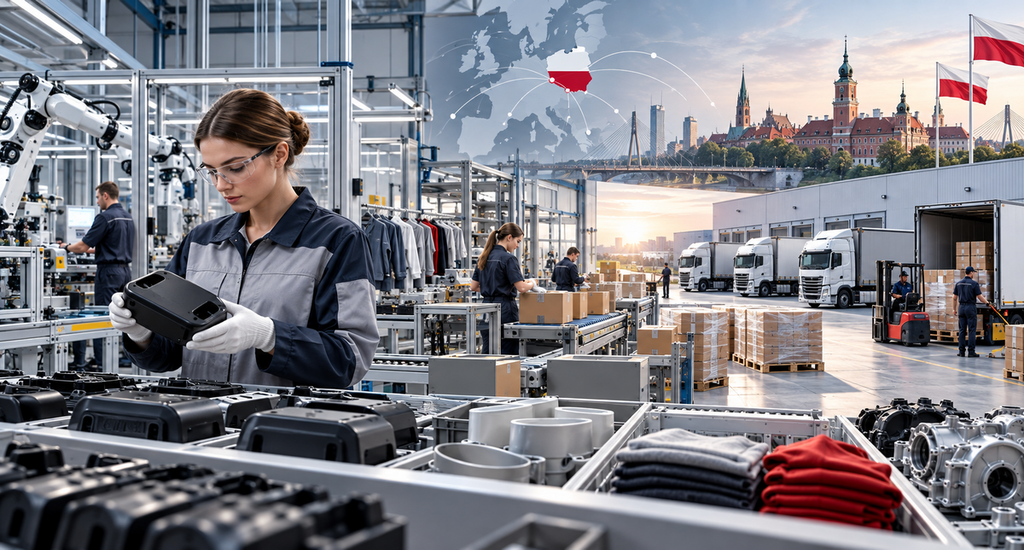
Contract manufacturing in Poland can help international brands source products closer to European customers without building their own factory. The opportunity depends on finding a manufacturer whose equipment, quality systems, production capacity and commercial terms match your product.
Poland's industrial development has created a broad manufacturing base. For global brands, the key question is not simply whether production is available, but which partner can deliver a reliable product at a competitive total cost.
Poland's contract manufacturing landscape
Polish manufacturers operate across textiles and apparel, electronics and appliances, automotive components, metalworking, machinery and furniture. Some provide a defined manufacturing process; others offer development, assembly, packaging or private-label support.
These capabilities are not interchangeable. A supplier experienced in high-volume components may be unsuitable for a small-batch consumer launch. A private-label producer may offer an established product range but limited scope for custom design.
Start with a precise specification: materials, tolerances, certifications required for your category, expected volumes, packaging and delivery markets. This turns a broad supplier search into a realistic shortlist.
Why brands consider outsourcing production to Poland
Productivity and total cost
Assess the delivered cost per acceptable unit, not just the quoted factory price. Tooling, minimum order quantities, scrap, testing, packaging, freight, inventory and returns can change the result substantially.
Labor costs are only one input. Equipment, process control and the supplier's familiarity with your product can matter more than a low hourly rate.
Access to European customers
Road, rail and port connections can support European distribution. A closer production partner may make factory visits, smaller replenishment orders and changes to specifications easier to manage.
Check actual transport routes and service levels. Geographic proximity does not guarantee a particular lead time or protection from disruptions.
Engineering, flexibility and scaling
Some partners can support prototypes, product adaptation or a phased move from pilot orders to larger batches. Confirm which activities are performed in-house and which are subcontracted.
Ask how capacity would be reserved, how quickly another shift could be added and what happens when a larger customer needs the same production line. Flexibility should be evidenced, not assumed.
Investment support where applicable
Poland offers investment-support mechanisms for qualifying projects. A manufacturing customer purchasing from an existing supplier should not assume it qualifies for the supplier's incentives. Obtain specialist advice before including public support in the business case.
Risks to address before appointing a manufacturer
The original attraction of outsourcing, with less direct operational responsibility, also creates dependency. Investigate:
- Quality consistency, testing methods and treatment of nonconforming goods.
- Reliance on imported materials, single-source components or subcontractors.
- Ownership and permitted use of designs, tooling and technical information.
- Cost changes linked to energy, raw materials, wages or exchange rates.
- Financial resilience, insurance and competing demands on capacity.
- Applicable product, workplace and environmental requirements.
For goods sold in the EU, determine the obligations of each economic operator. Outsourcing production does not automatically transfer your brand's legal responsibilities to a factory. EU guidance on product compliance
How to select a Polish contract manufacturing partner
1. Define the commercial and technical brief
Document required processes, forecast volumes, target markets, acceptable lead times and responsibilities for development or approvals. Identify non-negotiable requirements separately from preferences.
2. Research and shortlist suppliers
Compare demonstrated sector experience, machinery, technical staff and suitable references. A polished website is a starting point, not proof of production capability. Our guide to finding business partners in Poland explains a structured approach to shortlisting.
3. Verify capability and financial standing
Review the legal entity, financial information available, customer references and the scope of relevant certifications. Arrange a factory visit or a technical audit proportionate to product risk. Check whether the proposed work would be subcontracted.
4. Run a pilot and agree quality controls
Use samples or a controlled first batch to test communication, repeatability and delivery performance. Agree acceptance criteria, inspection points, traceability and a process for corrective actions.
5. Establish clear contractual arrangements
Have qualified advisers review pricing, minimum orders, tooling ownership, intellectual property, confidentiality, liability, delivery terms and termination. Define how forecasts become binding orders and how changes are approved.
6. Coordinate production and logistics
Assign an accountable contact on each side. Share forecasts, review production milestones and establish escalation routes. Plan stock buffers and alternative sources for critical inputs where appropriate.
Illustrative opportunities for global brands
A fashion brand might test a limited European collection with a textile producer before committing to seasonal volumes. An electronics company could assess assembly and testing partners while retaining product design internally. An automotive supplier might seek machining capacity for a specified component.
These are illustrative routes, not reported client results. Each requires its own technical validation and financial comparison.
The future of outsourced production in Poland
Automation, traceability, energy efficiency and customer sustainability requirements are important topics to discuss with suppliers. They can create opportunities for capable manufacturers, but can also require additional investment and documentation.
If you are considering relocating production rather than purchasing from an existing partner, compare the options in our guide to nearshoring to Poland.
Frequently asked questions
How do I find a contract manufacturer in Poland?
Prepare a product and volume brief, research sector-specific suppliers, verify capabilities and test a shortlist through technical discussions and pilot production. Use the same evaluation criteria for each candidate.
Is outsourcing production to Poland always cheaper?
No. Compare delivered costs, quality, inventory, tooling and management effort. A more expensive unit price can still be commercially attractive if it reduces other costs or improves responsiveness.
How Expand2Poland can help
Expand2Poland can help define your sourcing requirements, identify relevant organizations and coordinate introductions and evaluation discussions through our partners and suppliers service. Technical audits and legal or regulatory assessments should be handled by appropriately qualified specialists.
Book a consultation to discuss your product, volumes and Polish supplier search.
This article is general business information, not legal, tax or technical compliance advice.