
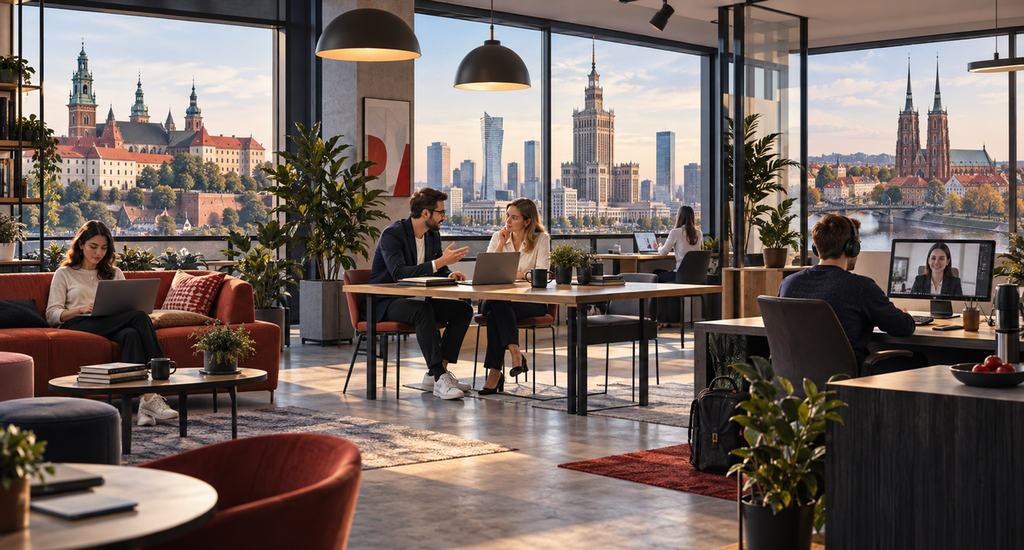
Coworking in Krakow, Warsaw or Wroclaw can give a small team a practical base while it explores the Polish market. Shared space may offer desks, meeting facilities and opportunities to meet other businesses without establishing a dedicated office immediately. Its value depends on how well the location and membership support your work.
Each city provides a different setting, but the best choice comes down to specific addresses and facilities. Start with where you need to meet, recruit and travel, then compare spaces using the same brief.
Krakow: match the setting to your working day
Central locations, Kazimierz and Zablocie can all form part of a Krakow shortlist. Compare travel from the places employees, customers and partners actually use. A convenient daily journey can be more valuable than a distinctive building.
If community matters to your business, ask about the organizations using the space and the events they attend. A conversation with the community manager can help establish whether introductions and activities are relevant to your goals.
For focused technical work, inspect acoustics, private call areas and meeting demand. The surrounding neighborhood and the working environment should both contribute to the choice.
Warsaw: consider your meeting and travel needs
Srodmiescie, Wola and Mokotow are useful starting areas for a Warsaw comparison. Assess addresses against customer locations, employee commutes and rail or airport journeys.
Proximity to institutions can help when you have regular meetings there. Base the decision on the people you expect to visit and the time saved, alongside the budget.
Compare smaller shared spaces with memberships in larger office developments. Reception, visitor access, parking and shared facilities may differ considerably between offers. Ask how they operate during a busy working day.
Wroclaw: assess the workspace and community together
Central and mixed-use locations can provide options for teams with different priorities. Check the actual commute, building access and nearby services for the addresses under consideration.
A team seeking collaboration may value an active community and relevant events. A team handling confidential work may place more weight on private rooms and predictable meeting access. Discuss those priorities with the operator.
Visit while people are working. This helps you understand noise, desk density and demand for common areas, giving a more representative picture than an empty-space tour.
Which coworking membership fits your team?
Choose the membership around attendance, privacy and meeting needs. A hot desk, dedicated desk, private room and meeting-only membership serve different purposes. Before comparing offers, define:
- Attendance: how many people will use the space and how often.
- Privacy: the need for focused work, calls and confidential meetings.
- Access: working hours, guest visits and building-entry arrangements.
- Storage: equipment, documents and personal belongings.
- Shared facilities: meeting rooms, printing and support.
Use that brief for each space in your city shortlist.
Ask what the fee includes, whether taxes are included and how extras are charged. Meeting rooms, parking, printing and lockers can materially affect the budget. Review deposits, notice, renewal and price-change provisions as part of the comparison.
For a private furnished office with a broader service package, read serviced offices in Poland.
Make shared space work for your business
Have IT review internet arrangements, access and use of corporate equipment. Discuss the changes needed for your systems and the support available if connectivity fails.
Check call privacy, printing, document storage and visitor movement. If the membership includes an address or mail service, confirm its permitted use and the arrangements when the membership ends.
Record important promises in the agreement. This gives both sides a clear understanding of facilities, maintenance and support.
Learn from a representative trial
Where available, use a trial day to complete normal work and hold a typical meeting. Ask employees about the commute, comfort and ability to concentrate. Compare the experience with the requirements in your brief.
Community activity is useful when it supports your objectives, so review its relevance alongside the cost and facilities. Set a later review point as headcount, attendance or privacy needs change. Coworking may remain the right fit, or the team may become ready for a dedicated office.
How Expand2Poland can help
Expand2Poland supports operational setup in Poland. We help clarify workspace needs and coordinate local provider conversations around your preferred cities and working model.
Book an introductory consultation to discuss your team size, meeting needs and the criteria for a practical coworking shortlist.
This article provides general information and does not constitute legal, financial or tax advice.