
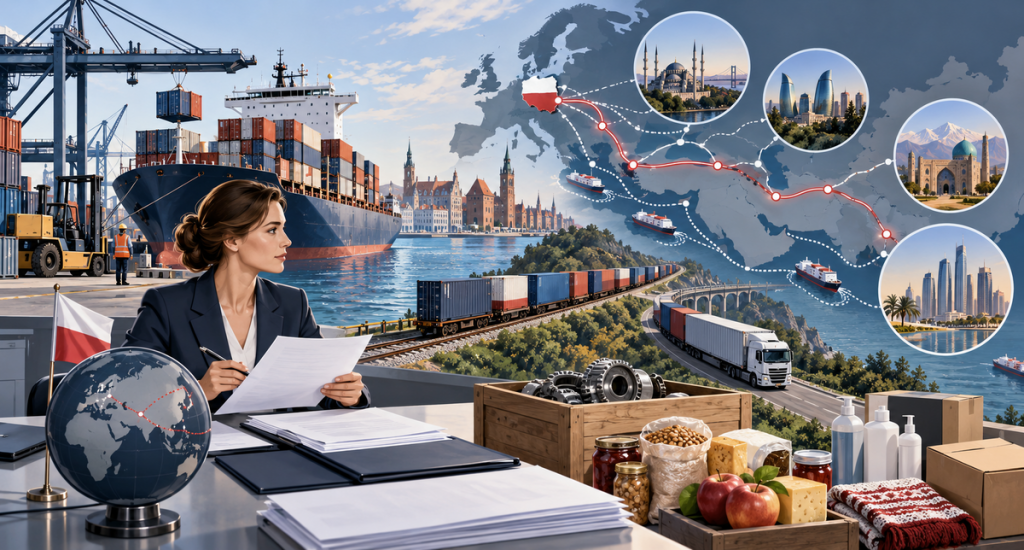
Poland’s export story is usually told through the lens of the European Union, and for good reason. The EU remains the country’s natural commercial home, offering regulatory alignment, customs-free movement within the Single Market, and dense industrial ties with Germany, Czechia, Slovakia, France, and the Netherlands. However, Poland’s export opportunity does not stop at the EU border. For manufacturers, food producers, machinery suppliers, automotive component firms, consumer goods brands, and specialized technology providers, Eurasian markets can offer a broader growth path.
Turkey, Kazakhstan, China, the Gulf states, and selected Caucasus markets all present different forms of demand. Some are attractive because of population size. Others matter because of energy wealth, industrial modernization, infrastructure investment, or their role as regional trading centers. Poland’s manufacturing base, competitive cost structure, EU quality positioning, and Baltic logistics access give exporters a credible platform from which to serve these markets.
The challenge is that “Eurasia” is not one market. A shipment to Turkey is commercially and legally different from a shipment to Kazakhstan, the UAE, Saudi Arabia, China, or Azerbaijan. Customs processes, documentation, product standards, payment practices, sanctions risk, labeling requirements, and buyer expectations vary significantly. Companies that approach the region with a single export template can quickly run into problems.
CIF deals add another layer of complexity. Under CIF, the seller arranges and pays for freight and insurance to the named destination port, but risk transfers to the buyer once the goods are loaded on board the vessel at the port of shipment. CIF also applies only to sea and inland waterway transport, and the minimum insurance required under CIF is limited cover, commonly associated with Institute Cargo Clauses C. For containerized or multimodal shipments, especially those involving rail or inland legs, exporters should carefully consider whether CIF is really the best Incoterm or whether alternatives such as FCA, CIP, CFR, or DAP better match the commercial risk profile.
Market Landscape
Poland-based exporters have several structural advantages when selling beyond the EU. The country has a broad industrial base, strong food and consumer goods sectors, improving port infrastructure, access to EU trade documentation systems, and a growing logistics ecosystem linking road, rail, and maritime routes. These strengths are especially relevant for goods that combine quality with price competitiveness, including machinery, automotive parts, processed foods, furniture, cosmetics, household goods, medical products, and selected technology-enabled industrial products.
The EU trade framework also matters, though it needs to be applied carefully. The EU has one of the world’s largest networks of trade agreements, with 44 preferential trade agreements covering 76 partners. These agreements can reduce tariffs, simplify access, and create a more predictable framework for exporters, but they do not apply uniformly across Eurasian markets.
Turkey is one of the most commercially relevant destinations for Poland-based exporters. The EU and Turkey are linked through a customs union covering many industrial goods, although agriculture, coal and steel, public procurement, and services are treated differently. This makes Turkey more accessible than many other non-EU markets, but not regulation-free. Product compliance, customs formalities, labeling, documentation, and local distribution still require close attention.
Kazakhstan operates under a different framework. The EU-Kazakhstan Enhanced Partnership and Cooperation Agreement entered into force in March 2020 and governs trade and economic relations, but it is not the same as a deep free trade agreement eliminating tariffs across the board. Kazakhstan can be attractive for machinery, equipment, industrial inputs, agriculture-related technology, and infrastructure-linked products, but exporters need to manage customs procedures, certification, payment risk, and geopolitical exposure carefully.
China is a major global market, but it is also one of the most difficult. The EU describes China as a partner, competitor, and systemic rival, with bilateral trade remaining substantial but marked by significant market-access asymmetries. For Polish exporters, China can be attractive in food, specialty consumer goods, industrial inputs, and selected technology categories, but the barriers are real: registration requirements, standards, intellectual property concerns, local competition, distribution complexity, and political risk.
The Gulf region offers a different profile. High purchasing power, large infrastructure programs, imported food demand, and growing interest in European industrial and consumer products create opportunities, but the EU-GCC free trade agreement negotiations were suspended in 2008. More recently, the EU formally launched FTA negotiations with the UAE in May 2025, but exporters should not assume that a Gulf-wide EU preference regime currently applies.
A final market reality has become impossible to ignore: sanctions and re-export risk. The EU has tightened controls on dual-use goods, advanced technologies, machinery, electronics, chemicals, and items that could support Russia’s military-industrial base. It has also emphasized anti-circumvention risks involving third countries. For exporters serving Eurasian markets, compliance diligence is now part of commercial discipline, not just a legal formality.
Opportunities and Challenges
- CIF can strengthen customer relationships, but it can also blur risk assumptions. Buyers in emerging or distant markets may prefer CIF because the Polish exporter controls freight and insurance to the destination port. This can make the sale easier, especially where the buyer has limited international logistics experience. The exporter, however, must understand that CIF separates cost responsibility from risk transfer. Once goods are loaded on board, the buyer bears the transit risk, even though the seller pays for freight and insurance to the destination port.
- Documentation quality is often the difference between delivery and delay. Exporters need accurate commercial invoices, packing lists, transport documents, export declarations, certificates of origin, product certificates, insurance documents, and destination-specific import documentation. Rules of origin determine the economic nationality of goods and can affect tariff treatment, trade policy measures, public procurement, and origin marking.
- Preferential access is useful only when the product qualifies. Some destinations may offer preferential treatment under EU agreements or arrangements, but the exporter must prove origin using the correct method. Depending on the agreement, the importer may rely on an EUR.1/EUR-MED certificate, an origin declaration or statement on origin, or another permitted route such as importer’s knowledge. REX or approved-exporter registration may be required for the relevant self-certification route. Supplier declarations support the exporter’s origin assessment; they are not the importer’s proof for claiming tariff preference. A generic “certificate of origin” approach is not sufficient.
- Food, machinery, automotive parts, and household goods can travel well, but localization matters. Polish products often compete effectively on quality and price, especially when EU production standards are valued. Packaging, labeling, technical manuals, warranty language, halal requirements, climate-resistant packaging, voltage or technical compatibility, and local-language marketing can all affect acceptance in Eurasian markets.
- Payment risk should be treated as a core export issue. Long-distance sales into markets with different legal systems and banking practices should be supported by trade finance discipline. Letters of credit, documentary collections, export credit insurance, staged payments, and careful counterparty screening can reduce exposure. Attractive sales growth is not useful if receivables become difficult to collect.
- Sanctions and diversion risk require active monitoring. Exporters of machinery, electronics, vehicles, components, industrial equipment, chemicals, and dual-use-adjacent items need to screen customers, intermediaries, end users, banks, routes, and unusual order patterns. The EU and G7 have published guidance on preventing sanctions evasion and identifying red flags connected to diversion through third countries.
Partnering and Strategy
Companies exporting Polish goods to Eurasian markets should begin with destination-specific market mapping. Turkey, Kazakhstan, China, the Gulf, and the Caucasus should not be grouped together operationally. Each market needs its own analysis of tariff treatment, import rules, customer expectations, product standards, payment norms, distribution channels, and political risk.
Incoterms should be negotiated deliberately. CIF can be useful for maritime shipments where the seller has strong logistics capability and wants to offer the buyer a more complete landed-port solution. For containerized goods, multimodal shipments, or rail-linked routes, exporters should review whether CIF creates mismatched risk assumptions. CIP may be more appropriate where multiple modes of transport are involved and higher insurance expectations are needed. FCA or FOB may be better when the buyer wants greater control over freight. CFR can work where the seller handles freight but the buyer arranges insurance.
Reliable logistics partners are essential. Exporters should work with freight forwarders, marine insurers, customs brokers, and destination agents that understand both Polish export procedures and the target market’s import reality. A forwarder who can move cargo out of Gdańsk is not automatically equipped to manage documentation for Kazakhstan, customs clearance in the Gulf, or buyer-side complications in China.
A practical export strategy should include:
- Market-by-market compliance review – Tariffs, standards, labeling, certification, import licenses, sanctions risk, and payment restrictions should be reviewed before quotations are finalized.
- Documentation workflow design – Commercial, origin, insurance, transport, and product documents should be standardized and checked before shipment to reduce border delays and disputes.
- Route and risk diversification – Maritime, rail, and multimodal routes should be compared based on cost, reliability, lead time, geopolitical exposure, and cargo sensitivity.
- Local representation where complexity justifies it – Distributors, agents, service partners, or representative offices can improve market knowledge, after-sales support, customs coordination, and trust with buyers.
- Trade-finance discipline – Banks, insurers, and export-credit tools should be incorporated into the sales model, particularly for larger orders, first-time buyers, or markets with higher payment risk.
The stronger exporters will be those that combine commercial ambition with procedural discipline. Eurasian markets can reward Polish products, but they also punish weak documentation, vague payment terms, unclear responsibility for logistics, and underdeveloped local relationships.
How Expand2Poland Can Help
- Export-readiness assessment for Poland-based producers
- Market and route analysis for Eurasian destinations
- Incoterms and logistics-model review
- Partner identification across forwarders, customs brokers, insurers, and local representatives
- Coordination with trade, legal, and compliance advisers
Exporting from Poland to Eurasian markets can open meaningful growth opportunities when logistics, customs, payment, and compliance are structured correctly. Contact Expand2Poland to build a practical export plan that protects your margins while helping your products reach the right markets with confidence.
The information provided in this article is for general informational and educational purposes only and does not constitute legal, financial, or tax advise.