
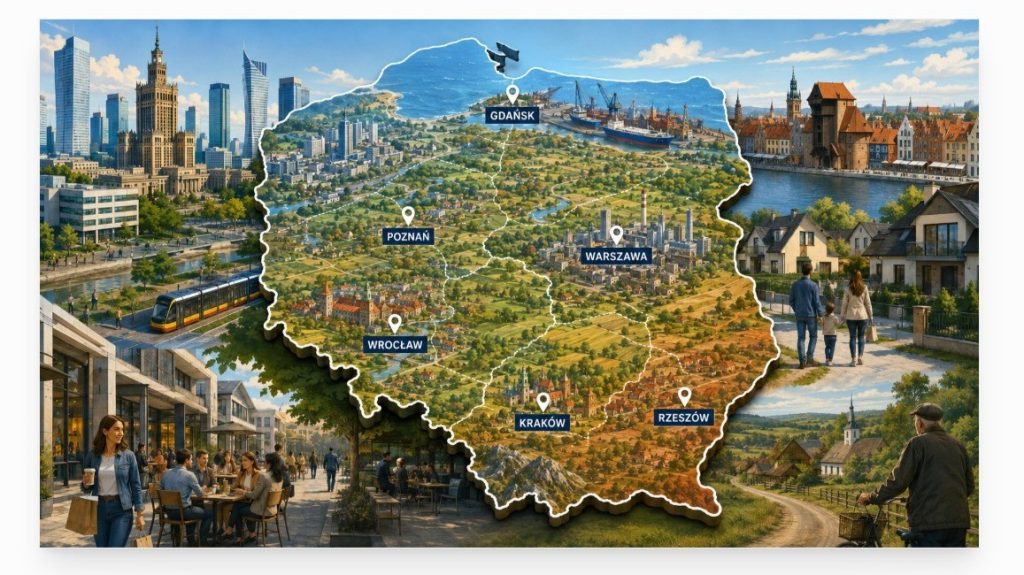
Poland is often treated by foreign companies as a single national market, but its commercial reality is more layered. Warsaw, Kraków, Wrocław, Gdańsk, Poznań, and other large urban centers concentrate higher-income consumers, international employers, universities, migrants, cultural institutions, and modern retail formats. Smaller cities, regional towns, suburban belts, and rural communities operate with different purchasing rhythms, trust networks, price sensitivities, and expectations of service.
This does not mean that Poland should be split simplistically into “modern cities” and “traditional countryside.” The more accurate picture is a spectrum. Some smaller cities are industrially strong, affluent, and commercially sophisticated. Some rural areas are closely linked to metropolitan labor markets. Some suburban communities combine urban income levels with family-oriented consumption patterns. Other regions face depopulation, aging, weaker infrastructure, and lower disposable income.
For companies entering Poland, this diversity creates both risk and opportunity. A product strategy designed only for Warsaw may fail to reach a large share of the market. A campaign that performs well in Kraków or Wrocław may not resonate in Podkarpackie, Podlasie, Lubelskie, or smaller towns in central Poland. A pricing model that works in affluent urban districts may be too narrow for more value-conscious households. At the same time, companies that learn how to serve regional Poland can access loyal customers, lower competition in selected categories, and underserved demand in areas that are often overlooked by international brands.
The strategic lesson is straightforward: Poland should be approached as a national market with regional operating models, not as a uniform consumer block.
Market Landscape
Poland’s demographic structure challenges the assumption that urbanization is simply rising in a linear direction. The country’s official urban population share has actually declined over time, from 62% in 1990 to 59% in 2024. Roughly 41% of the population therefore lives in rural areas, while many additional consumers live in small and mid-sized towns outside the largest metropolitan economies. Poland’s median age has also risen to 43.3, adding another layer to regional differences in consumption, labor availability, and service demand.
The major cities remain the country’s strongest commercial magnets. Warsaw is the country’s leading business center, with high household income, multinational employment, premium real estate, advanced services, and strong demand for international brands. Kraków and Wrocław combine university talent, technology, business services, and tourism. Gdańsk and the wider Tri-City area benefit from port activity, maritime trade, technology, and quality-of-life appeal. Poznań has strong logistics, manufacturing, and trade links with Western Europe.
Yet the largest opportunity is not limited to administrative city boundaries. Poland increasingly functions through metropolitan and functional urban areas that include surrounding commuting zones. Many consumers who work in Warsaw, Kraków, Wrocław, Poznań, or Gdańsk live outside the core city. Their spending patterns may resemble urban professionals in some categories, while remaining suburban or family-oriented in others. Retail parks, home-improvement stores, parcel lockers, schools, private healthcare, sports facilities, and commuter infrastructure are especially important in these zones.
Regional towns and rural communities follow a different logic. Local economies may revolve around agriculture, food processing, manufacturing plants, logistics facilities, public-sector employment, small businesses, or family-owned enterprises. Disposable income is often lower than in major urban areas, but that does not mean demand is weak. Spending may be concentrated on essentials, home improvement, vehicles, children, heating, household equipment, food, mobile services, and practical consumer goods.
Retail formats also vary by geography. Large shopping centers, premium retail, international restaurants, coworking spaces, and omnichannel services are more visible in major cities. Smaller towns often rely more heavily on discount chains, convenience stores, local retailers, marketplaces, and regional service providers. E-commerce has narrowed the gap, but logistics quality, delivery preference, and trust in online purchasing can still vary by age, location, and category.
For foreign companies, the main risk is designing for Poland’s most visible consumers while neglecting the rest. A Warsaw-centric strategy can produce strong early signals but weak national penetration. A regional strategy built only around low price can also fail if it underestimates the sophistication of consumers outside major cities. The Polish market rewards sharper segmentation.
Opportunities and Challenges
Urban consumers reward convenience, quality, and experience
In large cities, consumers are more likely to encounter international brands, compare products digitally, use delivery platforms, pay through mobile tools, and demand fast service. They may respond well to premium positioning, health-oriented products, technology, design, sustainability, and time-saving services.
Competition is also much stronger. Urban consumers have more options and less patience for weak execution. Brands entering Warsaw or Kraków need clear differentiation, polished localization, reliable customer support, and strong omnichannel performance.
Regional consumers value trust, practicality, and price logic
Outside the largest metropolitan markets, purchasing decisions are often more cautious and relationship-driven. Price matters, but so do durability, after-sales service, recommendations, availability, and perceived fairness. Customers may be willing to pay more for quality when the value is clear, but they are less likely to reward vague premium claims.
This creates opportunities for brands that combine reliability with accessible pricing. Home improvement, household goods, automotive services, children’s products, food, healthcare, telecom, energy efficiency, and practical digital services can all perform well when adapted to local expectations.
Smaller cities are not secondary in every category
Some smaller cities have strong industrial bases, universities, tourism, regional administration, or cross-border links. A city with a major employer, a growing logistics hub, or a successful manufacturing cluster may support demand that is stronger than population size alone suggests.
Companies should therefore avoid ranking locations only by total population. Employment structure, income, commuting patterns, age profile, and sector concentration can matter more than size.
Regional identity should be respected, not exaggerated
Poland contains meaningful regional identities, including Silesian, Kashubian, Podhale, Greater Poland, Masurian, Podlasie, and other local traditions. Marketing that acknowledges regional pride can work well, but only when handled naturally. Forced dialect use, superficial folklore, or generic “local” imagery can appear patronizing.
Better localization usually comes from working with local partners, adapting store formats, supporting community initiatives, using accurate place references, and understanding local consumer priorities.
E-commerce can reach regional Poland, but delivery design matters
Online sales have expanded access to products that once depended on urban retail networks. Parcel lockers, courier services, click-and-collect, and marketplace platforms allow companies to reach smaller towns and rural consumers more efficiently.
The challenge is fulfillment quality. Delivery costs, return processes, customer support, payment methods, and pickup-point availability can influence conversion. A company that serves regional Poland online still needs a logistics model designed for those customers, not simply a city-based e-commerce platform extended outward.
Demographics shape demand by place
Major cities attract students, young professionals, migrants, and higher-income households. Some regional areas are older, more family-oriented, or more exposed to youth outmigration. Products and services related to education, housing, childcare, healthcare, senior care, mobility, and financial planning must account for these differences.
A national campaign may create awareness, but regional demand depends on local life stage, household structure, and income reality.
Strategies and Partnerships
Companies expanding across Poland should begin with regional segmentation. The first layer should include major metropolitan areas, suburban belts, medium-sized regional cities, smaller towns, and rural communities. The second layer should examine income, age, employment, transport access, retail density, digital behavior, and local competition.
This analysis should shape product assortment. A retailer may offer premium formats in Warsaw and Kraków, family-value assortments in suburban zones, and practical, durable products in smaller regional towns. A healthcare company may focus on private specialist access in cities and telemedicine or mobile service models in underserved areas. A consumer-goods brand may use different pack sizes, price points, and retail channels depending on local purchasing behavior.
Distribution partnerships are essential. Regional wholesalers, local retailers, franchise operators, logistics firms, service technicians, and community organizations can help foreign companies build credibility. In smaller markets, a trusted local partner may matter more than a national advertising campaign.
A practical Poland-wide strategy should include:
- District and regional market mapping – Evaluate not only population size, but also income, employment base, commuting patterns, retail infrastructure, and service gaps.
- Channel differentiation – Use flagship urban retail, marketplace channels, discount retail, local distributors, click-and-collect, and mobile service models where each makes commercial sense.
- Localized communication – Adapt messaging by region and customer segment while maintaining one coherent national brand.
- Flexible pricing and assortment – Offer products and bundles that reflect local income, household needs, and category expectations.
- Regional logistics planning – Build delivery, returns, and service coverage around actual demand density, not only national averages.
- Community-based trust building – Support relevant local initiatives, schools, sports clubs, charities, or cultural programs where there is a genuine connection to the business.
Hiring also matters. Regional managers, sales representatives, customer-service staff, and field teams with local knowledge can improve market penetration. They understand which retailers matter, which communities are growing, how consumers compare offers, and how to communicate without sounding distant or imported.
Foreign companies should be careful with over-standardization. Consistency is valuable for brand control, but too much uniformity can weaken relevance. The better model is controlled localization: one strategic brand, adapted intelligently to different Polish markets.
How Expand2Poland Can Help
- Urban, suburban, and regional market segmentation
- Consumer and demographic analysis by location
- Local distributor, retailer, and service-partner identification
- Localization strategy for products, pricing, and communication
- Regional go-to-market planning across Poland
Poland’s strongest opportunities are not found only in its largest cities. Contact Expand2Poland to understand where your offer fits across the country and how to build a market strategy that reflects Poland’s real regional diversity.
The information provided in this article is for general informational and educational purposes only and does not constitute legal, financial, or tax advise.