
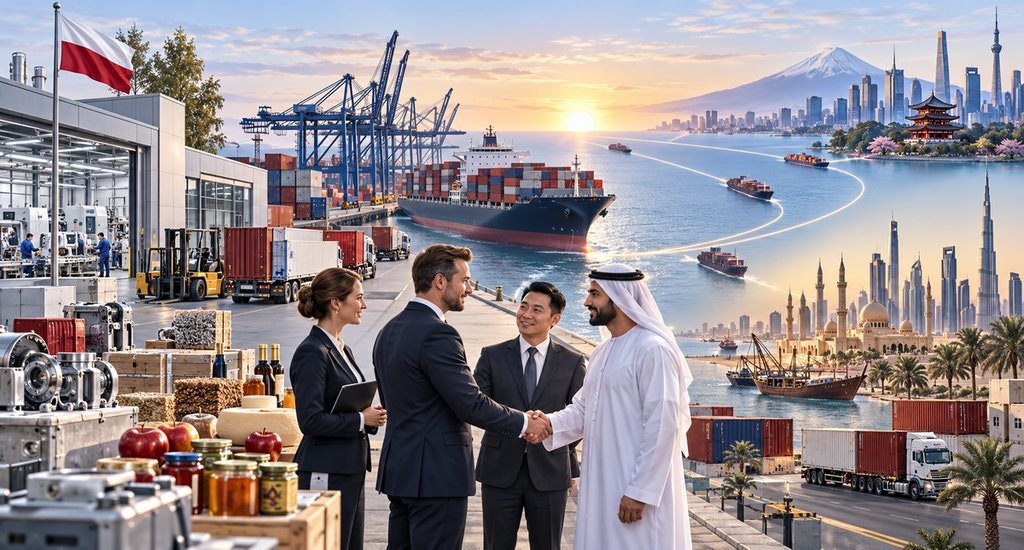
For decades, Poland’s export strength has been anchored in its deep integration with the European Union. The single market accounts for the overwhelming majority of Polish exports and has served as the engine of the country’s manufacturing and economic growth. Yet as global markets shift, consumer demand diversifies, and geopolitical risks reshape supply chains, Polish companies are increasingly looking beyond Europe, most notably to Asia and the Middle East & North Africa (MENA).
These regions offer fast-growing economies, young populations, significant infrastructure investment and rising consumer power. At the same time, they present a complex array of regulatory, cultural and logistical challenges. Companies that understand these dynamics and approach them strategically can unlock new revenue streams and strengthen long-term resilience.
This expanded analysis explores Poland’s positioning in Asian and MENA markets, the challenges exporters must navigate, and the steps companies can take to build strong, sustainable international expansion strategies.
A Shifting Export Landscape: Why Asia and MENA Matter
Polish exports have surged steadily for over twenty years, driven by efficient manufacturing, a skilled workforce and seamless access to the EU market. While the EU continues to be Poland’s largest trading partner, representing around three-quarters of total exports, the country’s firms and policymakers have become increasingly aware of the risks of over-concentration.
Demand slowdowns in Western Europe, combined with a more multipolar global economy, have pushed exporters to explore high-growth opportunities further afield. Asia and MENA stand out for several reasons:
1. Demographics and Rising Incomes – Many Asian and MENA countries have young, rapidly urbanizing populations with growing purchasing power. This has created strong demand for food, cosmetics, consumer goods, medical supplies and technology, categories in which Poland is highly competitive.
2. Infrastructure and Diversification – Massive investments in transport, energy and industrial capacity are generating opportunities for Polish machinery, construction materials and engineering services. Meanwhile, global companies are diversifying away from single-country dependencies, opening doors for reliable EU-based suppliers.
3. Improved Connectivity – Direct flights, maritime routes and rail corridors, including the Eurasian rail connections via Poland, have shortened transit times and made long-distance trade more efficient.
These structural trends mean that Asia and MENA are no longer “optional” markets for Polish exporters, they are becoming essential pillars of long-term growth.
Key Markets and Sector Opportunities
Although Asia and MENA are vast and heterogeneous regions, several markets stand out due to their compatibility with Polish export strengths.
China
China is Poland’s largest Asian trading partner. The relationship remains imbalanced, China exports far more to Poland than vice versa, but demand exists for premium food products, cosmetics, specialty machinery and processed goods. Polish exporters who succeed in China typically do so by carving out niche segments and emphasizing quality, EU standards and safety.
South Korea and Japan
These highly developed economies value precision engineering, advanced manufacturing and certified food products. Polish automotive parts, electronics components, industrial machinery and natural-ingredient cosmetics have gained traction. Free trade arrangements between the EU and Japan further streamline market access.
India
India is an emerging opportunity for Polish companies specializing in IT services, pharmaceuticals, smart technologies and food exports. Rapid digitization and a growing middle class create long-term potential, though market entry requires patience and careful local partnership selection.
Saudi Arabia, UAE and Israel
In the MENA region, Poland has built strong momentum in construction equipment, renewable energy components, agri-food exports, medical supplies and specialty chemicals. The Gulf states, in particular, are diversifying their economies beyond oil and investing heavily in infrastructure, healthcare and tourism, areas where Polish suppliers can add value.
Polish success stories include premium meat and dairy producers entering Asian markets by meeting strict food safety protocols, cosmetics brands expanding in the Gulf through natural-ingredient lineups, and machinery manufacturers adapting equipment to desert climates or local safety codes.
Barriers and Risks: What Exporters Must Overcome
Despite significant opportunities, Asia and MENA present challenges that differ materially from European business environments.
Regulatory Complexity
Import requirements vary widely, and compliance often extends beyond basic customs duties. Food exporters may need halal certifications, while pharmaceuticals and cosmetics require detailed ingredient documentation and safety testing. Machinery and electronics often must meet region-specific technical standards.
Cultural Expectations
Successful exporting depends heavily on trust and relationships. Business etiquette, negotiation styles and communication norms differ from Polish or European contexts. Many exporters falter not because their products fail, but because they underestimate cultural nuance.
Logistics and Distance
Longer supply chains introduce risks such as shipping delays, higher freight costs or geopolitical disruptions. Even with improved rail and air routes, exporters must plan inventory and distribution with greater precision.
Payment and Political Risk
Late payments, currency fluctuations and political instability in certain markets require proactive mitigation strategies. Without insurance or hedging tools, a single contract failure can destabilize cash flow.
Recognizing these challenges upfront allows companies to anticipate obstacles rather than react to them.
Strategic Pathways for Entering Asia and MENA
Expanding into high-growth international markets requires methodical planning and long-term commitment. Companies that thrive tend to follow a structured, research-driven approach rather than rushing into quick wins.
1. Conduct Deep Market Research
Successful exporters begin by analyzing market size, consumer behavior, competition, pricing expectations and regulatory norms. Poland’s government trade offices, national chambers of commerce and industry associations offer valuable data and introductions.
Understanding local distribution structures, whether markets rely on centralized wholesalers, sector-specific distributors, or direct-to-retail relationships, is equally important.
2. Choose the Right Market Entry Mode
Some companies succeed by appointing local distributors, who bring existing networks and cultural familiarity. Others prefer joint ventures to maintain greater control or to navigate regulatory requirements. For highly regulated industries, partnering with experienced local firms can be essential for obtaining certifications and licenses.
3. Adapt Products and Branding
Exporters often need to adjust packaging, flavor profiles, product ingredients or technical specifications. This is especially true for food products requiring halal certification, cosmetics that must follow strict ingredient regulations, or machinery that must operate under climatic extremes.
Branding also matters: colors, symbols, imagery and messaging should reflect local consumer preferences rather than simply translating campaigns from Europe.
4. Strengthen Logistics and Risk Management
Exporters must develop reliable supply chain strategies that account for longer transit routes and geopolitical risks. This includes selecting stable freight partners, building buffer inventory where necessary, and using credit insurance or hedging tools to stabilize revenue.
5. Invest in Long-Term Relationship Building
In both Asia and MENA, trust develops slowly but pays significant dividends. Companies that regularly visit markets, participate in local business councils, and maintain continuous communication tend to outperform those treating exports as transactional.
How Expand2Poland Can Help
International expansion is most successful when supported by on-the-ground expertise. Expand2Poland works closely with Polish and international firms to navigate the complexities of doing business internationally. Our partner network conducts tailored market research, identifies reliable distribution partners, assists with product compliance, and designs risk mitigation frameworks.
By combining strategic insight with local intelligence, we help exporters build sustainable, profitable and culturally attuned expansion strategies, ensuring that Polish products stand out in competitive global markets.
The information provided in this article is for general informational and educational purposes only and does not constitute legal, financial, or tax advise.