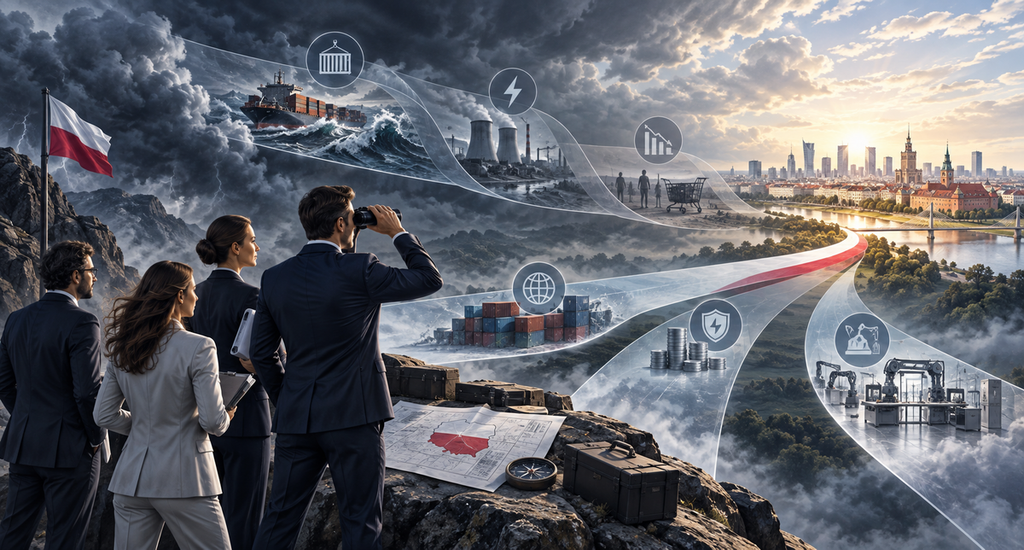
The possibility of a global recession poses significant challenges for companies and economies worldwide. While the depth and timing of downturns can vary, the risk environment, shaped by geopolitical tensions, energy instability, supply chain fragility, and shifting monetary policies, remains a top concern for executives.
Poland, however, enters such periods with an important advantage: a track record of resilience. The country weathered the global financial crisis and the pandemic-era contraction better than many peers. Its diversified economy, robust domestic demand, conservative financial system, and steady inflow of EU funds have created a buffer against external shocks. Still, no economy is immune. Understanding how various recession scenarios could unfold in Poland allows firms to proactively plan, adapt quickly, and even capture opportunities that emerge in turbulent times.
This expanded analysis examines the structural strengths underpinning Poland’s economy, the risks posed by different recession pathways, and the strategies businesses can adopt to build resilience and maintain competitiveness.
Market Landscape: Why Poland Has Historically Weathered Downturns Well
A Large and Dynamic Domestic Market
Poland’s internal market, nearly 38 million consumers, helps stabilize growth when exports soften. Household consumption has long been a key pillar of GDP, supported by rising wages, low unemployment, and a strong entrepreneurial culture.
Diversified Manufacturing and Services
Poland’s economy does not rely on a single industry. Its mix of sectors includes:
- Automotive and machinery
- Aerospace and precision manufacturing
- Food processing and agriculture
- Business services and IT outsourcing
- Chemicals and pharmaceuticals
- Construction and logistics
This diversification reduces vulnerability to sector-specific downturns.
Conservative Banking and Financial Regulation
Poland’s banking sector is well-capitalized and tightly supervised. High liquidity buffers and prudent lending practices help minimize systemic risk during global shocks.
The Engine of EU Cohesion Funds
Ongoing EU funding for infrastructure, innovation, digitization, and sustainability projects serves as powerful countercyclical support. These investments boost employment and modernize the country’s industrial base even when private investment slows.
Fast Recovery Capabilities
When past recessions hit, Poland recovered quickly, benefiting from strong private consumption, stable exports, and rapid adoption of technology in sectors such as e-commerce, business services, logistics, and IT.
These structural strengths are significant, but they do not remove recession risk. Rather, they position Poland as one of the more adaptable and resilient EU economies.
How Different Global Recession Scenarios Could Affect Poland
While Poland is resilient, a global downturn could affect the country in several ways depending on the type of recession:
1. A Demand Shock in Western Europe
Germany, France, the Netherlands, and Italy are top destinations for Polish exports, especially automotive parts, machinery, electronics, and processed foods. A contraction in Western European consumer or industrial demand would:
- Reduce orders for intermediate goods
- Lower export revenues for manufacturers
- Slow production in sectors integrated into German supply chains
Manufacturers with high concentration in one country or sector would feel this first.
2. Energy Price Spikes and Inflation Pressures
Poland’s energy mix still depends significantly on fossil fuels. A global energy price shock could:
- Increase operating costs for manufacturers
- Raise transportation and logistics expenses
- Put pressure on consumer spending through higher household bills
Industries with energy-intensive production processes, metallurgy, chemicals, food processing, would face the greatest exposure.
3. Supply Chain Disruptions from Asia or the U.S.
Poland’s manufacturing ecosystem relies heavily on imported components. Global bottlenecks could lead to:
- Delays in production
- Higher costs for raw materials
- The need to identify regional or domestic suppliers
However, these same disruptions may accelerate nearshoring, benefiting Poland as companies shift production closer to European end markets.
4. Slowdown in China or Global Trade Tensions
A slowdown in China could:
- Reduce global demand for European exports
- Depress commodity prices
- Create volatility in key global supply chains
This indirectly affects Poland as a major provider of intermediate goods to Western European firms exporting worldwide.
5. Heightened Geopolitical Risk in Eastern Europe
Regional tensions influence investor sentiment. Even without direct impact, perceived instability can lead to:
- Delayed investment decisions
- Higher costs of capital
- Reduced appetite for long-term commitments
However, Poland’s position as a stable EU member often makes it a destination for capital fleeing higher-risk markets in the region.
6. Monetary Tightening in Global Markets
Tighter global financial conditions could:
- Raise borrowing costs for Polish firms
- Slow consumer lending and mortgage activity
- Reduce liquidity for private investment
Companies relying heavily on loans or financing need to prepare for structurally higher interest rates.
Opportunities and Challenges
Opportunities
- Diversification: Entering new markets lowers reliance on any one region’s economic performance.
- Nearshoring momentum: Rising global tensions and supply chain risks increase demand for EU-based production.
- Automation and digitization: Slowdowns create windows to invest in long-term efficiency.
- Talent availability: Recessions often improve hiring conditions, allowing firms to acquire skilled workers.
- Government support: Fiscal measures and stimulus programs can reduce costs or unlock grants.
Challenges
- Export volatility
- Energy and input cost fluctuations
- Access to capital constraints
- Weakened consumer demand
- Increasing currency volatility
Businesses must prepare for a more complex, less predictable operating environment.
Partnering and Strategic Actions: How Businesses Can Build Resilience
1. Conduct Comprehensive Scenario Planning
Businesses should model multiple recession paths, including:
- Declines in export-driven revenues
- Rising energy prices
- Weak consumer demand
- Interest rate fluctuations
- Currency volatility (EUR/PLN, USD/PLN)
Scenario plans should include thresholds at which certain actions such as cost cuts, hiring freezes, or market shifts would be triggered.
2. Diversify Both Markets and Suppliers
Exporters: Expand market portfolios beyond Western Europe by exploring:
- Asia
- Middle East / North Africa
- North America
- Southern Europe
Manufacturers: Identify alternate suppliers or Polish/EU-based substitutes to reduce import dependency.
3. Strengthen Financial Resilience
Companies should:
- Maintain healthy liquidity and cash buffers
- Secure revolving credit lines early
- Revisit payment terms with customers and suppliers
- Consider currency hedging for EUR or USD exposures
- Stress-test interest rate sensitivity
A proactive approach ensures stability if markets tighten rapidly.
4. Invest in Efficiency: Automation & Digitization
Periods of uncertainty are ideal for modernizing operations:
- Automated production lines
- Digital workflow tools
- E-commerce platforms
- Cloud-based systems
- Data analytics and forecasting
These investments improve both resilience and competitiveness long-term.
5. Upskill and Cross-Train Employees
A multi-skilled workforce gives companies flexibility when adapting to changing demand. Training should include:
- Data literacy
- Process optimization
- New technologies
- Leadership development
6. Engage with Policymakers and Industry Groups
Firms should maintain dialogue with:
- Business chambers
- Industry associations
- Government ministries
Participation ensures companies can influence supportive policy measures and understand upcoming regulatory changes.
How Expand2Poland Can Help
Expand2Poland supports businesses in navigating uncertainty with:
- Scenario risk modeling
- Supply chain mapping and diversification plans
- Market expansion strategies across the EU and beyond
- Assistance securing financing and incentives
- Digital transformation and operational efficiency roadmaps
We help organizations turn uncertainty into strategic advantage by preparing for multiple outcomes and leveraging Poland’s strengths in times of global instability.
The information provided in this article is for general informational and educational purposes only and does not constitute legal, financial, or tax advise.