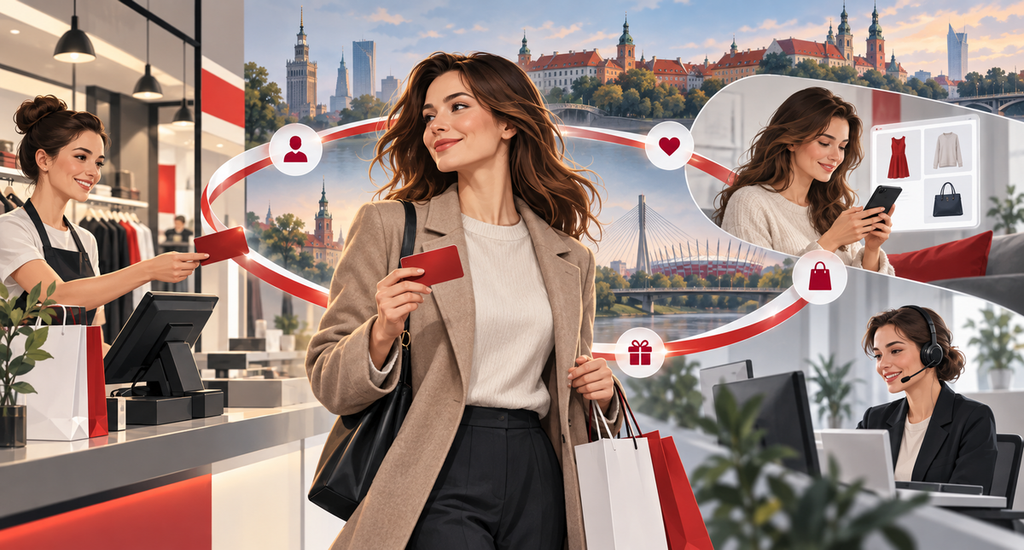
Loyalty programs used to be simple: a plastic card, a stamp, a discount at the register. In Poland, they’ve become something more strategic, a way to protect margin in a competitive retail environment, smooth demand across seasons, and turn one-time buyers into repeat customers who feel recognized. At the same time, customer relationship management (CRM) adoption has matured from “a database of emails” into the operating system behind segmentation, personalization, and service recovery.
Done well, loyalty and CRM reinforce each other. Loyalty creates reasons to identify yourself and return; CRM turns that data into relevant offers, better service, and smarter decisions. Done poorly, they become noise: generic points, irrelevant SMS blasts, and a privacy posture that makes customers uneasy. Poland is a market where both outcomes are common because consumer expectations are high, competition is intense, and trust around data usage is increasingly part of brand equity.
This article looks at how loyalty programs and CRM are evolving among Polish brands, what patterns are working, where companies get stuck, and how to design programs that create “pull” without training customers to only buy on discount.
Market Landscape
Polish consumers generally like loyalty programs, especially when the benefit is clear and the path to redemption feels short. Across grocery, fuel, pharmacies, beauty, fashion, hospitality, and services, loyalty has become normalized. The most common formats still revolve around points, vouchers, and member-only pricing, but the delivery mechanism has shifted. Mobile apps increasingly replace physical cards, with integration into digital wallets and in-app payment experiences making participation frictionless.
CRM adoption has expanded alongside this shift. Many mid-sized and large brands now use CRM platforms to unify purchase history, campaign interactions, service tickets, and preferences. That unification matters because Polish customers behave omnichannel: they research on mobile, compare prices, read reviews, then buy online or in-store depending on convenience. When a brand’s data is fragmented, one system for e-commerce, another for the call center, another for stores, personalization becomes guesswork and the loyalty program starts to feel generic.
There is also a growing “multi-partner” and cashback ecosystem. Some consumers prefer to accumulate benefits across brands rather than committing to a single retailer. That creates both a threat and an opportunity: if your program is too narrow or too stingy, customers will simply switch to the platform that gives them cross-category benefits.
Two constraints shape everything. The first is margin pressure. Polish shoppers are value-aware, and many categories have intense price competition, which can tempt brands into discount-heavy loyalty mechanics. The second is data governance. Loyalty and CRM live inside a regulated environment, and customers have become more sensitive to spam and unclear consent. Data protection requirements (including GDPR) make transparency, consent, and secure handling non-negotiable.
What’s changing: loyalty is moving from “discounting” to “relationship design”
A useful lens is to see loyalty programs as behavior design rather than a rewards ledger. The best programs are not the ones that give the most points; they are the ones that encourage the specific behaviors that improve unit economics and customer lifetime value.
In Poland, a few behaviors are especially relevant:
- Frequency and habit formation in grocery, cafés, convenience retail, and services.
- Basket expansion in categories where customers naturally buy narrow sets of items.
- Cross-category migration (e.g., a beauty retailer trying to move a skincare buyer into supplements or devices).
- Channel shifting (e.g., nudging store buyers into online replenishment, or online buyers into click-and-collect).
- Referral and advocacy, particularly when customer acquisition costs rise.
CRM makes these behaviors measurable. Loyalty makes them incentivizable. The combination allows brands to test, learn, and adjust instead of guessing.
Opportunities and Challenges
Loyalty that actually builds profit, not just participation
The biggest opportunity is building a loyalty scheme that improves economics without defaulting to permanent discounting. Tiering is one of the most effective tools here when it’s designed around value, not vanity. A tier system works when it rewards meaningful engagement, repeat purchase cadence, category breadth, or higher-margin behaviors, rather than simply rewarding whoever spends the most during a promotion period.
Polish consumers respond well to rewards that feel “real” rather than theoretical. If the program requires months of spending before anything tangible happens, participation drops. On the other hand, if rewards are too generous too quickly, you end up funding behavior that would have happened anyway. The sweet spot tends to combine quick early wins (to create habit) with longer-term milestones that encourage retention.
Personalization that feels helpful, not creepy
CRM-enabled personalization can be a major differentiator, but it comes with a narrow line: relevance builds trust; over-targeting breaks it. Many brands mistakenly equate personalization with more messages. In reality, the win is fewer messages that are better timed and more useful.
A practical example: if a customer regularly buys a specific product category, a replenishment reminder or a member-only bundle offer can feel like service. But if a customer receives generic blasts across unrelated categories, it’s perceived as spam, especially in SMS channels.
Omnichannel visibility vs. data fragmentation
Poland’s retail ecosystem blends strong brick-and-mortar behavior with fast-growing e-commerce and mobile-first browsing. A loyalty program that lives only in-store or only online will struggle. The most common failure mode is that customers earn points in one channel but can’t easily redeem in another, or customer service can’t see loyalty status when solving issues. Those gaps turn “loyalty” into frustration.
The challenge is integration. Many companies still operate on a patchwork of POS systems, e-commerce platforms, marketing tools, and customer service software. Without integration, CRM becomes incomplete and loyalty becomes generic.
Compliance and consent as part of brand trust
GDPR compliance is not just a legal checkbox; it’s an expectation. Polish consumers are increasingly wary of data collection that feels excessive or unclear. Successful brands treat privacy as part of the customer experience: clear consent choices, understandable explanations of data use, and visible security hygiene. When loyalty programs are transparent about what’s collected and why, customers are more willing to share data because the value exchange is obvious.
Partnering and Strategies
Start with one strategic question: “What do we want customers to do more of?”
Before selecting a points engine or a CRM vendor, define the behavior you want to increase. Is it purchase frequency? Subscription uptake? Higher-margin categories? Reduced churn after first purchase? A loyalty program that doesn’t tie directly to a business outcome becomes an expensive marketing accessory.
Choose a mechanism that matches your margins and buying cadence
Points-based systems are familiar and easy to understand, but they can quietly become discount machines if not controlled. Cashback is emotionally powerful but can erode margin if it’s not tightly targeted. Tiering works well when customers have repeatable purchase patterns and you can create meaningful benefits beyond price (priority service, exclusive access, faster returns, member-only bundles).
In Poland, where value sensitivity is real, many brands succeed by mixing small guaranteed benefits (e.g., member pricing, birthday perks) with targeted challenges (e.g., “buy twice this month, unlock X”) rather than offering blanket discounts.
Build CRM around a unified customer view
A CRM implementation is less about features and more about data design: unique customer identifiers, clean consent records, and the ability to connect transactions, interactions, and support issues across channels. If your loyalty program runs through an app, the app becomes a powerful identity layer, but only if it’s connected to POS and e-commerce.
A practical approach is to build a “minimum viable integration” first: unify identity and purchase history, then progressively add service interactions, product preferences, and predictive scoring as the foundation stabilizes.
Make redemption easy and communicate it clearly
The fastest way to kill a program is to make customers work to understand it. Polish consumers respond well to simplicity: clear rules, visible point balances, and straightforward redemption. The best programs communicate benefits in the moment, at checkout, in-app, or in a post-purchase message, rather than burying details in terms and conditions.
Use analytics as an ongoing control system
Loyalty programs require tuning. Track a few metrics that tell the truth:
- Incremental lift (are members buying more than they would have?)
- Repeat rate and time-to-second-purchase
- Margin impact (including reward liability)
- Redemption rate (too low signals irrelevance; too high may signal overspending)
- Churn and reactivation performance
- Channel migration (online vs in-store shifts)
Then adjust. If your program becomes “everyone gets 10% off,” it’s not loyalty; it’s a price cut.
How Expand2Poland Can Help
Expand2Poland helps brands build loyalty programs and CRM foundations that work in Poland’s competitive, omnichannel environment, without turning customer retention into a margin leak. We support clients with:
- Loyalty strategy and program design: selecting mechanics (points, tiering, cashback, hybrid) tied to your unit economics and customer behavior.
- CRM and data architecture: defining the customer data model, integrating key systems (POS, e-commerce, app, customer service), and creating a single customer view.
- Personalization playbooks: building segmentation, offer logic, and messaging rules that improve relevance while reducing noise.
- Measurement and optimization: dashboards and testing plans that show whether loyalty is driving incremental profit.
The information provided in this article is for general informational and educational purposes only and does not constitute legal, financial, or tax advise.