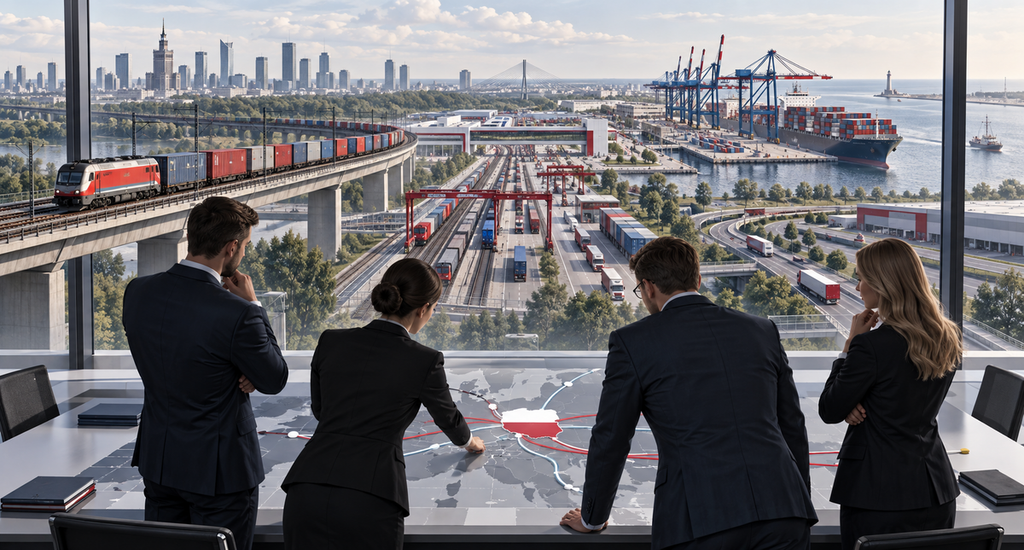
China’s Belt & Road Initiative (BRI) is one of the most ambitious infrastructure programs in modern history, designed to enhance connectivity between Asia, Europe, and Africa through a web of transport, trade, and investment corridors. For Poland, strategically located between Western Europe and Eurasia, the initiative presents both opportunity and complexity.
Positioned at the crossroads of major continental trade routes, Poland serves as a gateway for rail freight entering the European Union. Its logistics infrastructure, industrial parks, and transport corridors make it a natural bridge linking Asia’s manufacturing powerhouses with Europe’s consumer markets.
Yet the dynamics of Sino-Polish cooperation within the BRI framework are influenced by shifting geopolitics, EU regulations, and global supply chain reconfigurations. Understanding these layers is essential for businesses seeking to leverage Poland’s position while managing political and operational risks.
Market Landscape: Poland’s Role in the Modern Silk Road
The New Silk Road Rail Connection
At the heart of the BRI’s European vision lies the China–Europe Railway Express, also known as the New Silk Road. One of its main arteries runs through Kazakhstan, Russia, and Belarus into Poland’s Małaszewicze transshipment hub, near the Belarusian border.
Here, goods from China are transferred from the wider 1,520-mm railway gauge used in the East to the EU’s 1,435-mm standard gauge. From this point, cargo continues westward to destinations such as Hamburg, Rotterdam, and Duisburg, or southward to Czechia, Slovakia, and Hungary.
Transit times on this corridor typically range from 12 to 16 days, compared with up to 40 days by sea, offering a middle ground between air freight’s speed and maritime shipping’s cost efficiency. The route is particularly attractive for high-value or time-sensitive goods, including automotive components, electronics, and fashion products.
Expanding Infrastructure and Investment
Poland has invested heavily in strengthening its logistics and transport ecosystem to capture trade flows associated with the BRI.
- Rail Terminals and Logistics Parks: Modern intermodal hubs in Małaszewicze, Łódź, Bydgoszcz, and Sławków have expanded capacity to handle increasing container volumes.
- Port Infrastructure: The Port of Gdańsk, one of the fastest-growing harbors in Europe, has attracted foreign investment, including from Asian stakeholders, to upgrade terminals and expand cargo handling facilities.
- Industrial Parks and Free Zones: Chinese and Polish developers have established joint industrial areas designed for light manufacturing, warehousing, and distribution to EU markets.
Local companies such as PKP Cargo have explored partnerships with Chinese logistics operators to increase throughput and efficiency, while regional development agencies promote Poland’s role as the logistics heart of Central Europe.
The Regulatory and Political Context
Despite economic promise, BRI engagement in Poland faces scrutiny from EU regulators and policymakers. Brussels’ concerns about state-backed investment, transparency, and security have led to heightened oversight of Chinese capital entering strategic sectors.
All projects must comply with EU competition, procurement, and environmental standards. In practice, this means greater documentation, public tender requirements, and due diligence obligations compared to non-EU markets.
Geopolitical considerations further complicate cooperation. Tensions between China and Western countries, the war in Ukraine, and evolving EU-China relations have introduced new layers of caution. While Poland values its commercial ties with China, it remains aligned with EU and NATO frameworks, requiring a careful diplomatic balance.
Opportunities and Challenges
Opportunities
1. Strategic Location and Market Access: Poland’s position along key Eurasian corridors offers companies an efficient entry point to both Western and Eastern European markets. Its proximity to Germany, the Czech Republic, and the Baltics enhances interconnectivity for cross-border logistics and distribution.
2. Cost and Time Advantages in Freight: Rail freight along the New Silk Road provides faster delivery than maritime transport and lower costs than air freight, particularly for mid-value goods such as automotive parts or machinery.
3. Infrastructure Investment Potential: Poland’s continuous infrastructure modernization; rail, road, and port, presents investment opportunities in construction, logistics services, and equipment supply. International firms can partner with Polish and Chinese developers to participate in projects co-financed by EU or private capital.
4. Supply Chain Diversification: For manufacturers seeking resilience after pandemic-related disruptions, Poland’s integration into Asia-Europe rail networks offers an alternative to sea routes that pass through congested or geopolitically sensitive areas.
5. Gateway for Central and Eastern Europe (CEE) Poland’s logistics network enables access to smaller but growing markets across CEE, including Slovakia, Hungary, Romania, and the Baltic states. Companies can establish regional distribution hubs in Poland to serve the entire region efficiently.
Challenges
1. Regulatory Complexity and Oversight EU procurement, environmental, and state-aid rules require transparency and fair competition. Negotiating with Chinese state-owned enterprises (SOEs) can be challenging when project terms conflict with EU compliance frameworks.
2. Political and Geopolitical Risk: Tensions between major powers such as China, the U.S., and the EU may affect trade flows, investment policies, or sanctions regimes. Businesses must anticipate potential disruptions to rail routes passing through Russia or Belarus.
3. Infrastructure Bottlenecks: While Poland’s logistics capacity has expanded, rail congestion at border crossings such as Małaszewicze and occasional customs delays can still hinder throughput, especially during peak demand periods.
4. Currency and Financial Risk: Contracts denominated in yuan, zloty, or euros expose companies to exchange rate volatility. Managing financial exposure through hedging and currency diversification is essential.
5. Public Perception and Strategic Scrutiny: Growing skepticism about China’s global ambitions has influenced public opinion and policymaking across Europe. Transparency, sustainability, and local job creation are critical to maintaining support for BRI-linked projects.
Partnering and Strategic Actions
1. Conduct Comprehensive Route and Cost Analysis
Before committing to rail freight or investment projects, companies should perform end-to-end cost modelling comparing sea, rail, and air options. Factors include:
- Freight cost per container and weight limits.
- Transit reliability and customs clearance times.
- Potential rerouting requirements due to geopolitical events.
Collaboration with experienced freight forwarders and logistics operators familiar with BRI corridors helps optimize schedules and mitigate disruptions.
2. Select Partners with Care
Due diligence is paramount when working with Chinese logistics providers or investors. Evaluate:
- Ownership structures and ties to state institutions.
- Compliance with EU and Polish transparency laws.
- Track records in environmental and labor standards.
- Reputation for reliability and delivery performance.
Joint ventures should be structured with clear governance frameworks, dispute resolution clauses, and compliance audits to prevent conflicts or regulatory breaches.
3. Engage with Polish and EU Authorities Early
Successful BRI projects in Poland often result from proactive engagement with government stakeholders. Early dialogue with Polish ministries, regional development agencies, and EU regulators helps ensure legal clarity and access to relevant incentives.
Projects involving infrastructure or logistics facilities may require environmental assessments and planning approvals under EU directives. Companies that align with sustainability goals, such as reducing emissions through rail transport, gain regulatory and reputational advantages.
4. Diversify and Build Resilience
Given the uncertainty surrounding global trade routes, companies should avoid overreliance on a single corridor. Practical steps include:
- Maintaining alternative sea or air routes for high-priority shipments.
- Using multi-modal logistics solutions that combine rail and maritime transport.
- Procuring political risk insurance to protect against policy shifts or expropriation.
- Incorporating force majeure and contingency clauses in all logistics contracts.
This flexibility ensures that operations continue even if one route experiences disruption.
5. Balance Opportunity with Compliance
Participation in the BRI can yield strong commercial results, but only within a robust compliance framework. Companies should establish:
- Regular legal reviews to ensure adherence to EU competition law.
- ESG (environmental, social, and governance) assessments for all partnerships.
- Internal policies to monitor sanctions, export controls, and customs regulations.
A well-governed approach protects both financial interests and corporate reputation.
Strategic Outlook: Poland’s Role as a Bridge
Poland’s integration into the BRI reflects its broader ambition to serve as Central Europe’s logistics and innovation hub. As global supply chains diversify and regional corridors evolve, Poland’s infrastructure investments, spanning rail, road, and ports, position the country as a resilient connector between East and West.
However, the future of Sino-Polish cooperation will depend on balancing economic pragmatism with political alignment. While the BRI provides avenues for trade and technology exchange, adherence to EU norms and transatlantic commitments will continue to shape the pace and scope of engagement.
For companies, success lies in adapting to this dual reality, leveraging Poland’s logistical strengths while maintaining transparency, compliance, and geopolitical awareness.
How Expand2Poland Can Help
Expand2Poland supports international businesses navigating the complexities of Poland’s role within the Belt & Road Initiative.
Our partner network can help with:
- Route assessment and comparative analysis of rail, sea, and multimodal logistics options.
- Partner vetting for joint ventures or investment projects.
- Regulatory advisory to ensure full compliance with EU and Polish procurement, environmental, and competition laws.
- Risk mitigation and political strategy, including insurance coordination and contingency planning.
With our blend of market expertise, legal insight, and geopolitical awareness, Expand2Poland helps you harness the benefits of Poland’s strategic position, securely, efficiently, and sustainably.
The information provided in this article is for general informational and educational purposes only and does not constitute legal, financial, or tax advise.