
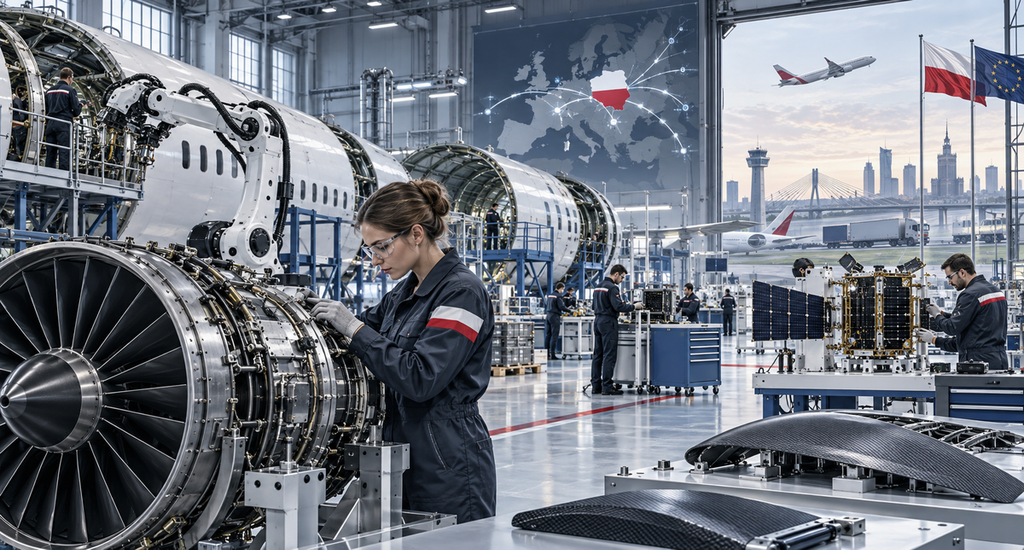
Poland’s aerospace and defense industries rest on a foundation of engineering excellence, technological adaptability, and international cooperation. Over the past three decades, the country has transformed its Cold War-era industrial complex into a modern, export-oriented ecosystem integrated with NATO and EU supply chains.
From the Aviation Valley cluster near Rzeszów to helicopter assembly in Świdnik and Mielec, Poland’s industrial base combines advanced engineering, cost efficiency, and reliability. Today, it serves as both a key supplier to Western partners and an anchor for Europe’s evolving defense architecture.
As global supply chains reconfigure amid geopolitical tension and renewed emphasis on defense self-sufficiency, Poland’s aerospace and defense ecosystem offers foreign investors and strategic partners a combination of scale, technical depth, and political stability unmatched in Central and Eastern Europe.
Market Landscape
A Modern Industry with Deep Roots
Poland’s aviation and defense sectors trace their origins to the early 20th century, when state-owned enterprises began producing aircraft for domestic use. After the Cold War, a period of privatization, restructuring, and foreign investment redefined the industry’s trajectory. By the early 2000s, Polish manufacturers founded “Aviation Valley”, an industry cluster centered in Rzeszów that today comprises more than 100 aerospace firms, from global primes to precision component specialists.
Aviation Valley companies design and produce aircraft structures, fuselage sections, engine components, landing gear, avionics, and flight-control systems. The cluster’s success stems from close collaboration between business, academia, and government, with regional universities providing a steady supply of engineers and technicians.
Two flagship manufacturers, PZL Mielec (operated by Lockheed Martin) and PZL Świdnik (owned by Leonardo Helicopters), anchor Poland’s rotary-wing sector, producing Black Hawk, AW139, and AW149 helicopters for military and civilian markets. Together with firms such as WSK Rzeszów (Pratt & Whitney) and Avio Aero (GE Aerospace), these plants integrate Poland into global supply chains for aircraft engines and propulsion systems.
Rapid Growth in Defense Manufacturing
Poland’s defense spending has expanded dramatically. In 2024, the government committed over 3% of GDP, one of the highest rates in NATO, to national defense. This investment underpins programs for armored vehicles, air-defense systems, drones, precision munitions, and radar technology.
The Polish Armaments Group (PGZ), a state-owned conglomerate, leads domestic production of military systems including the Krab self-propelled howitzer, Borsuk infantry fighting vehicle, and Piorun MANPADS missile. Increasingly, these systems are being exported to allied nations in Europe, the Middle East, and Asia.
International primes, including Lockheed Martin, Northrop Grumman, Raytheon, MBDA, Saab, and Thales, have established joint ventures and offset partnerships with Polish firms to support Poland’s modernization program and integration into NATO standards.
Strategic Location and Infrastructure
Poland’s central position in Europe provides efficient logistics to both Western and Eastern markets. The country’s extensive road and rail freight network, complemented by access to seaports in Gdańsk, Gdynia, and Szczecin, enables global distribution of aerospace and defense components.
Foreign investors also benefit from Special Economic Zones (SEZs) and the Polish Investment Zone (PIZ) program, which offer corporate income tax exemptions, R&D grants, and support for workforce training. These incentives reduce operational costs and accelerate project launches.
Integration with NATO and EU Standards
Adherence to NATO interoperability standards ensures that products made in Poland are compatible with allied systems. Poland’s alignment with EU certification frameworks for aerospace manufacturing and export control further enhances trust among international partners.
The presence of major global primes, coupled with a robust domestic supplier base, makes Poland one of the few European countries capable of covering the entire aerospace and defense production value chain, from design to final assembly.
Opportunities and Challenges
Opportunities
- Diversification of Supply Chains International manufacturers can reduce risk and cost by relocating production or sourcing components from Poland. The country’s strong engineering tradition, combined with lower labor costs, provides a resilient alternative to Western European suppliers.
- Joint Ventures and Technology Partnerships Collaborative projects in aerospace systems, drones, space technologies, and cyber-defense are expanding. Foreign companies can leverage Polish expertise in precision engineering and electronics while sharing in R&D incentives.
- Defense Procurement and Offset Programs Poland’s procurement policy favors local participation and technology transfer. Multinationals involved in major defense contracts can meet offset obligations by partnering with Polish firms for component production or system integration.
- Space and Satellite Development Poland’s membership in the European Space Agency (ESA) has spurred new projects in satellite manufacturing, launch technologies, and earth-observation data services. This emerging domain provides opportunities for dual-use (civil–military) applications.
- Engineering and Maintenance Services Skilled Polish labor supports maintenance, repair, and overhaul (MRO) operations for aircraft engines, avionics, and composite structures. The sector’s reliability and cost efficiency attract clients from across Europe.
- Growing Export Markets As Poland expands its own defense production, exports are increasing, particularly to NATO allies and nations seeking mid-range equipment that balances performance and affordability.
Challenges
- Procurement Complexity Navigating Poland’s defense procurement process can be time-consuming. Understanding tender procedures, offset requirements, and security clearances is essential.
- Competition from Established EU Players Western European suppliers, particularly in France and Germany, maintain strong footholds in advanced aerospace and defense segments. Differentiation through cost, speed, or niche technology is key.
- Skills Development and Retention Demand for engineers and technicians is rising faster than supply. Continuous investment in training is required to sustain quality standards and innovation capacity.
- Technology Transfer Sensitivities In defense collaborations, technology sharing is often subject to export-control regulations and security restrictions. Structuring compliant, transparent partnerships is vital.
- Macroeconomic Factors Inflation, exchange-rate fluctuations, and global supply disruptions can influence production costs and delivery schedules. Strong local partnerships help mitigate these risks.
Partnering and Strategies
1. Identify the Right Partners and Regions
Poland’s aerospace and defense capabilities are geographically concentrated:
- Rzeszów (Aviation Valley): Aerospace design, jet engines, and precision machining.
- Mielec and Świdnik: Helicopter assembly and rotorcraft systems.
- Warsaw and Radom: Electronics, radar, and military R&D.
- Gdańsk and Gdynia: Naval technologies and logistics for export.
Foreign firms should begin by mapping potential collaborators in these clusters and visiting trade associations such as Aviation Valley Association and Polish Chamber of National Defense Manufacturers.
2. Structure Joint Ventures or R&D Partnerships
Joint ventures allow technology transfer while preserving control over IP and quality. Polish partners benefit from local funding and procurement eligibility, while foreign firms gain credibility and market access.
Collaborative R&D programs, co-funded by the National Centre for Research and Development (NCBR) or Horizon Europe, reduce costs and foster innovation in materials science, automation, and AI-enabled manufacturing.
3. Optimize Supply Chains and Logistics
Leverage Poland’s high-density road freight infrastructure, which handles 20% of all EU road transport, and its modern ports for global distribution. Co-locating production and assembly in inland logistics hubs (such as Bydgoszcz or Łódź) can shorten lead times.
4. Engage with Public Stakeholders
Participation in offset programs and public tenders often requires close collaboration with ministries and state-owned entities. Early engagement with the Ministry of National Defense, Polish Development Fund (PFR), and PGZ improves visibility and alignment with national priorities.
5. Invest in Talent and Training
Develop in-house training centers or sponsor vocational programs at local technical universities. Investing in workforce development enhances loyalty, skill retention, and compliance with offset or local-content requirements.
6. Embrace Dual-Use Innovation
Many aerospace technologies have civil and defense applications. Firms developing composites, avionics, or drone technologies can serve both commercial and military clients, diversifying revenue and accelerating innovation.
Example in Practice
An Italian aerospace supplier specializing in avionics partnered with a Polish firm in Aviation Valley to co-produce flight-control modules for next-generation helicopters. By setting up a joint R&D center and leveraging SEZ tax incentives, the partners reduced production costs by 25% and qualified for Polish defense tenders requiring domestic participation.
Within three years, the venture expanded to serve customers in Germany and the Middle East, illustrating how strategic collaboration with Polish manufacturers can unlock regional and global opportunities.
Strategic Outlook
Poland’s aerospace and defense ecosystem stands at a pivotal moment. With rising defense budgets, expanding export potential, and growing integration into global supply chains, the country offers one of Europe’s most compelling environments for industrial collaboration and investment.
Its blend of engineering talent, manufacturing competence, and geopolitical relevance ensures that Poland will play a critical role in shaping the next generation of European aerospace and defense innovation.
How Expand2Poland Can Help
Expand2Poland provides end-to-end advisory services for aerospace and defense companies entering or expanding in Poland.
We can help with:
- Supplier identification across the aerospace and defense value chain.
- Support with SEZ and Polish Investment Zone applications for tax and R&D incentives.
- Partnership facilitation with local manufacturers, research centers, and public entities.
With our strategic network, we help international primes and tier-one suppliers integrate seamlessly into Poland’s aerospace and defense ecosystem, enhancing competitiveness, lowering risk, and securing a durable European foothold.
The information provided in this article is for general informational and educational purposes only and does not constitute legal, financial, or tax advise.