
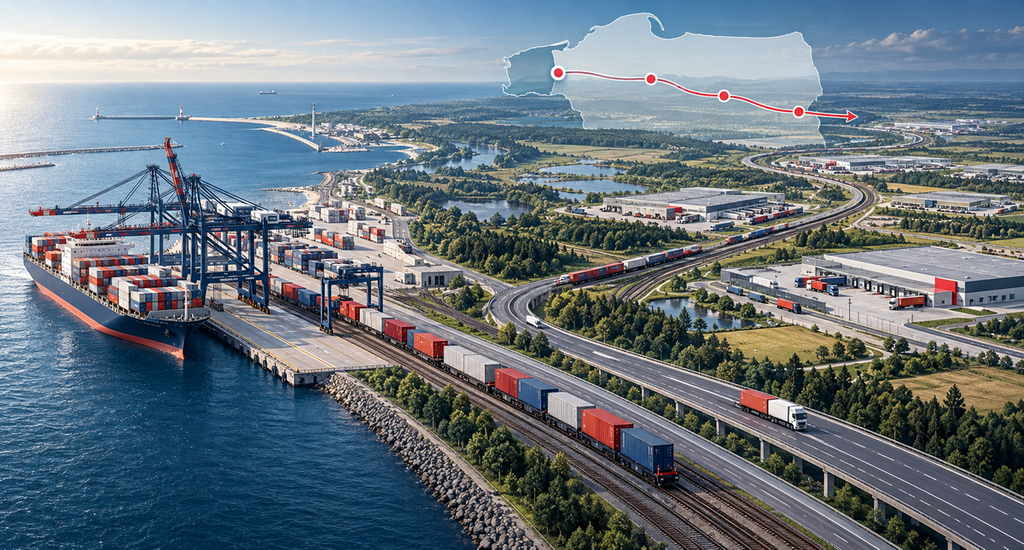
While Poland’s coastal ports, particularly Gdańsk and Gdynia, receive much of the spotlight as gateways to the Baltic Sea, a network of inland logistics hubs east of Gdańsk is quietly transforming how goods move across Central and Eastern Europe.
Cities such as Tczew, Bydgoszcz, Toruń, and Olsztyn have evolved into strategic distribution and transshipment nodes that connect maritime trade routes with overland corridors stretching toward Eastern Poland, the Baltics, and Ukraine. These hubs provide cost-effective alternatives to congested seaports and serve as critical links in Europe’s evolving multimodal logistics chain.
This article explores the development of Poland’s inland logistics infrastructure, highlights its strategic value for international supply chains, and offers guidance on how companies can integrate these hubs into their regional logistics and expansion strategies.
Market Landscape
A Network Built on Connectivity
The corridor east of Gdańsk has seen significant infrastructure investment over the past decade. Supported by EU structural funds and Poland’s national logistics development strategy, new warehouses, container terminals, and intermodal yards have been built to handle growing freight volumes.
Two cities, Bydgoszcz and Toruń, stand at the heart of this transformation. Situated along key rail lines linking Gdańsk with Warsaw and Silesia, they offer natural access points for goods entering from the Baltic coast and heading toward Poland’s industrial south. Bydgoszcz’s Emilianowo terminal and Toruń’s expanding logistics parks are now recognized as Tier II distribution zones, complementing the Tier I coastal ports.
Meanwhile, Tczew, located just 35 kilometers south of Gdańsk, functions as a rail interchange and container-handling hub that alleviates congestion at the Tricity ports. Its proximity to the A1 motorway and modern rail sidings allows for rapid transfer between sea and inland transport modes.
To the northeast, Olsztyn has become a staging area for deliveries to the Warmian-Masurian region, the Baltics, and Ukraine. The area’s intermodal capacity and land availability make it attractive for e-commerce and light assembly operations.
Infrastructure and Government Support
These hubs are linked by robust road and rail infrastructure. The S7 expressway and A1 motorway provide rapid north–south and east–west connections, while the Vistula River corridor supports barge transport for bulk goods.
The Polish government’s Investment Zone program, which replaced the former Special Economic Zones (SEZs), extends tax exemptions and grants to new investors establishing logistics and production facilities in designated regions. For example, inland hubs in Kuyavian-Pomeranian and Warmian-Masurian Voivodeships offer property tax relief, job creation incentives, and investment allowances.
These advantages position inland locations as cost-efficient extensions of port-based logistics, particularly as Gdańsk and Gdynia experience increasing throughput pressure.
Alleviating Port Congestion and Strengthening Resilience
Gdańsk’s DCT terminal, now among Europe’s top container ports, has approached capacity limits. Inland hubs provide a relief valve, enabling containers to be transshipped inland for sorting, storage, and regional distribution. This decentralization reduces dwell times, enhances supply chain flexibility, and mitigates the risk of disruption caused by port congestion or weather-related delays.
Additionally, the development of dry ports, inland facilities linked by dedicated rail lines to coastal terminals, supports efficient customs pre-clearance and multimodal flows. This mirrors successful models in Germany and the Netherlands, where inland logistics nodes complement major ports like Hamburg and Rotterdam.
Opportunities and Challenges
Key Opportunities
- Strategic Inventory Positioning Companies can reposition inventory closer to final markets by using inland hubs as regional distribution points. For e-commerce players, this reduces delivery times to customers in Warsaw, Lublin, or Vilnius.
- Value-Added Services and Nearshoring Inland hubs enable light manufacturing, final assembly, and packaging, activities that add value while benefiting from lower labor and facility costs than at port locations.
- Access to Eastern Markets Bydgoszcz and Olsztyn are ideally placed for shipments to the Baltics, Ukraine, and Belarus. Despite geopolitical challenges, Poland’s position as a gateway to Eastern Europe remains strategically important for multinational firms serving regional customers.
- Tax Incentives and Lower Costs Locations within the Polish Investment Zone benefit from income tax exemptions for qualifying investments. Combined with cheaper land prices and lower wages than in coastal cities, this offers a compelling cost advantage.
- Sustainability and Green Logistics Inland hubs facilitate modal shifts from road to rail or river, reducing carbon emissions and helping companies meet ESG objectives. Several new facilities integrate solar roofs, electric vehicle charging, and smart energy systems.
- E-Commerce and Retail Expansion Poland’s e-commerce market, now exceeding €17 billion annually, drives demand for regional fulfillment centers. Inland hubs with large land parcels can accommodate automated warehouses and last-mile distribution centers serving both Polish and cross-border consumers.
Challenges
- Infrastructure Maturity Some hubs, particularly in smaller cities, still require upgrades in warehousing standards, automation, and digital integration to match Western European benchmarks.
- Labor Availability While Poland’s overall workforce exceeds 15 million, local labor pools vary. Certain regions face shortages in logistics managers and equipment operators. Companies must invest in training or offer relocation incentives.
- Coordination Between Stakeholders Developing an efficient inland logistics ecosystem requires alignment among municipalities, rail operators, developers, and private investors, a challenge given diverse interests and regulatory layers.
- Capital Expenditure Building modern facilities. especially those equipped for automation and temperature control, requires significant upfront investment. ROI depends on long-term volume stability.
- Competition from Established Hubs Central Poland (Łódź, Stryków) remains dominant in national logistics. Newer hubs must differentiate through niche services such as multimodal flexibility, sustainability, or proximity to specific corridors.
Partnering and Strategies
1. Evaluate Network Design and Trade Flows
Start by conducting a supply chain network assessment to determine whether inland hubs can reduce costs, delivery times, or environmental impact. Identify which products or SKUs would benefit most from decentralized storage.
Leverage data analytics and digital twins to simulate inventory positioning scenarios. Compare total landed costs between maintaining port-based warehouses and relocating to inland hubs such as Bydgoszcz or Tczew.
2. Engage Early with Key Stakeholders
Collaborate with port authorities, rail freight operators, and logistics park developers to explore available infrastructure, capacity, and incentives. Many inland developers now offer turnkey build-to-suit facilities with flexible lease terms.
Engaging with municipal governments can also reveal co-financing opportunities for utilities, road access, or training programs.
3. Optimize Multimodal Operations
Integrate rail, road, and inland waterway solutions to diversify transportation risk. For example, containers arriving in Gdańsk can be moved by rail to Toruń for sorting, then distributed by truck to Warsaw or Lublin.
Implement digital tracking and IoT-enabled monitoring to enhance real-time visibility across transport modes.
4. Leverage Incentive Programs
Utilize the Polish Investment Zone (PIZ) framework to access corporate tax exemptions for logistics and manufacturing activities. Incentives are based on investment size, location, and job creation metrics.
Work with advisory partners to ensure eligibility documentation, regional authority applications, and environmental assessments are handled efficiently.
5. Build Local Partnerships
Identify reliable 3PLs (third-party logistics providers) and customs brokers who understand local regulations and border procedures. Partnering with established Polish firms accelerates market entry and risk management.
Encourage collaborative relationships with regional universities and vocational schools to secure a future labor pipeline for logistics operations.
6. Incorporate Sustainability and Technology
New logistics parks increasingly feature automated systems, robotics, and renewable energy integration. Companies should prioritize facilities that align with sustainability goals and EU carbon reduction initiatives.
Using data-driven warehouse management systems (WMS) improves throughput efficiency while enabling predictive maintenance.
7. Engage in Public–Private Cooperation
Multinational tenants who engage constructively with local governments, through business councils or regional development agencies, can influence future infrastructure planning (e.g., road improvements, intermodal terminal expansion). This proactive stance ensures long-term logistical competitiveness.
Example in Practice
A European automotive supplier previously handled all imports through Gdańsk and shipped directly to factories in southern Poland. After partnering with a logistics developer in Bydgoszcz, the company established an inland distribution center with rail connectivity and SEZ incentives.
The result:
- A 12% reduction in transportation costs.
- 30% faster turnaround times between port discharge and factory delivery.
- Improved resilience during port congestion periods.
This hybrid model, combining port operations with inland distribution, has since become a blueprint for other regional suppliers.
Strategic Outlook
Poland’s inland logistics hubs east of Gdańsk represent a new frontier for supply chain optimization. As trade volumes grow and sustainability imperatives intensify, decentralized networks anchored by inland hubs will redefine how goods flow through Central and Eastern Europe.
For companies seeking efficiency, resilience, and cost savings, these hubs offer a powerful combination of connectivity, affordability, and scalability. Early movers that secure land, partnerships, and incentives today will hold a strategic advantage in tomorrow’s competitive landscape.
How Expand2Poland Can Help
Expand2Poland supports companies in identifying, evaluating, and establishing operations within Poland’s emerging logistics ecosystem.
We can help with:
- Feasibility studies and network modelling to assess the ROI of inland hubs.
- Introductions to logistics park developers and regional authorities.
- Assistance in securing Polish Investment Zone incentives and permits.
- End-to-end project coordination, from location scouting to contract negotiation.
By combining local expertise with international standards, we help you design logistics strategies that enhance resilience, reduce costs, and future-proof your European operations.
The information provided in this article is for general informational and educational purposes only and does not constitute legal, financial, or tax advise.