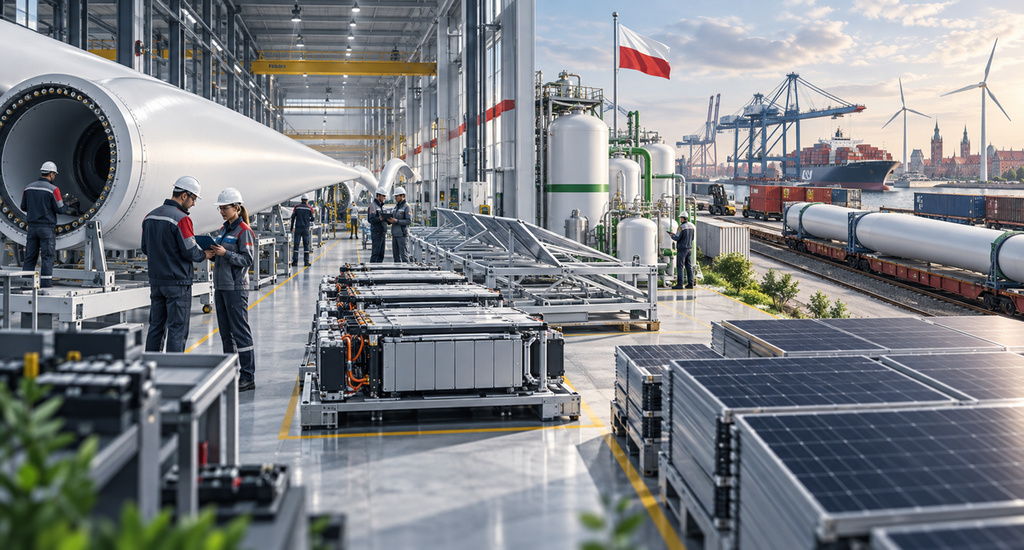
The global shift toward renewable energy has triggered one of the largest industrial transformations in modern history. As countries race to decarbonize, the demand for solar panels, wind turbines, battery systems, hydrogen technologies, and supporting digital infrastructure continues to surge. Manufacturing capacity has become a key strategic priority, with governments and companies seeking reliable, cost-competitive locations for production.
Poland is rapidly positioning itself as one of Europe’s rising hubs for clean-energy manufacturing. Building on decades of industrial know-how and strong engineering talent, the country is attracting foreign investors, expanding local supply chains, and deploying renewable energy domestically at scale. While Poland faces competition from global manufacturers and ongoing supply-chain constraints, its geographic location, workforce quality, and integration into the EU market make it an increasingly important anchor in the renewable-technology value chain.
This expanded analysis explores Poland’s current manufacturing ecosystem, future opportunities, operational challenges, and strategic considerations for global companies seeking to enter or expand within the region.
Market Landscape
Poland’s industrial base was historically rooted in heavy industry, metallurgy, machinery, and automotive manufacturing. These sectors now serve as a foundation for modern renewable-energy production, supported by a rapidly evolving network of specialized suppliers and research institutions.
A Fast-Developing Renewable Component Ecosystem
Across Poland, manufacturers are already producing a variety of renewable-energy components, including:
- Photovoltaic (PV) modules and mounting systems, supplied by a mix of local producers and foreign-owned factories.
- Power inverters and smart grid electronics, designed by domestic electronics companies and multinational R&D centers.
- Wind turbine towers, blades, nacelles, and foundations, leveraging Poland’s steel production and fabrication capabilities.
- Hydrogen system components, such as tanks, valves, and electrolysis system elements.
- Battery casings, wiring systems, and energy-storage enclosures, supporting Europe’s growing demand for grid-scale storage.
Companies such as LM Wind Power (GE), Vestas, and Siemens Gamesa maintain operations in Poland, alongside a fast-rising group of Polish firms developing advanced power electronics, automation systems, and grid technologies.
Rapid Domestic Expansion of Renewables
Poland’s own energy transition is accelerating. The country has become one of Europe’s most dynamic solar markets, adding gigawatts of photovoltaic capacity annually. Wind power, especially offshore wind, is slated for massive expansion, supported by:
- Government auctions and long-term support mechanisms
- Grid upgrades and interconnection improvements
- Strong collaboration with Baltic Sea neighbors
The planned rollout of nuclear energy adds further incentives for technology manufacturers to establish local production.
Drivers of Investment
Several structural advantages make Poland attractive for renewable-energy production:
- Cost-competitive skilled labor across engineering, manufacturing, and technical trades.
- Deep integration with EU industrial supply chains, especially Germany and Scandinavia.
- EU funding and state-aid mechanisms that support green manufacturing.
- Modern logistics infrastructure, including ports, roads, and rail corridors.
- Rising domestic demand, creating opportunities for local sourcing and long-term contracts.
However, the ecosystem remains partly dependent on imported raw materials, especially rare earths, semiconductors, and lithium, creating vulnerability to global price swings and supply disruptions. Competition from Asian producers also poses ongoing pressure on margins and speed to market.
Opportunities and Challenges
Poland offers significant openings for foreign and domestic investors, but capitalizing on them requires navigating both advantages and constraints.
Investment and Partnership Opportunities
There are several compelling pathways for entering Poland’s renewable-technology ecosystem:
Manufacturing Expansion: Investors can build new factories for PV modules, inverters, wind-tower components, or energy-storage assemblies. Poland’s industrial zones provide both infrastructure and generous incentives for capital-intensive projects.
Joint Ventures and Supplier Partnerships: Global firms increasingly partner with Polish suppliers to co-develop components or assemble systems locally to meet EU supply-chain localization requirements.
R&D Collaborations: Polish universities, technical institutes and R&D centers have strong capabilities in power electronics, materials science, automation, and hydrogen technologies. Joint research projects can accelerate innovation and reduce development costs.
Export Opportunities: With proximity to Germany, the Nordics, and other EU markets, Poland is a strategic export base for companies supplying onshore/offshore wind, solar, or battery storage projects across Europe.
Key Challenges to Manage
While the environment is favorable, several challenges require careful preparation:
Supply-chain dependencies: Manufacturers still rely heavily on imports for semiconductors, rare earth elements, and advanced battery materials.
Competition from Asia and Western Europe: Producers must differentiate through quality, speed, customization, and integration with EU sustainability standards.
Regulatory complexity: Renewable-energy regulations, particularly around grid connections, hydrogen standards, and offshore wind, are evolving, requiring active monitoring.
Workforce availability: Although Poland offers strong talent, high-skill labor shortages in engineering, automation, and energy systems are emerging in major industrial clusters.
Infrastructure capacity constraints: Rapid growth in renewable deployment can create bottlenecks in energy infrastructure, grid connection timelines, and permitting.
Companies entering the market must therefore blend strong operational planning with long-term strategic foresight.
Partnering with Polish Manufacturers
Successful market entry hinges on building strong relationships across Poland’s manufacturing ecosystem. Global companies should adopt a structured approach that includes:
Choosing the Right Location
Poland’s Polish Investment Zone can provide conditional income-tax relief for eligible investments, while legacy special-economic-zone permits form a separate system. Tax support does not itself waive planning, construction or environmental permits. Industrial clusters such as:
- Śląsk (Silesia) for heavy industry and automotive supply chains.
- Pomorskie (Pomerania) for offshore wind and port logistics.
- Wielkopolska for machinery and component manufacturing.
Aligning with Local Renewable-Energy Projects
Work with Polish utilities, project developers, and grid operators to forecast demand for components across:
- Solar farms.
- Onshore and offshore wind.
- Hydrogen pilot projects.
- Industrial decarbonization efforts.
Aligning production schedules with future capacity auctions can secure long-term contracts and ensure predictable demand.
Leveraging Poland’s Logistics Network
Poland’s central location allows efficient export to:
- Germany, Czechia, Austria, and Switzerland.
- The Nordics via Baltic Sea ports.
- Southeastern Europe and the Balkans.
- Western Europe through high-capacity road and rail links.
For manufacturers supplying heavy turbine components or battery systems, proximity to deep-water ports like Gdańsk and Gdynia is particularly advantageous.
How Expand2Poland Can Help
Expand2Poland supports renewable-energy manufacturers, investors, and project developers across every stage of entering or expanding in the Polish market. Our partner network can assist with:
- Incentive and grant applications for green manufacturing investments
- Partner matchmaking with suppliers, universities, and R&D institutes
- Regulatory navigation, including renewable-energy permitting and compliance
- Supply-chain mapping to identify local sourcing and reduce import risk
- Project setup support, from company formation to recruitment and procurement
- Long-term operational advisory, ensuring scalability and cost optimization
By combining deep local knowledge with international business expertise, Expand2Poland helps renewable-energy companies establish a strong, resilient presence in one of Europe’s most promising manufacturing hubs.
The information provided in this article is for general informational and educational purposes only and does not constitute legal, financial, or tax advise.