
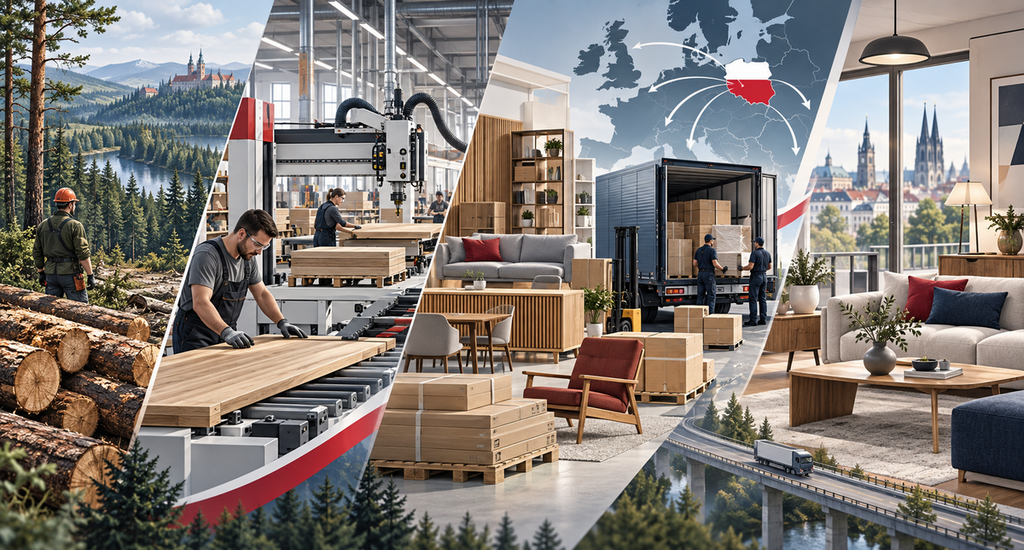
Poland’s furniture sector has one of those “hiding in plain sight” stories. You can walk through showrooms in Germany, Sweden, France, or the UK and unknowingly be surrounded by products made in Polish factories, sometimes under private labels, sometimes for iconic global retailers, and increasingly under Polish brand names.
That scale didn’t happen by accident. Poland combines a long woodworking tradition with modern mass production, strong logistics, and a supplier ecosystem that can move fast. It’s also a market where “value” doesn’t automatically mean “cheap.” Polish manufacturers compete on repeatable quality, reliable lead times, and the ability to build everything from flat-pack to premium upholstered pieces. Architectural Digest has described Poland as the world’s third-largest furniture exporter, with most production shipped abroad.
For international brands, importers, and investors, the opportunity isn’t just “buy furniture from Poland.” The real advantage comes from building the right kind of partnership, one that protects your margin, your IP, and your reputation while letting you scale.
Market landscape: a manufacturing powerhouse built for export
Poland’s furniture industry is export-oriented by design. Many factories have been structured for high-volume production runs for Western Europe, meaning predictable processes, standardized quality systems, and experience meeting demanding buyer requirements. The ecosystem includes:
- Large contract manufacturers producing for global retailers and major private-label distributors.
- Mid-size factories that can run custom collections with shorter decision cycles.
- Specialist workshops focused on materials (solid wood, upholstery, metal frames), finishes, or niche categories.
Poland’s Investment and Trade Agency has highlighted how the sector scaled quickly in the years leading up to the current decade, with exports moving into “large European supplier” territory and continuing to strengthen its role in EU supply chains.
Two realities shape the business model:
First, Poland’s advantage is execution. If you need consistent repeatability, dimensions, finish quality, packaging discipline, and compliance documentation, Poland is often easier than trying to coordinate a fragmented multi-country supplier network.
Second, the “easy win” is already taken. Basic commodity furniture is highly competitive. The better opportunities now sit in segments where you can differentiate with design, sustainability, modularity, and brand story.
Where the opportunity hides: not in “more product,” but in smarter positioning
If you’re entering the Polish furniture value chain, you’ll get better results by deciding what you want to be known for, not just what you can source.
1) Sustainable wood and credible traceability
Demand for sustainable furniture is global, but buyers increasingly want proof, not slogans. Manufacturers that can support certified sourcing and clear chain-of-custody documentation become stronger long-term partners (and safer for your brand). Even if your customer doesn’t ask for it today, your next customer, or your next retailer, might.
2) “Small space” design and modular living
European cities keep nudging consumers toward smaller apartments and flexible living. Modular shelving, storage-beds, sofa systems with replaceable covers, and furniture designed to be repaired or reconfigured create pricing power. Poland’s production capabilities fit this well: factories can combine standardized cores with customizable exteriors.
3) Premium-but-accessible upholstery
This is where Poland quietly wins. Upholstery requires process discipline: cutting, sewing, foam specs, frame stability, and fabric consistency. When executed well, it creates “premium feel” without luxury pricing. Poland’s mix of skilled labor and industrial quality systems can be a strong match.
4) Contract and hospitality furniture
Hotels, serviced apartments, student housing, and office fit-outs need durability and predictable delivery more than trendiness. If you can pair Polish manufacturing with a reliable project management layer (specs, timelines, installation coordination), you can build recurring B2B revenue.
The trade-offs: what usually goes wrong (and how to avoid it)
Furniture partnerships break for reasons such as misaligned expectations and missing controls. Here are the most common friction points, and the practical fix for each.
Quality drift after the first sample
A first sample can be perfect and still lead to a bad production run. The fix is to treat sampling as the start of documentation:
- Lock tolerances (not just “looks good”).
- Document approved materials and alternates.
- Require pre-production samples from the actual line.
- Define an inspection plan (first article, in-process, pre-shipment).
Hidden cost in packaging, damage rates, and returns
A great unit price means little if damage rates eat your margin. Furniture is brutal on logistics, corners crush, surfaces scratch, hardware gets lost. Your supplier relationship should include packaging engineering, drop testing expectations, and clear liability rules.
Lead time volatility from components
The bottleneck may not be the factory. It can be fabric availability, foam grades, metal fittings, drawer slides, or finishing chemicals. If you sell in multiple markets, you want dual-source options for key components and pre-approved alternates to prevent production stoppages.
IP and “near copies”
If you’re bringing unique designs, protect them. That doesn’t mean distrusting every factory, it means being professional: NDAs, clear ownership clauses, restricted sharing of drawings, and staged disclosure (a factory doesn’t need your full collection roadmap on day one).
A practical playbook: how to build a supplier relationship that scales
Here’s the structure that tends to work best for foreign companies.
Step 1: Choose your operating model
Most foreign buyers fall into one of four approaches:
- Private label sourcing (fastest route to revenue, most competitive on price).
- Co-development (you bring brand + market insight; partner brings engineering + execution).
- Contract manufacturing (you own designs and specifications; they manufacture to spec).
- Acquisition or equity investment (highest control; requires deeper local capability).
Your choice should match your risk tolerance and how differentiated your product really is.
Step 2: Qualify factories like you’d qualify a strategic vendor
Beyond price, evaluate:
- Category specialization (case goods vs upholstery vs mixed).
- Quality system maturity (repeatability, documentation discipline).
- Export experience (shipping standards, labeling, compliance habits).
- Financial stability (a factory under stress makes bad decisions).
- Communication speed and technical clarity.
Step 3: Build a “commercial backbone” early
Strong partnerships run on clear rules:
- Incoterms and who owns risk at each stage.
- Payment terms tied to milestones (sample approval, production start, pre-shipment inspection).
- Change control (how material substitutions are approved).
- Warranty and defect handling process.
- Service levels for rework, spare parts, and hardware replacement.
Step 4: Treat logistics as part of product design
Furniture winners engineer for shipping: flat-pack optimization, replaceable components, standardized hardware, and packaging that survives real handling. This is often where Poland’s operational maturity becomes a strategic advantage, if you explicitly make it part of the partnership.
How Expand2Poland can help
If you want to work with Polish manufacturers without wasting months on wrong fits or expensive missteps, Expand2Poland can support you with a structured, on-the-ground approach:
- Supplier discovery and vetting: identify factories that match your category, quality level, and capacity needs, then sanity-check them with operational due diligence.
- Commercial structuring: help shape contracts, pricing models, quality expectations, and change-control rules so scaling doesn’t break the relationship.
- Production readiness: set up sample-to-production workflows, inspection checkpoints, and packaging standards that reduce damage rates and returns.
- Market entry strategy: decide whether you should private-label, co-develop, or build a branded position, based on your margins, channels, and timeline.
- Local coordination: bridge language and cultural gaps during negotiations, technical discussions, and escalation moments, when speed and clarity matter most.
The information provided in this article is for general informational and educational purposes only and does not constitute legal, financial, or tax advise.