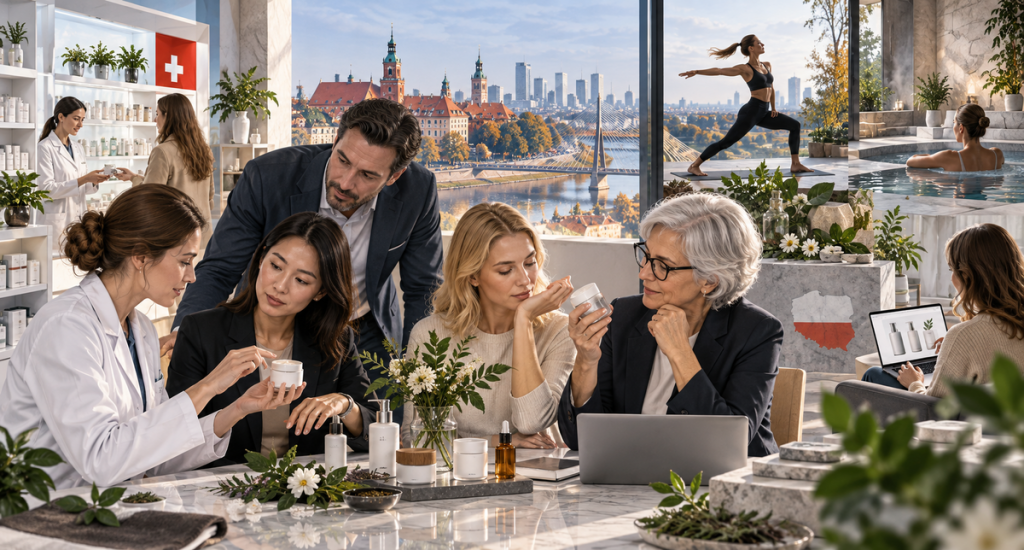
Poland’s beauty and wellness sector sits at the intersection of heritage, health-conscious consumption, and modern retail innovation. It is a market shaped not only by rising disposable income and digital commerce, but also by deeper cultural habits around personal care, aesthetics, pharmacy-led trust, and restorative wellness. For foreign brands, investors, and operators, that combination creates a compelling opportunity. Poland offers scale, a sophisticated consumer base, and a strategic position within the European Union, but it also rewards businesses that understand how beauty and wellness are perceived locally.
The cosmetics market alone is significant. U.S. government market guidance describes Poland as one of the largest cosmetics markets in Central Europe, valued at about $5.48 billion in 2023 and expected to reach $5.72 billion in 2024. That scale matters because it signals more than consumer appetite. It reflects a market with established distribution, growing premium demand, and enough depth to support both mass and specialized positioning. At the same time, Poland’s wellness economy extends beyond products. Spa traditions, health resort treatment, aesthetic medicine, and holistic self-care all contribute to a broader ecosystem that blends commercial beauty with therapeutic wellness.
For companies considering entry, the key issue is not whether demand exists. It does. The more important question is how to position a brand or service in a market where effectiveness, safety, and credibility matter at least as much as trend appeal. Poland’s beauty and wellness sector is dynamic, but it is not superficial. Buyers are increasingly interested in ingredients, product integrity, visible results, sustainability, and professional endorsement. That makes market entry promising, but also more exacting.
Market Landscape
Poland’s beauty market has broadened substantially over the last decade. Growth has been sustained by rising consumer spending, interest in higher-quality products, and strong momentum in premium, natural, vegan, and eco-conscious cosmetics. Trade.gov specifically notes growing demand in Poland for premium and natural cosmetics, alongside increasing consumer preference for vegan products and environmentally conscious packaging. That indicates a market where consumers are not only buying more beauty products, but are also becoming more selective about formulation, ethics, and brand values.
Wellness, meanwhile, remains deeply rooted in Polish culture. Poland has a long-standing health resort tradition supported by official spa towns and treatment facilities. Government-linked reporting notes 46 officially registered health resorts in Poland, while Statistics Poland reported 263 health resort facilities operating at the end of 2024, serving 884.2 thousand patients during the year. Those figures show that wellness in Poland is not limited to luxury consumption. It also has an institutional, medical, and tourism dimension that gives the broader sector unusual depth. For beauty and wellness brands, that creates commercial opportunities around therapeutic positioning, longevity, recovery, and evidence-based self-care.
The retail environment is also evolving quickly. Beauty buying in Poland increasingly spans physical retail, online channels, and content-driven discovery. Consumers research online, compare products across channels, and respond strongly to educational, review-based, and influencer-supported purchasing journeys. That favors brands that can communicate clearly and consistently across distribution formats. It also means digital presence alone is not enough. The strongest brands usually combine product quality, localized communication, and channel discipline with a value proposition that feels trustworthy and relevant in the Polish context.
Opportunities and Challenges
Natural, Clean, and Botanical Positioning
One of the clearest growth opportunities is in natural and clean beauty. Polish consumers are showing increasing interest in vegan, cruelty-free, and eco-conscious products, according to Trade.gov. That makes room for brands built around botanical ingredients, transparent formulations, and sustainability narratives. However, clean beauty is no longer a novelty positioning. It is becoming mainstream enough that weak claims or vague messaging will not be persuasive. Brands need substance behind the story, including ingredients, compliance, and clear performance benefits.
Cosmeceuticals and Performance-Led Beauty
Poland is a strong market for products positioned around efficacy and safety. Consumers often look for results, not just image. That creates favorable conditions for cosmeceuticals, dermocosmetics, and beauty products that borrow credibility from science, pharmacy, or clinical care. The opportunity is especially strong for companies that can connect beauty outcomes with skin health, barrier support, sensitive-skin needs, or age-related concerns. The challenge is that this part of the market requires careful claims management, strong product substantiation, and disciplined marketing language. Products may sell on aspiration, but they are often retained on proof.
Men’s Grooming and Expanding User Segments
Men’s grooming also presents meaningful upside. As the market matures, more male consumers are seeking specialized skincare, beard care, hair care, and service-led grooming experiences. This does not necessarily mean building entirely separate product universes. In many cases, the better opportunity lies in solving practical needs with credible branding and simple routines. As in other segments, Polish consumers tend to respond well when a brand feels effective and authentic rather than over-marketed.
Wellness Tourism and Service-Based Expansion
Poland’s spa and wellness infrastructure creates openings that go beyond packaged consumer goods. Health resorts, medical wellness, recovery-oriented hospitality, and urban holistic services all have room to grow. The health resort system is already sizable, with hundreds of operating facilities and substantial patient volume. That supports demand for complementary offerings such as premium skincare, treatment-linked cosmetics, wellness supplements, and service partnerships that connect hospitality, health, and personal care. The challenge is that service models often require stronger local partnerships and a clearer understanding of licensing, operator structure, and customer expectations.
Regulation and Market Credibility
Regulation is a commercial issue in this sector, not merely a legal one. Under EU rules, only cosmetic products with a designated EU-based responsible person can be placed on the market, and products must be notified through the Cosmetic Products Notification Portal, or CPNP. Once notified through CPNP, no additional national notification is required within the EU. For foreign entrants, this is important because Poland is not a standalone regulatory market. It operates inside the EU cosmetics framework, which can simplify expansion but requires disciplined product documentation, labeling, and safety compliance from the start.
Strategies and Partnerships
Brands entering Poland’s beauty and wellness market should start with positioning clarity. The strongest entries are usually built around one of three models: premium efficacy, natural and ethical beauty, or professionally validated wellness. Trying to combine all three without a clear hierarchy can weaken the offer.
Localization is essential. Packaging, claims language, instructions, and digital content should be professionally adapted for Polish consumers, not merely translated. The market tends to reward brands that communicate clearly, explain product benefits concretely, and build trust through consistency. In beauty and wellness, storytelling matters, but unsupported storytelling can quickly undermine credibility.
Partnerships also play a central role. Depending on the business model, relevant partners may include distributors, e-commerce specialists, pharmacies, wellness operators, dermatology-linked professionals, spa facilities, or local content creators. In many cases, the right Polish partner can accelerate market learning more effectively than a broad but unstructured launch.
Finally, sustainability should be approached as an operating principle rather than a marketing add-on. Consumer interest in recyclable, biodegradable, and lower-impact packaging is rising, and brands that integrate sustainability into product design, packaging, and refill logic are likely to be better aligned with where the market is heading.
How Expand2Poland Can Help
Expand2Poland helps beauty and wellness brands enter Poland with a market strategy grounded in consumer behavior, regulatory reality, and local commercial execution.
We support clients with:
- Market and category analysis
- Entry strategy and localization planning
- Guidance on EU compliance and product launch readiness
- Introductions to distribution, retail, and wellness partners
- Support with brand positioning and Polish-market messaging
For cosmetics, wellness, and personal care companies looking to grow in Poland, Expand2Poland helps turn market potential into a credible, locally adapted expansion strategy.
The information provided in this article is for general informational and educational purposes only and does not constitute legal, financial, or tax advise.