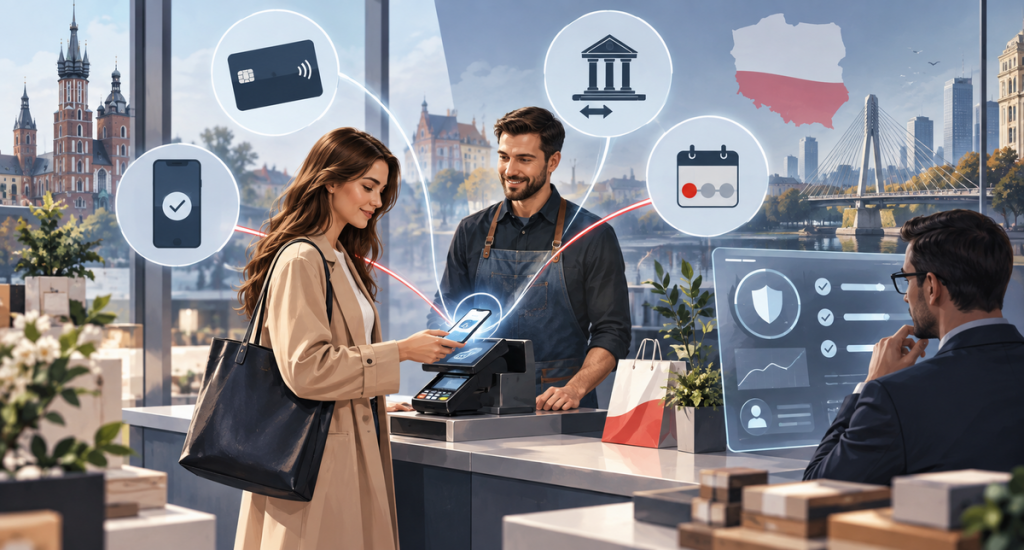
Poland’s financial services market has moved quickly from traditional banking toward a more mobile, platform-driven payments environment. Consumers who once relied primarily on bank branches, cards, and standard bank transfers now expect payments to be instant, embedded, mobile-first, and easy to complete at the point of purchase. For retailers, service providers, e-commerce platforms, and fintech companies, the payment experience is no longer a back-office function. It has become part of customer acquisition, conversion, loyalty, and trust.
Poland is a particularly interesting market because its banking sector combines two traits that do not always appear together. On the one hand, Polish banks have historically been risk-conscious and strongly regulated. On the other hand, they have become highly innovative in digital channels, especially mobile banking, instant transfers, and account-linked payments. The success of BLIK illustrates this shift clearly. The Polish mobile payment system is embedded into banking apps, supports online and in-store payments, ATM withdrawals, and instant transfers, and reportedly processed 2.4 billion transactions worth around PLN 350 billion in 2024.
Buy-now-pay-later, digital wallets, QR payments, and embedded finance sit within this broader transformation. For younger consumers and online shoppers, payments are becoming less visible as a separate step and more integrated into the shopping journey. For merchants, the question is no longer whether to accept digital payments. The more strategic question is which payment mix improves conversion while protecting margins, reducing fraud, supporting compliance, and preserving customer trust.
Market Landscape
Poland’s payments landscape is shaped by high digital adoption, strong bank participation, and a consumer base that has become comfortable with mobile financial tools. BLIK’s rise is especially important because it is not a foreign wallet layered on top of the local banking system. It is a domestic payment infrastructure built into the mobile banking environment, which helps explain why it has become so deeply embedded in Polish e-commerce and peer-to-peer payments.
The broader European regulatory environment is also pushing the market toward faster and safer account-based payments. The EU adopted new rules in 2024 to make euro instant payments available around the clock, with transfers completed within 10 seconds, and the regulation also takes account of non-eurozone member states. Poland does not use the euro domestically, but EU payment reforms still influence the competitive direction of banks, fintechs, and cross-border payment providers operating in the Polish market.
Digital wallets and embedded payment tools are gaining strength in both online and physical commerce. Card payments, mobile payments, and account-based payment methods now compete not only on cost, but also on speed, user experience, fraud protection, settlement timing, and integration with loyalty systems. For retailers, the checkout page is becoming a commercial decision point. A poorly designed payment flow can reduce conversion. A payment mix that matches Polish customer habits can improve completion rates and repeat purchasing.
BNPL is the more complicated part of the fintech story. Deferred payment and installment solutions can increase affordability and reduce checkout friction, especially for fashion, electronics, household goods, furniture, travel, and higher-ticket e-commerce purchases. Providers such as PayPo, Allegro Pay, Klarna, and bank-linked installment products have helped normalize the idea that payment timing can be part of the customer proposition. Yet BNPL is not simply a convenience feature. It is a credit product or credit-like product, and regulators across Europe are paying closer attention to affordability, transparency, consumer understanding, and debt accumulation.
The direction of travel is clear. In the UK, BNPL regulation is being brought under the Financial Conduct Authority from 2026, with affordability checks, clearer disclosures, financial difficulty support, and access to the Financial Ombudsman Service. Although the UK is outside the EU, its reforms reflect a wider European concern: BNPL can be useful when responsibly designed, but risky when customers stack multiple small debts without understanding their total exposure.
For Poland, this creates a market with strong commercial upside and rising compliance expectations. Payment innovation will continue, but merchants and fintech providers will need to balance convenience with responsible design.
Opportunities and Challenges
- Digital payments can improve conversion and customer retention. Polish consumers are already accustomed to fast mobile payment experiences, especially through bank-linked systems such as BLIK. Retailers that offer familiar, low-friction payment methods are better positioned to reduce checkout abandonment and build repeat purchasing behavior.
- BNPL can expand purchasing power, but it must be handled carefully. Deferred payment tools can help merchants sell higher-value products and attract younger online shoppers. The risk is overextension. If BNPL is promoted too aggressively, consumers may take on obligations they do not fully understand, which can create reputational and regulatory exposure for both fintech providers and merchants.
- Payment choice should be tied to customer segment, not added blindly. A fashion e-commerce brand, a furniture seller, a subscription service, a B2B platform, and a grocery delivery app may all need different payment flows. More payment options are not always better if they clutter the checkout, increase fees, or confuse the buyer.
- Loyalty and payments are starting to merge. Payment methods can be connected to rewards, cashback, personalized offers, installment eligibility, and customer analytics. This can increase engagement, but it also raises questions around data privacy, consent, profiling, and responsible targeting.
- Fraud prevention and cybersecurity are becoming central to payment strategy. The more payments move into mobile apps, instant transfers, embedded checkout, and digital wallets, the more important fraud controls become. EU payment reforms are increasingly focused on fraud prevention, strong authentication, payee verification, and consumer protection.
- Cross-border interoperability will influence scale. Poland-based merchants selling across the EU need payment systems that work beyond the domestic market. BLIK is powerful in Poland, but cross-border sales may still require cards, wallets, bank transfer methods, local market payment options, and compliant VAT treatment.
Strategies and Partnerships
Businesses operating in Poland should treat payments as part of commercial strategy, not merely a technical integration. The right payment mix can improve conversion, reduce friction, and strengthen customer trust. The wrong mix can create unnecessary cost, compliance risk, or operational complexity.
The first step is to understand customer behavior by channel. Mobile shoppers may prefer different payment methods than desktop buyers. Younger consumers may be more open to BNPL or wallet-based payments. Older consumers may still prefer cards, bank transfers, or familiar bank-linked options. B2B customers may prioritize invoices, bank transfers, or account terms over consumer-style wallets.
A practical payments strategy should include:
- Integrating trusted local payment methods. In Poland, this generally means treating BLIK as a core option for e-commerce and mobile checkout, while still supporting cards, transfers, wallets, and other methods depending on customer segment.
- Selecting BNPL partners carefully. Merchants should work with providers that apply responsible affordability checks, transparent terms, clear repayment communication, and strong customer support. A BNPL partner is not just a checkout vendor; it becomes part of the customer experience.
- Designing checkout around speed and clarity. Payment flows should be mobile-optimized, simple, and transparent. Hidden fees, unclear repayment schedules, confusing redirects, or weak error handling can damage trust quickly.
- Building compliance into the model early. Consumer credit rules, AML obligations, data privacy, strong customer authentication, fraud monitoring, and customer-complaint handling should be considered before launch, not after scale.
- Using transaction data responsibly. Payment data can support segmentation, loyalty, inventory planning, and credit scoring. The commercial value is significant, but data use must be transparent, lawful, and proportionate under GDPR and financial-sector expectations.
- Preparing for EU-level payment reform. PSD3, the Payment Services Regulation, instant payment rules, and open banking reforms will continue shaping the European payments environment. Companies entering Poland should build systems flexible enough to adapt as requirements evolve.
Partnerships are central to execution. Retailers may need payment gateways, acquirers, BNPL providers, fraud-prevention platforms, loyalty technology, and customer-service support. Fintech startups may need licensed financial partners, banking-as-a-service providers, legal advisers, AML specialists, and local commercial channels. Foreign companies should be especially careful not to assume that a payment model successful in another European market will automatically work in Poland. Polish consumers have their own habits, and the dominance of local mobile payment behavior changes the competitive logic.
The strongest approach combines convenience with trust. Fast checkout can win a transaction. Transparent terms, reliable refunds, responsible lending, and responsive support are what bring the customer back.
How Expand2Poland Can Help
- Polish payments-market assessment
- Fintech and BNPL partner identification
- Payment-method localization for Polish consumers
- Coordination with legal, AML, and financial-regulatory advisers
- Go-to-market support for retailers, platforms, and fintech startups
Poland’s fintech market rewards companies that make payments simple, trusted, and commercially useful. Contact Expand2Poland to build a payments strategy that fits Polish consumer behavior while keeping compliance and long-term brand credibility at the center.
The information provided in this article is for general informational and educational purposes only and does not constitute legal, financial, or tax advise.