Poland’s urban story is becoming more complex than the familiar narrative of simple city growth. The country is not experiencing classic, across-the-board urban expansion in the way some emerging markets do. Official statistics show a declining total population, a falling urban share, and a rising median age. In 2024, Poland’s population stood at 37 million, urban residents accounted for 59% of the total, down from 62% in 1990, and the median age had risen to 43.
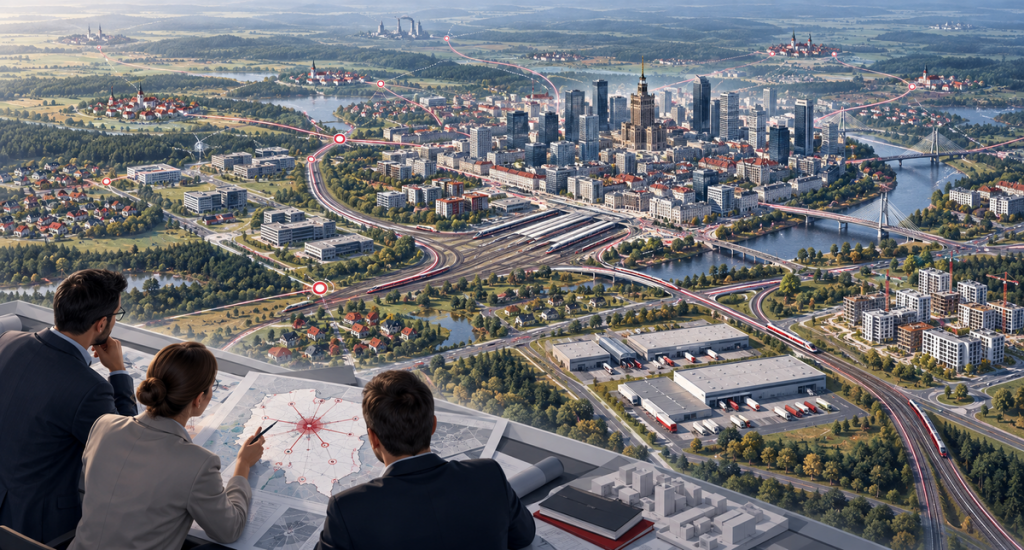
A better description is concentration rather than pure urbanization. Economic activity, investment, skilled labor, and modern service demand are clustering in major metropolitan areas and their commuting zones, while many smaller towns and rural areas face weaker demographic momentum and thinner labor pools. Statistics surrounding Poland’s functional urban area framework underscores this reality: cities increasingly operate together with surrounding commuting zones as integrated labor and business systems, not as isolated administrative units.
For investors and international operators, this distinction is important. The commercial opportunity in Poland remains strong, but it is becoming more spatially selective. Warsaw, the Tri-City area, Poznań, Kraków, Wrocław, and other leading urban centers continue to attract capital, office demand, logistics activity, and infrastructure upgrades. At the same time, the policy agenda is increasingly shaped by urban sprawl, congestion, degraded urban fabric, and the widening development gap between metropolitan and non-metropolitan Poland.
This changing geography affects far more than real estate. It influences where infrastructure spending is concentrated, where employers can recruit efficiently, which districts are likely to support mixed-use redevelopment, and where incentives outside the main hubs may create overlooked opportunities. Companies entering Poland should therefore think in terms of urban systems and regional trade-offs, not just city rankings.
Market Landscape
Poland’s largest cities remain the country’s primary engines of business concentration. The government’s National Urban Policy notes that roughly 60% of the population lives in cities, while around three-fourths of the country is affected directly by urban issues when surrounding urbanized areas and strong functional linkages are taken into account. The same policy framework identifies cities as the main hubs of science, public services, business networks, labor, and productivity growth.
Infrastructure investment continues to reinforce that urban role. European and Polish public programs are channeling large sums into urban mobility, transport modernization, and city-linked infrastructure. The European Commission approved around EUR 2 billion in urban transport funding for Poland under the FEnIKS 2021–2027 program, while the Centre for EU Transport Projects has continued to announce new urban transport agreements, including support for tram and interchange investments in cities such as Szczecin, Poznań, and Bytom.
The office and mixed-use markets reflect the same pattern. Poland’s largest office markets ended 2025 with nearly 13 million square meters of stock, while new supply remained unusually constrained. Demand has remained concentrated in better-located, modern assets, especially in central zones and major regional cities. In Warsaw, JLL reported a vacancy rate of 10.5% at the end of the first quarter of 2025, with central zones materially tighter than non-central locations. Cushman & Wakefield and Colliers both noted that office construction has slowed significantly while demand has held up, especially for higher-quality space.
Real estate development is also adapting. Colliers’ research on mixed-use projects points to rising importance for schemes that combine office, residential, retail, service, and sometimes heritage or post-industrial elements. In larger cities, these formats are becoming more relevant as land becomes scarcer, occupier needs diversify, and older sites are repositioned rather than treated as one-dimensional assets.
Outside the main metropolitan areas, the picture is different. Poland still offers investment support across the country through the Polish Investment Zone, and local development and rural-support mechanisms remain available through public programs and agencies. Yet these areas often require a more deliberate strategy because the economic logic is not driven by density alone. Labor availability, transport links, incentive intensity, and sector fit matter more.
Opportunities and Challenges
Urban transport modernization
Urban mobility is one of the clearest commercial openings. Poland is still investing heavily in tram systems, rolling stock, interchange nodes, and broader public transport upgrades under current EU-backed programs. This creates opportunities not only for construction firms and infrastructure financiers, but also for suppliers of signaling, electrification, passenger information systems, accessibility solutions, and digital mobility tools.
The challenge lies in execution complexity. Urban transport projects often sit at the intersection of municipal planning, public procurement, EU funding rules, and long delivery timelines. Commercial success depends as much on local coordination and delivery discipline as on technical capability.
Mixed-use and brownfield repositioning
Mixed-use development is becoming more central to urban strategy in Poland’s larger cities. Developers are responding to changing office use, rising expectations around amenity and placemaking, and the practical need to make better use of scarce urban land. Projects that repurpose historical or industrial buildings can be especially attractive where they align with transport access and neighborhood renewal.
The opportunity is real, but it is not automatic. Brownfield or legacy urban sites can carry planning, permitting, infrastructure, and remediation challenges. Investors who assume that every centrally located post-industrial parcel is a straightforward redevelopment play are likely to underestimate both timing risk and execution cost.
Flexible office and service-oriented buildings
Poland’s office market is no longer shaped by a simple expansion model. Limited new supply, stronger central demand, and a preference for higher-specification buildings are shifting the commercial logic toward quality, flexibility, and service. Older assets increasingly face pressure either to modernize or to evolve in use. The market signals are pointing less toward speculative volume and more toward selective repositioning.
For international companies, this favors targeted strategies. Flexible workspace, hospitality-inflected office services, and hybrid-compatible building concepts are more likely to succeed in the strongest urban districts than in weaker secondary locations with limited tenant depth.
Smart-city and public-service technology
Urban concentration also strengthens the case for digital service layers. Traffic management, public information systems, mobility integration, and broader city operations become more commercially relevant as metropolitan systems grow more complex. Poland’s public policy framework explicitly links urban development with mobility, resilience, environmental quality, and better management of city systems.
Adoption, however, tends to move more slowly than private-sector technology vendors often expect. Municipal procurement cycles, budget structures, and integration requirements can delay commercialization. Firms entering this space generally benefit from patience, local partnerships, and a clear understanding of how public buyers evaluate long-term value.
Rural depopulation and selective non-metropolitan opportunity
Rural depopulation is often framed only as a risk, and in many sectors it is one. It can weaken labor availability, shrink local consumer demand, and reduce the commercial viability of undifferentiated service models. Yet non-metropolitan Poland should not be dismissed. The Polish Investment Zone provides tax relief across the country, with materially different aid intensities by region, and public support remains available for local development and rural areas.
The better question is not whether to invest outside major cities, but under what conditions. Industrial projects, logistics operations, specialized manufacturing, and selected service activities can still work well where transport access is solid, labor can be sourced, and incentives materially improve the economics.
Strategies and Partnerships
International companies should begin with metropolitan mapping, not city branding. Administrative city limits often hide the real commercial footprint. Functional urban areas, commuting patterns, infrastructure corridors, and district-level demand matter more than broad assumptions about a city’s reputation.
A second priority is to link location decisions to asset strategy. In the strongest metros, the opportunity may lie in mixed-use redevelopment, premium office repositioning, or urban mobility-linked services. In regional or peri-urban areas, the better play may involve logistics, industry, back-office functions, or incentive-supported production investment. The same national market can justify very different models depending on place.
Partnerships with municipalities and local institutions can be decisive, especially in transport, regeneration, infrastructure, and service-heavy urban projects. Poland’s urban policy framework is built around local governments and functional urban areas, which means serious projects often depend on alignment with public planning priorities and implementation pathways.
Companies considering non-metropolitan locations should also evaluate incentive structures early. The Polish Investment Zone can materially alter project economics, but support levels vary by region, investor type, and activity. Regional aid intensity is lower in some of the strongest metropolitan areas and higher in parts of eastern and less-developed Poland, which can influence where expansion makes the most financial sense.
The broader strategic lesson is straightforward. Poland’s growth is becoming more spatially layered. Winning in this environment requires sharper location logic, stronger public-private navigation, and a willingness to distinguish between metropolitan demand, suburban spillover, and regional incentive plays.
How Expand2Poland Can Help
- Urban and metropolitan market-entry analysis
- District and location assessment for real estate and operating decisions
- Partner identification with municipalities, developers, and local stakeholders
- Guidance on Polish Investment Zone and regional incentive options
- Support in structuring urban, regional, and infrastructure-linked growth strategies
The information provided in this article is for general informational and educational purposes only and does not constitute legal, financial, or tax advise.