
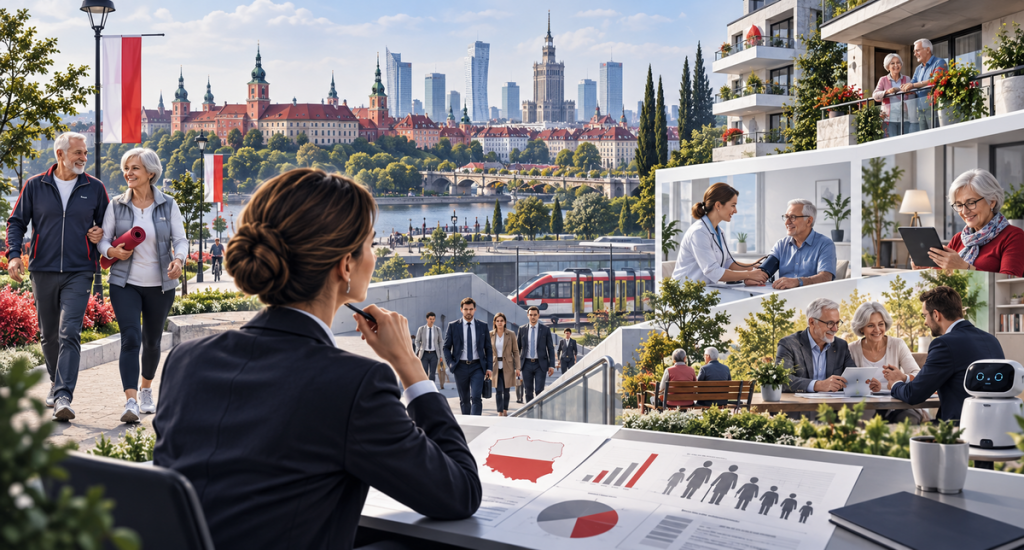
Poland’s demographic profile is moving into a new phase. Fertility rates have remained weak, life expectancy has lengthened over time, and the median age is rising. Taken together, these trends point to a market that will not disappear in importance, but will change in character. For companies planning long-term investments in Poland, that distinction matters. The question is no longer simply how large the market is, but rather what kind of market it is becoming.
That shift has implications far beyond social policy. Demographics shape labor supply, household spending patterns, urban development, healthcare demand, infrastructure planning, financial services, and the long-term economics of many sectors. In Poland, those pressures are becoming more visible. Major cities continue to attract capital and younger professionals, but many regions are experiencing a slower and older population profile, with practical consequences for employers, service providers, and investors.
For foreign companies, this should not be viewed only as a warning sign. Aging societies create pressure, but they also create new categories of demand. Businesses that understand how Poland’s demographic change will affect consumption, housing, care, work, and mobility can position themselves more intelligently than those still relying on a growth model built around abundant labor and youthful demand. The opportunity is real, but it is more structural, more regional, and more strategic than a simple headline about population aging might suggest.
Market Landscape
Over the past two decades, Poland’s population has remained broadly stable in headline terms, but stability at the national level can be misleading. Beneath that top-line figure, the internal composition of the country is changing. The share of older residents has grown, working-age cohorts are under greater pressure, and the balance between dynamic urban centers and weaker regional labor markets has become more pronounced.
Warsaw, Kraków, Wrocław, and other major cities continue to attract younger professionals, students, and higher-value employers. These urban centers benefit from stronger labor pools, more developed services, and better access to business networks. For many international firms, they remain the natural entry points into Poland. However, that concentration of talent also highlights a wider problem. Outside the leading cities, many areas face depopulation, labor shortages, and weaker demographic renewal. Emigration, lower birth rates, and uneven regional development have left some local markets more exposed than others.
Demographics affect demand differently across sectors. A younger urban consumer market may still support growth in certain technology, retail, and lifestyle categories. At the same time, an older national profile is increasing relevance for healthcare, assisted living, rehabilitation, preventive care, financial planning, accessible housing, and convenience-led services. Businesses that treat Poland as a single, uniform market may misread where demand is deepening and where operating conditions are becoming more difficult.
The government has introduced family benefits and other measures intended to support household formation and encourage higher birth rates. Those policies may matter at the margin, but it is not yet clear that they will reverse the broader demographic trajectory. Companies should be cautious about basing strategy on the assumption that the labor market will soon return to a more favorable age structure. In practice, many sectors will need to operate under conditions where labor remains tighter, age-related demand rises, and regional demographic divergence becomes more commercially important.
For investors, the lesson is straightforward. Poland remains a serious market with strong fundamentals, but long-term planning now requires closer attention to demographic composition, not just aggregate scale.
Opportunities and Challenges
Healthcare, Eldercare, and Preventive Services
One of the clearest growth areas lies in healthcare and age-related services. As the population ages, demand tends to rise not only for hospitals and clinics, but also for rehabilitation, diagnostics, home-based care, chronic disease support, mobility solutions, and preventive wellness. This creates space for both direct service providers and enabling businesses, including technology companies, medical equipment suppliers, care coordination platforms, and specialized insurers.
The challenge is that healthcare-related demand is rarely served well through a fragmented market approach. Success often depends on trust, continuity, regulatory discipline, and partnerships across the care ecosystem. Companies entering this space need to think less in terms of isolated products and more in terms of integrated service logic.
Age-Friendly Housing and Accessible Urban Living
As Poland’s population matures, housing requirements are likely to become more differentiated. Accessibility, proximity to healthcare, walkable neighborhoods, reliable transport, and adaptable interior design are becoming more commercially relevant. This creates opportunities for developers, property managers, home services companies, mobility providers, and businesses involved in smart-home or assisted-living solutions.
Yet the opportunity is not limited to senior housing in the narrow sense. A more strategic view is to design mainstream residential and urban services that remain usable across life stages. Age-friendly planning, when done well, does not isolate older consumers. It improves usability, resilience, and long-term asset relevance.
Leisure, Travel, and Lifestyle Consumption
Aging does not necessarily mean retreat from consumption. In many markets, older households continue to spend meaningfully on leisure, travel, wellness, culture, and convenience, especially where health, time availability, and household savings allow. In Poland, this can support growth in hospitality, domestic travel, educational leisure, fitness and wellness offerings, specialty retail, and curated service experiences aimed at mature consumers.
The commercial opportunity here is often misunderstood. Older consumers are not one segment with one preference set. Some are highly price-sensitive, others are quality-driven, and many respond strongly to reliability, comfort, clarity, and service. Companies that rely on stereotypes rather than actual segmentation are likely to miss the mark.
Workforce Pressure and the Automation Case
A shrinking working-age population raises one of the most important strategic questions for any operator in Poland: how labor-dependent is the business model? In sectors that rely heavily on routine staffing, demographic pressure can increase wage pressure, recruitment difficulty, turnover risk, and service instability. This is especially relevant in logistics, manufacturing, care services, construction, hospitality, and certain technical and administrative roles.
That challenge is likely to accelerate investment in automation, process redesign, and workforce upskilling. For many firms, automation in Poland is no longer only a productivity initiative. It is becoming a resilience strategy. Businesses that adapt early may protect margins and improve continuity, while those that continue to assume easy labor availability may find scaling increasingly difficult.
Financial Services for Aging Households
As the population structure changes, so do household financial needs. Retirement planning, long-term savings, insurance, wealth preservation, inheritance structuring, and products designed around later-life stability may all become more relevant. This creates room for banks, insurers, asset managers, and advisory firms that can serve aging households with credibility and simplicity.
The challenge is that this market requires trust-based positioning. Products aimed at older consumers need clarity, practicality, and a strong reputation. A complex or overly aggressive approach may perform poorly, even if the underlying demand is strong.
Strategies and Partnerships
International companies looking at Poland through a demographic lens should begin with regional analysis, not national averages. Population aging in Warsaw means one thing, population aging in a smaller regional city may mean something else entirely. Market entry decisions, workforce planning, and site selection should all be informed by local age structure, migration patterns, household composition, and sector-specific labor dynamics.
Partnering is especially important in markets shaped by demographic change. Businesses entering healthcare, eldercare, housing, wellness, or financial services often benefit from working with local operators who understand user behavior, referral patterns, municipal realities, and regulatory expectations. In many cases, the right Polish partner can shorten the learning curve far more effectively than a broader but less grounded launch strategy.
Companies should also think carefully about how aging changes product and service design. Such considerations are important not only to healthcare or retirement-related sectors, but also to retail, banking, real estate, mobility, and digital services. Clear communication, ease of use, accessibility, and service reliability become more important in a market where older consumers represent a growing share of demand. Localization, in this context, means more than translation. It means designing around actual usage patterns in Poland.
On the operating side, firms should test how exposed they are to workforce tightening and where automation or redesign can improve resilience. That may include digitizing back-office processes, reducing dependence on hard-to-fill roles, strengthening internal training, or building more flexible staffing structures. Businesses that make these adjustments early are more likely to protect service quality as labor conditions become tighter.
Finally, companies should treat demographic change as a strategic planning variable rather than a background statistic. It affects where to invest, who to hire, how to build, what to sell, and which partnerships are worth pursuing. In Poland, demographic discipline will increasingly separate durable market strategies from assumptions that no longer fit the shape of the country.
How Expand2Poland Can Help
Expand2Poland helps international companies respond to Poland’s demographic shift with practical, market-specific strategy.
We support clients with:
- Market and regional demographic analysis
- Entry strategy for healthcare, housing, wellness, and financial services
- Partner identification across local care, real estate, and service ecosystems
- Workforce and operating model planning
- Commercial localization for aging consumer segments
For companies planning long-term growth in Poland, demographic change is not a side issue. It is becoming one of the factors most likely to shape where opportunity is strongest, where execution is hardest, and which strategies will remain viable over time.
The information provided in this article is for general informational and educational purposes only and does not constitute legal, financial, or tax advise.