
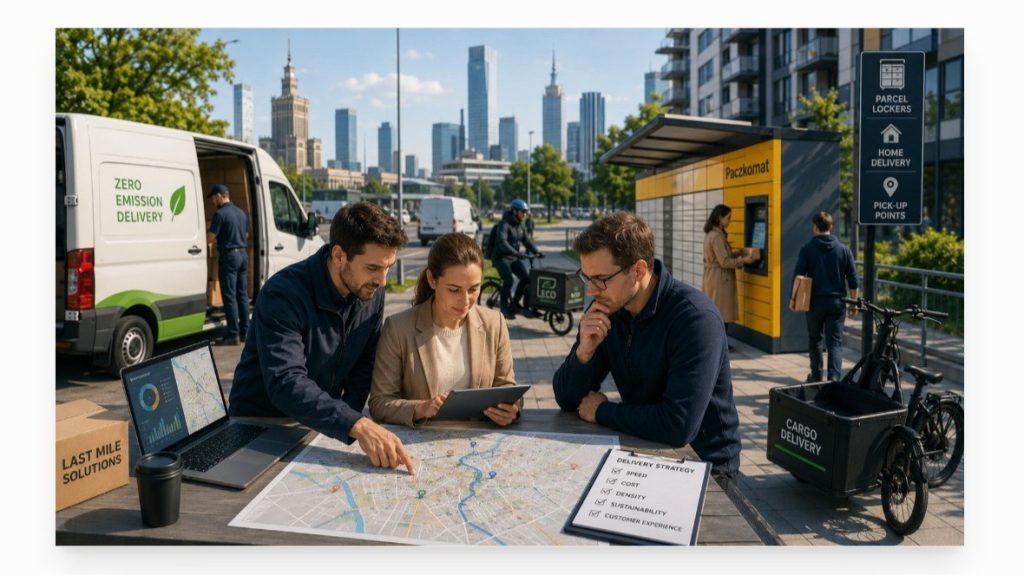
Last-mile logistics has become one of the most important pressure points in Polish commerce. The final movement of goods from a distribution center, store, parcel locker, or urban depot to the customer is often the most expensive and operationally fragile part of the delivery chain. In large Polish cities such as Warsaw, Poznań, Wrocław, Kraków, Gdańsk, and Łódź, the challenge is intensifying as e-commerce volumes grow, customers expect faster delivery, and municipalities pay closer attention to congestion, emissions, noise, and curbside use.
The old delivery model was relatively straightforward: collect parcels from a central hub, send vans into the city, and deliver to individual addresses. That model is now under strain. Dense apartment blocks, limited parking, failed delivery attempts, narrow streets, traffic delays, and rising labor costs all reduce efficiency. At the same time, customers want more control. They want to choose when, where, and how they receive goods. For retailers and logistics providers, the last mile is no longer just a cost center. It is part of the customer experience and a source of competitive differentiation.
Poland is especially interesting because it has become one of Europe’s most advanced parcel-locker markets. The success of Paczkomaty and other out-of-home delivery networks has changed consumer behavior and reduced reliance on direct-to-door delivery. This gives Poland a different last-mile profile from markets where home delivery remains dominant. Foreign companies entering Poland should understand that delivery strategy is not simply about finding a courier. It is about designing a delivery ecosystem that balances convenience, cost, density, sustainability, and brand trust.
Market Landscape
Poland’s last-mile market is shaped by three forces: e-commerce growth, dense out-of-home delivery networks, and increasing pressure on urban mobility.
Parcel lockers are the clearest symbol of this transformation. InPost, the best-known operator, delivered more than one billion parcels in 2024 and had roughly 25,000 automated parcel machines in Poland by the end of that year. Its model has trained Polish consumers to view lockers not as a fallback option, but as a preferred delivery method. For many customers, parcel lockers offer 24/7 access, lower delivery friction, fewer missed deliveries, and more control than waiting at home.
Competition is increasing. Allegro, Poland’s dominant e-commerce platform, has been expanding its own logistics capabilities and planned to add 2,500 parcel lockers in Poland in 2025. Orlen and Poczta Polska also announced a strategic partnership intended to create a network of more than 30,000 pickup and drop-off points. This growing competition confirms that out-of-home delivery is becoming infrastructure, not just a service add-on.
Urban regulation is another important factor. Warsaw introduced a clean transport zone in 2024, and other Polish cities are moving in a similar direction. These zones are still developing, but the policy signal is clear: the most polluting vehicles will face increasing restrictions in central urban areas. For logistics operators, this accelerates the case for electric vans, cargo bikes, route consolidation, and more efficient urban depots.
The real estate side of last-mile logistics is also changing. Retailers and logistics providers are experimenting with micro-fulfillment centers, dark stores, urban warehouses, and store-based fulfillment. These facilities can reduce delivery times but carry higher rental and staffing costs. A centrally located micro-hub may improve delivery speed, but it must generate enough volume to justify its expense.
Technology is becoming essential. Route optimization, predictive demand planning, real-time tracking, parcel-locker load forecasting, delivery-window management, and customer notifications all influence operational performance. The companies that win in last-mile logistics will not necessarily be the ones with the most vehicles. More often, they will be the ones that use data to make each route, locker, courier, and delivery promise work harder.
Opportunities and Challenges
- Parcel lockers can reduce failed deliveries and improve delivery economics. Lockers allow carriers to consolidate many parcels into a single stop rather than sending couriers to dozens of individual addresses. For retailers, they can lower failed-delivery risk and give customers more flexibility. The challenge is capacity management. Popular locker locations can fill quickly, especially during holidays or sales peaks.
- Electric vans and cargo bikes can strengthen urban access. Clean transport zones, sustainability expectations, and congestion pressure make low-emission delivery fleets more attractive. Electric vans may work well for higher-volume routes, while cargo bikes can be effective in dense central districts. The economics depend on range, charging access, payload, route density, weather, and driver availability.
- Micro-fulfillment can improve speed but weaken margins if poorly located. Urban micro-hubs can support same-day or next-day delivery, but they are expensive to operate. The business case is strongest where order density is high, inventory can be managed tightly, and the facility serves multiple delivery channels, such as home delivery, click-and-collect, and locker replenishment.
- Retail stores can become fulfillment assets. Supermarkets, convenience stores, pharmacies, electronics retailers, and specialty chains can use existing locations as pickup points, return points, or local fulfillment nodes. This can improve asset utilization, but store teams need the right processes, storage space, and technology support.
- Customer expectations are becoming more precise. Polish consumers are increasingly accustomed to live tracking, flexible pickup, clear notifications, and convenient returns. A fast delivery promise is not enough if the delivery window is vague, the return process is difficult, or customer service cannot resolve issues quickly.
- Courier labor is a structural constraint. Last-mile delivery depends on drivers, couriers, warehouse staff, dispatchers, and support teams. Labor shortages, turnover, platform-work regulation, seasonal peaks, and wage pressure can all affect service reliability. Predictive staffing and better route planning are now part of workforce strategy.
- Carrier duplication creates inefficiency. Multiple vans from competing carriers often serve the same streets, apartment buildings, and office districts. Urban consolidation, shared pickup points, and coordinated delivery windows can reduce congestion and cost, but cooperation between competitors is difficult and must be structured carefully.
Strategies and Partnerships
Companies operating in Polish cities should begin by mapping their actual last-mile cost drivers. Average delivery cost is often misleading. The real insight comes from understanding delivery density, failed attempts, return rates, parcel size, time-window pressure, locker availability, courier productivity, and customer-service incidents by district.
Warsaw requires particular attention because it combines high demand with heavy congestion, diverse neighborhoods, dense apartment living, and growing regulatory pressure. A last-mile model that works in a suburban retail park may not work in Śródmieście, Mokotów, Wola, or Praga. Similar district-level thinking applies in Wrocław, Poznań, Kraków, Gdańsk, and Łódź.
A strong urban delivery strategy should include several practical elements:
- Use lockers as part of the core delivery model. Parcel lockers should not be treated as an optional checkout feature. For many Polish customers, they are a preferred delivery channel and should be integrated into pricing, returns, customer communication, and inventory planning.
- Segment deliveries by urgency and density. Not every order needs the same delivery model. High-density, low-urgency orders may fit lockers or consolidated delivery. Urgent orders may justify direct courier delivery. Bulky goods may require scheduled delivery with specialized handling.
- Design returns with the same care as outbound delivery. Returns are central to e-commerce trust. Locker-based returns, pickup points, store returns, and clear digital labels can reduce friction and improve repeat purchasing.
- Evaluate micro-fulfillment selectively. Micro-hubs work best where order density, product mix, and service promises justify the cost. Retailers should test limited pilots before committing to expensive urban real estate.
- Invest in routing and visibility technology. Route optimization, customer notifications, locker capacity forecasting, and real-time exception management can reduce cost while improving reliability.
- Plan for low-emission access early. Electric vans, charging infrastructure, cargo bikes, and consolidated delivery models should be evaluated before regulations force a rushed fleet transition.
- Build relationships with municipalities and property developers. Loading zones, locker placements, residential delivery rooms, micro-hub permissions, and clean-transport pilots often depend on local coordination.
Partnerships will shape execution. Retailers may need parcel-locker operators, couriers, software providers, fulfillment partners, property owners, and municipal contacts. Logistics providers may need electric-vehicle leasing partners, charging operators, route-optimization tools, and workforce agencies. Property developers can become important allies by designing buildings with parcel rooms, loading bays, and locker areas from the start.
The broader strategic lesson is clear. Last-mile logistics in Poland is becoming less about moving parcels one by one and more about managing urban delivery capacity as a system. Companies that combine lockers, data, micro-fulfillment, low-emission transport, and customer-friendly returns will be better positioned than those trying to solve every delivery with more vans.
How Expand2Poland Can Help
- Last-mile market and delivery-network assessment
- Parcel locker, carrier, and fulfillment partner identification
- Urban logistics strategy for Warsaw and major Polish cities
- Micro-fulfillment and click-and-collect planning
- Support with low-emission delivery and municipal coordination
Poland’s last-mile market rewards companies that can make delivery faster, cleaner, and more predictable without losing control of cost. Contact Expand2Poland to design a practical urban logistics strategy that fits Polish customer expectations and city-level operating realities.
The information provided in this article is for general informational and educational purposes only and does not constitute legal, financial, or tax advise.