
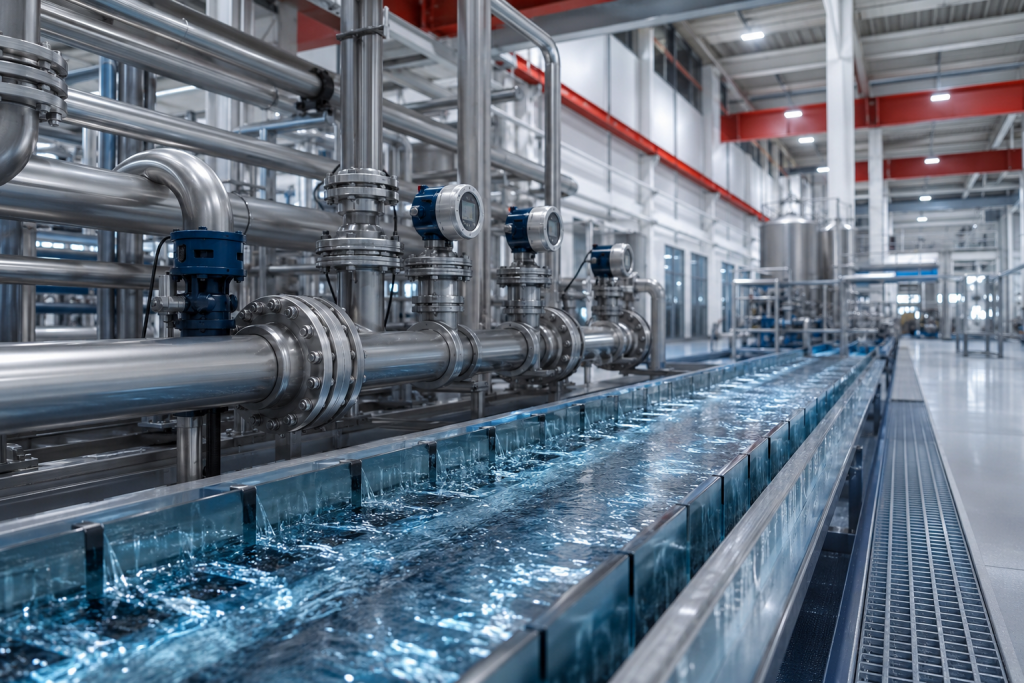
Water-resilient manufacturing in Poland starts with treating water as an operational asset. Water is often treated as a low-cost utility until scarcity, quality variation, discharge limits, or a permit constraint interrupts production. For manufacturers in Poland, that assumption is becoming less defensible. Climate volatility, competition among users, stricter environmental expectations, and the energy required to pump, heat, cool, and treat water turn water management into an operating-resilience issue.
The strongest investment cases do not begin with a catalog of equipment, they begin with a site water balance: where water enters, how its quality changes, which processes truly require potable-grade supply, where it is lost, and what leaves the boundary. That evidence allows management to rank no-cost controls, process changes, reuse loops, treatment assets, and external sourcing options by risk-adjusted value.
For a foreign investor, Poland offers an extensive industrial base, capable engineering partners, and access to EU and national funding channels. It also requires careful local diligence. Abstraction, wastewater discharge, rainwater management, municipal contracts, and environmental permits can differ materially by location and process. Water strategy therefore belongs in site selection and capital design, not in a sustainability appendix written after construction.
Market Landscape
Polish manufacturing operates under the EU Water Framework Directive and national Water Law, with permits and charges applying to relevant water services and discharges. The practical compliance position depends on the source of supply, receiving environment, wastewater composition, volumes, and the installation’s other environmental obligations. A project may rely on a municipal network, its own intake, a third-party industrial system, or a combination, and each structure creates different continuity and liability questions.
The European Commission’s Water Resilience Strategy, published in 2025, places efficiency, circularity, infrastructure, digitalization, and investment at the center of the EU response. It includes a nonbinding EU-level ambition to improve water efficiency by at least 10 percent by 2030, while recognizing that baselines and conditions vary. For companies, the important signal is directional: water performance will increasingly influence permits, financing, customer expectations, and resilience planning.
Poland’s water risk is uneven. A national average does not describe a specific catchment, municipality, or industrial park. Seasonal drought, intense rainfall, aging infrastructure, competing agricultural or household demand, and receiving-water quality can create local constraints. Site diligence should therefore test historical interruptions, planned network investment, source redundancy, discharge headroom, flood exposure, and the legal status of every connection.
Funding may be available through EU programs, national and regional environmental funds, or broader modernization calls, but eligibility, aid intensity, timing, and procurement rules change. A technically attractive recycling project is not automatically grant-ready. Applicants need a defined baseline, eligible expenditure, measurable environmental effect, permits, financing, and a credible implementation schedule. The official Polish European Funds portal and the relevant managing authority should be checked for the current call.
Water-Resilient Manufacturing in Poland: Opportunities and Challenges
The first opportunity is measurement. Main-meter data can hide leaks, uncontrolled cleaning, cooling-tower losses, or a single water-intensive line. Submetering major users, reconciling intake with product, evaporation, wastewater, and sludge, and setting normal ranges by shift can reveal avoidable consumption before capital spending begins. Digital meters are useful only when ownership and escalation rules turn anomalies into action.
The second opportunity is fit-for-purpose quality. Many sites use high-quality water for tasks that could accept recovered condensate, treated rinse water, harvested rainwater, or another lower-grade stream. A reuse matrix should match each source with potential uses and specify microbiological, chemical, temperature, and reliability requirements. Food, pharmaceutical, electronics, and other sensitive operations need validated barriers that protect product quality and hygiene.
Closed-loop cooling, counter-current rinsing, dry or optimized cleaning, condensate recovery, membrane systems, and process redesign can all reduce intake. Savings are site-specific; blanket claims about a technology’s percentage reduction are unreliable. Recovery also concentrates salts and contaminants, creates reject streams, consumes energy and chemicals, and requires maintenance skills. The correct measure is total life-cycle performance, not water volume alone.
Business continuity is often the decisive benefit. A buffer tank, alternate connection, reuse loop, or drought-response protocol can protect production when supply is constrained. However, storage brings hygiene and permitting considerations, while an alternate source may not meet quality or capacity expectations during a regional event. Resilience measures must be tested under realistic scenarios, including concurrent heat, power, and supplier disruption.
Strategies and Partnerships
Build the baseline from at least twelve months of volume, cost, production, weather, and wastewater data. Map flows at process level and express performance both as absolute cubic meters and intensity per unit of output. Separate structural improvement from a change in product mix or production volume. Assign uncertainty grades to estimates so investment decisions do not depend on false precision.
Create a hierarchy of measures. Repair leaks and stabilize operating procedures first. Then optimize cleaning, cooling, and scheduling; segregate clean and contaminated streams; and only then size treatment and reuse equipment. Pilot difficult applications with the actual Polish water chemistry and wastewater profile. Contracts should define performance tests, consumables, membrane life, uptime, waste handling, training, data access, and responsibility for permit modifications.
Integrate water with energy, carbon, production, and finance. Heating and pumping reductions may strengthen the return, while advanced treatment can increase electricity use. Model capital cost, operating cost, avoided water and discharge charges, downtime risk, maintenance, residual disposal, and possible grant support. Use sensitivity analysis rather than a single payback period.
Govern the program across engineering, environment, quality, procurement, finance, and operations. Set trigger levels for unusual consumption and water quality, conduct periodic mass-balance reviews, and include water requirements in change control for new products and equipment. Supplier and landlord obligations should be documented, especially in leased or multi-user industrial sites.
Treat each major project as an operational change, not a sustainability installation. Define the commissioning sequence, temporary supply arrangements, sampling plan, acceptance criteria, operator training, spare-parts strategy, and response to an off-specification result. Confirm who may stop a reuse loop when quality is uncertain and how production will continue. After start-up, compare verified savings with the approved baseline and normalize for volume and product mix. Review performance at 30, 90, and 365 days so membrane fouling, control overrides, or behavioral drift do not erase the benefit. This disciplined measurement and verification also strengthens lender, grant, customer, and board reporting because it separates modeled impact from delivered results.
How Expand2Poland Can Help
Through our trusted partner network, Expand2Poland supports our clients with the following:
- Polish site and catchment water-risk screening
- Water-balance, metering, and opportunity assessment
- Technology, utility, and engineering-partner introductions
- Permit, funding, and implementation coordination
- Business-case and supplier-proposal comparison
- Local stakeholder and project-governance support
Water efficiency is most valuable when it protects output as well as resources. Expand2Poland can help investors translate a corporate water objective into a site-specific Polish program with credible data, qualified partners, and accountable delivery.
The information provided in this article is for general informational and educational purposes only and does not constitute legal, financial, or tax advice.
The information provided in this article is for general informational and educational purposes only and does not constitute legal, financial, or tax advise