
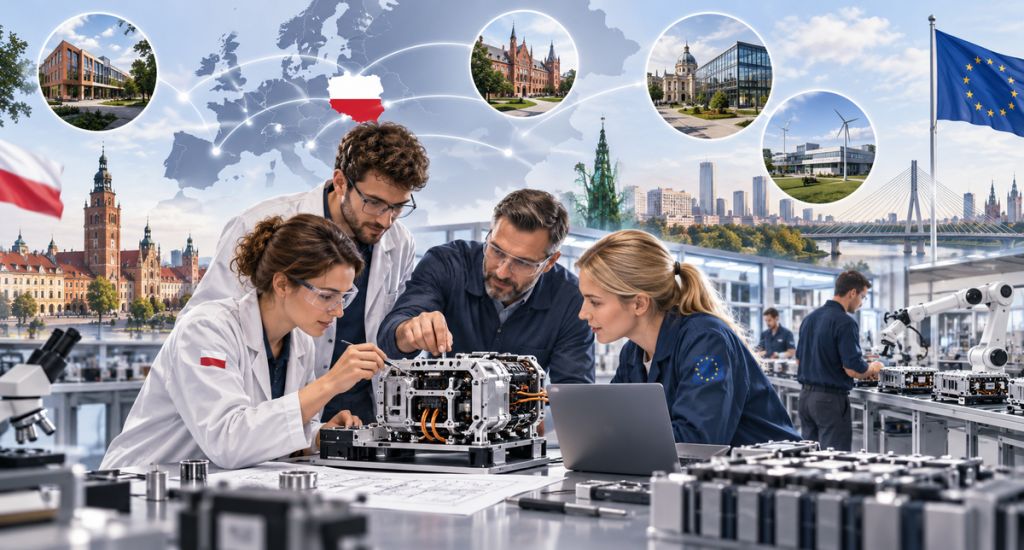
Collaborative research and development has become a more practical route to innovation than many companies once assumed. In a market where technology cycles are shortening, capital discipline is tighter, and specialized talent is increasingly distributed across institutions and countries, few businesses can afford to build every capability internally. Poland fits well into this new model. It offers a large higher-education base, expanding research infrastructure, access to EU-wide funding channels, and a policy environment that continues to encourage stronger links between science and industry.
For foreign investors, the case for looking at Poland is not limited to labor cost or engineering availability. The more compelling argument is strategic fit. Poland can serve as a research partner, a technical development location, a commercialization bridge into the EU market, or a consortium member in larger cross-border innovation programs. The strongest opportunities tend to arise where a company has a defined technology objective and needs complementary research capability, public co-funding, or a regional innovation platform to reduce cost and accelerate progress.
The opportunity is real, but it should not be romanticized. Joint R&D does not create value simply because multiple institutions are involved. It works when the scientific agenda is credible, the commercialization path is thought through early, and the governance model is mature enough to handle IP, reporting, publication rights, cost allocation, and cross-border coordination. In Poland, as elsewhere, successful collaboration is usually the result of disciplined structuring rather than enthusiasm alone.
Market Landscape
Poland’s research base is broader than many foreign companies initially expect. According to Statistics Poland, 352 higher education institutions operated in the 2024/2025 academic year, and 292,000 graduates received diplomas in the 2023/2024 academic year. That gives the country scale, but scale is only part of the story. Poland also has a layered institutional ecosystem that includes universities, basic-research funding through the National Science Centre, applied R&D support through the National Centre for Research and Development, and large public research networks such as Łukasiewicz, which links 22 institutes across 12 cities and brings together 4,500 scientists and engineers.
The research profile itself is commercially useful. Across the Polish system, capabilities are especially visible in engineering, materials, manufacturing-related technologies, life sciences, diagnostics, and selected digital and security-adjacent fields. Within the Łukasiewicz system alone, institutes highlight strengths in health, biotechnology, materials science, sustainable technologies, machine design, technical safety, and workforce-development-linked innovation. These are not abstract academic specialties. They align closely with sectors where foreign investors often seek European collaboration partners: advanced manufacturing, medtech, industrial automation, energy transition, diagnostics, and applied software-enabled systems.
The funding environment also deserves attention. At EU level, Horizon Europe remains the bloc’s flagship research and innovation program, with an indicative 2021–2027 budget of EUR 93.5 billion. It is designed explicitly to support cross-border research and innovation, including collaborative projects involving multiple beneficiaries. Alongside that, Poland’s National Contact Point within NCBR provides proposal support, consortium-building assistance, and guidance on legal, financial, and IP issues for Horizon Europe applicants. NCBR also finances Polish participants in international projects across multilateral and bilateral programs, while NCN supports international cooperation in basic research, including through the Weave mechanism.
This means that Poland is not simply a place with universities, it’s a place with multiple entry points into collaborative R&D, depending on whether the objective is fundamental science, applied development, industrial scaling, or consortia participation. The commercial task is to choose the right channel rather than treating all research partnerships as functionally identical.
Opportunities and Challenges
Access to talent, facilities, and publicly supported collaboration
The most obvious advantage of joint R&D is access. A foreign company can tap specialized researchers, laboratories, and institutional credibility without building every element internally. In Poland, that can mean partnering with a university department for advanced scientific work, working with a Łukasiewicz institute on applied technology development, or structuring a consortium that combines academic expertise with industry-driven commercialization goals. Public support mechanisms at EU and national levels can lower the cost of experimentation and broaden the scope of what a company is willing to attempt.
The catch is that funding does not remove operational burden. Horizon Europe and similar mechanisms can be attractive, but they come with proposal complexity, reporting obligations, partner coordination demands, and tight rules around deliverables and documentation. Companies that treat grant funding as easy external money tend to underestimate the management load that comes with it.
Deep-tech and applied-innovation projects
Poland is well positioned for collaborative work in areas that sit between research and industrial application. This includes advanced materials, manufacturing technologies, diagnostics, biotechnology, digital systems, and selected energy-transition or security-relevant technologies. EIT communities in fields such as health, climate, digital, and manufacturing add another layer to the European innovation ecosystem and can help connect research, startup activity, education, and commercialization.
Not every project, however, should be placed into a multinational framework. Some technologies move best through tightly controlled bilateral development rather than larger consortia. The more sensitive the IP, the shorter the commercialization horizon, or the more competitive the field, the more careful companies need to be about who sits inside the collaboration and what rights each party receives.
Intellectual property and governance discipline
IP is often where otherwise promising collaborations lose momentum. The European IP Helpdesk is explicit that intellectual property management is central to the implementation and impact of collaborative EU-funded projects, and consortium agreements are expected to address internal organization, financial matters, conflict resolution, exploitation, dissemination, and IP handling. In other words, the legal framework is not peripheral paperwork, it’s part of the value-creation mechanism.
This is where foreign investors need to be disciplined. Background IP, foreground results, licensing rights, publication review periods, data use, confidentiality, and exit scenarios should be discussed before technical work begins, not after the first meaningful result appears. Good science can survive imperfect administration for a while. Commercialization usually cannot.
Subsidy design, tax support, and state-aid boundaries
Poland’s R&D environment is strengthened by tax tools and public co-financing, but those benefits come with rules. Official Polish guidance confirms that businesses carrying out R&D may use the B+R tax relief, and qualifying businesses may also benefit from the IP Box regime. At EU level, the RDI state-aid framework distinguishes between economic and non-economic activity and sets the conditions under which public support for R&D projects, research infrastructure, innovation activities, or clusters can be treated as compatible aid.
The practical implication is simple: collaborative R&D should be structured with funding rules in mind from the outset. A technically strong project can still run into problems if the funding stack, cost allocation, or exploitation model creates state-aid or compliance issues later.
Strategies and Partnerships
Companies should begin with a technology and commercialization map, not with a funding call. The first question is what the business is trying to achieve: proof of concept, prototype development, validation, process improvement, platform IP, or access to future talent. Once that is clear, the right institutional form becomes easier to identify. Some projects are best suited to a university-led consortium. Others belong in an applied institute setting or a smaller industry-science partnership with more concentrated decision-making.
Partner selection should also be more selective than many first-time entrants assume. Brand name alone is not enough. The better test is whether the prospective Polish or EU partner has relevant technical credibility, prior experience with externally funded projects, internal project-management capacity, and a realistic attitude toward timelines and commercialization. A smaller but execution-oriented institution may be more valuable than a prestigious but diffuse partner.
A few practical rules improve the odds of success:
- Match the collaboration model to the technology objective – Large consortia can be effective for broad platform development or public-priority themes. Bilateral or tightly structured multi-party arrangements often work better for proprietary or time-sensitive development.
- Negotiate IP and exploitation terms early – Background IP, result ownership, access rights, publication controls, and dispute procedures should be fixed before technical momentum builds.
- Budget for management, not only science – Proposal work, reporting, partner coordination, and financial administration require dedicated capacity. Under-resourcing this layer is a common mistake.
- Align public funding with a commercial path – Grants can reduce cost and risk, but they should support a plausible route to deployment, licensing, productization, or operational advantage.
The strongest collaborations usually combine scientific ambition with commercial sobriety. Poland offers the ingredients for that balance, but the structure has to be built intentionally.
How Expand2Poland Can Help
- Research and innovation landscape assessment in Poland
- Partner identification across universities, institutes, and applied R&D entities
- Support with consortium strategy and funding-path selection
- Coordination with legal and tax advisors on IP and funding structure
- Commercialization-focused guidance for cross-border R&D partnerships
If your company is exploring joint research, EU-funded innovation, or a Poland-based R&D strategy, Expand2Poland can help you build the right structure from the beginning. Contact us to turn a promising collaboration idea into a workable business plan.
The information provided in this article is for general informational and educational purposes only and does not constitute legal, financial, or tax advise.