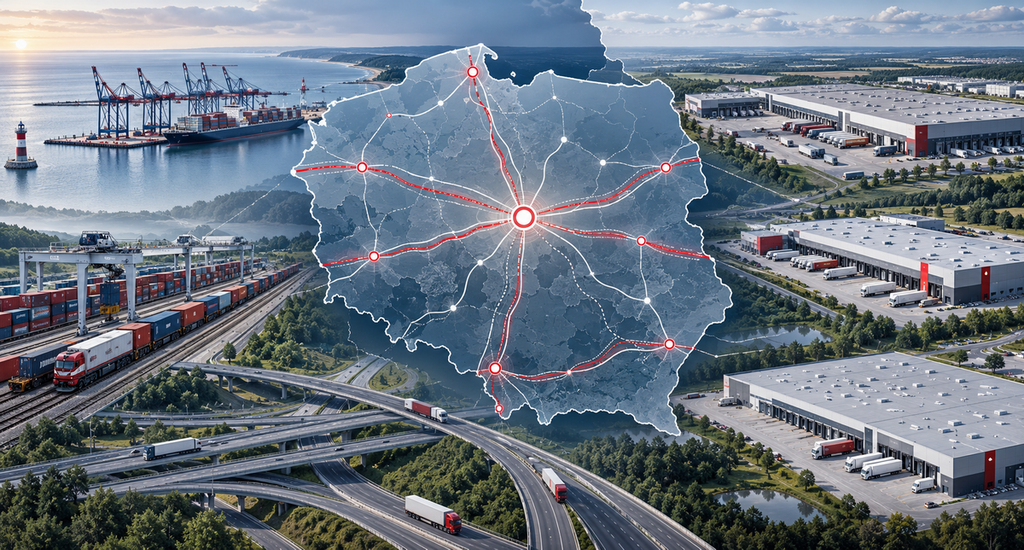
Logistics parks in Poland can support domestic distribution, ecommerce fulfillment and European supply chains. Selecting the right location requires more than comparing warehouse rents: customer routes, workforce, power, building specifications and operational resilience all affect the decision.
For an international company, the most useful starting point is a facility brief linked to the business's actual goods flows and service requirements.
Why companies assess Poland for logistics
Poland's position in Europe, road and rail networks and Baltic ports make it relevant to companies serving Polish customers and wider regional markets. Manufacturing activity and online retail can create different warehouse needs, from industrial supply to returns-intensive fulfillment.
The advantages are project-specific. A location suitable for national parcel distribution may not fit port-related cargo or temperature-controlled goods. Actual route performance matters more than a general claim of centrality.
Polish logistics locations to investigate
Warsaw and the surrounding region
The capital region can be relevant for access to a large customer base and commercial activity. Compare the precise site with delivery areas, road access, workforce availability and congestion. Proximity to Warsaw does not make every facility equivalent.
Łódź and central Poland
Central locations can be candidates for distribution across multiple Polish regions. Model actual transport distances and schedules, including inbound goods, customer deliveries and returns, before deciding that a central point is optimal.
Upper Silesia
The region's industrial activity can make it relevant to manufacturing supply chains and southern routes. Investigate customer and supplier locations alongside labor, utilities and facility specifications.
Wrocław and Poznań
These areas may be relevant to western routes and particular industrial or customer networks. Compare individual sites and border-crossing routes rather than choosing a city on reputation alone.
Baltic port regions
The Gdańsk–Gdynia area and Szczecin can be relevant where maritime access forms part of the supply chain. Port proximity is only one factor: check handling arrangements, inland connections, customs processes and the location of final customers.
Secondary locations
Other towns can be suitable where a project needs a specific workforce, customer relationship or expansion area. Lower headline property costs may be offset by transport, staffing or infrastructure requirements.
Opportunities shaping logistics requirements
Ecommerce and returns
Fulfillment can require flexible picking, packing, parcel-carrier collection and a dedicated returns process. Evaluate peak demand, product variety and the cost of handling returned stock.
See ecommerce entry into Poland for the customer-facing side of this operating model.
Industrial and light-production space
Some projects combine storage with assembly, service or light production. Confirm that the facility and its permitted use accommodate the intended activity. Requirements may differ from those of a standard warehouse.
Urban delivery and specialist storage
Facilities closer to customers may support certain delivery models, while cold-chain or other specialist operations require additional technical capability. Investigate the economics and permissions for the actual goods and service level.
Energy efficiency and sustainability
Building performance, energy supply and customer reporting requirements can affect facility choice. Review certification scope, measured performance and the responsibilities of landlord and tenant. A certificate is not a substitute for checking operational fit.
Risks and constraints to evaluate
Planning, permits and utilities
Confirm permitted use, development status, access and utility capacity. A advertised site or building does not prove that the required power, fit-out or operational approvals are available on your timetable.
Workforce and automation
Assess the staff required for each shift and the local recruitment environment. Automation can change building, power and capital requirements; it does not remove the need for technical support and operational planning.
Cost and contractual exposure
Compare rent with service charges, utilities, fit-out, equipment, maintenance, insurance and transport. Review indexation, guarantees, expansion rights, reinstatement and termination terms with advisers.
Flexibility and resilience
Consider peak capacity, business continuity, alternative carriers and the possibility of expansion. A facility that meets today's needs may become restrictive if the product mix or delivery promise changes.
A six-step strategy for choosing a logistics park
1. Build the operating brief
Define volumes, product dimensions, storage conditions, throughput, shifts and service levels. Identify any special handling, returns or production needs.
2. Model the network and total costs
Map suppliers, customers, transport routes and inventory flows. Compare scenarios using consistent assumptions for rent, staffing, freight and fit-out.
3. Check site and regulatory feasibility
Use technical and legal specialists to investigate title or lease arrangements, permitted use, utilities and the project approvals required. Discuss relevant questions with the appropriate authorities rather than assuming approval times.
4. Design for the required flexibility and performance
Review dock configuration, clear height, floor loading, safety systems, expansion potential and energy needs. Separate essential requirements from improvements that can be added later.
5. Compare providers and negotiate responsibilities
Obtain comparable proposals from relevant developers, landlords or logistics operators. Define fit-out, maintenance, service levels and responsibilities clearly.
6. Plan commissioning and ongoing management
Prepare recruitment, systems, equipment installation, testing and the transition of stock. Establish performance measures and escalation routes before launch.
Our guide to finding business partners in Poland can support a structured provider search.
An illustrative location comparison
A company considering a national distribution center could compare a central site with one closer to its largest customer cluster. The central site might reduce some routes while the customer-focused option improves others. Staffing, inventory and carrier arrangements could change the result.
This is a comparison method, not a reported investment case or a promise of occupancy, returns or permitting speed.
Logistics as part of a wider Polish expansion
Warehouse selection should connect with the company's sales, staffing and setup plans. A good property decision cannot compensate for an untested customer proposition or an incomplete operating model.
If the facility would serve other markets, assess Poland as a base for EU expansion alongside the site comparison.
Frequently asked questions
Where is the best warehouse location in Poland?
It depends on suppliers, customers, goods flows and service requirements. Compare actual sites using transport, staffing, utilities and total operating costs, not location labels alone.
Should I lease a warehouse or use a logistics provider?
Compare control, volumes, staffing, capital and flexibility. A service provider may reduce setup work; a dedicated facility may better fit specialized requirements. The contract and operating responsibilities matter in both cases.
How Expand2Poland can help
Expand2Poland's recruitment and operations service can help clarify workplace and local operating needs and coordinate relevant providers. Technical property assessment and lease or investment advice require qualified specialists.
Book a consultation to discuss your Polish operating footprint and the providers you need to assess.
This article is general business information, not property, investment, engineering or legal advice.