
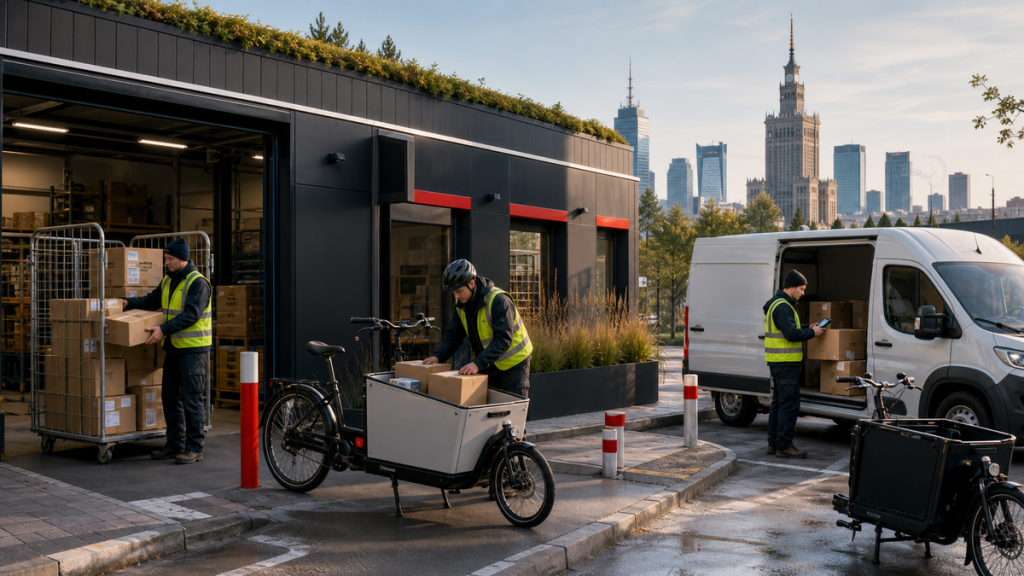
The growth of e-commerce is changing how businesses think about logistics in Poland. For retailers, distributors, and delivery operators, getting products into the country is only part of the challenge. Increasingly, competitive advantage depends on how efficiently those products reach customers in Warsaw, Kraków, Wrocław, and other major metropolitan areas.
Near-city logistics hubs offer one potential solution. Positioned close to urban demand, these facilities can help companies shorten delivery routes, consolidate shipments, manage returns, and improve service reliability.
However, proximity alone does not guarantee savings. A poorly designed hub can introduce additional handling, higher property costs, and unnecessary inventory. The commercial case depends on how the facility fits into the wider distribution network.
For international businesses considering logistics investments in Poland, understanding these trade-offs is essential before committing to a location or operating model.
Why Urban Logistics Is Becoming More Important in Poland
Poland’s established e-commerce market creates substantial demand for efficient distribution and last-mile delivery services.
According to Statistics Poland, 69.7% of people aged 16–74 purchased goods or services online during the preceding 12 months in 2025, an increase of 2.3 percentage points from the previous year. Separately, 18.3% of enterprises covered by the relevant statistical survey conducted e-sales in 2024.
These figures demonstrate the importance of digital commerce, although they should not be interpreted as direct measures of parcel volumes or local delivery demand.
The pressure is particularly visible in metropolitan distribution. Customers increasingly expect convenient delivery options, predictable arrival times, and straightforward returns. Meanwhile, logistics operators must manage congestion, limited loading space, labor costs, and restrictions on vehicle access.
The European Commission identifies urban freight as essential to city economies while recognizing its contribution to congestion, air pollution, and noise.
Near-city facilities can help address these challenges by moving selected logistics activities closer to customers. Their effectiveness, however, depends on achieving sufficient delivery density and avoiding unnecessary duplication elsewhere in the network.
What Is a Near-City Logistics Hub?
A near-city logistics hub is a distribution facility located within or close to a metropolitan area, designed to support deliveries, collections, or other logistics activities serving nearby customers.
Unlike large regional distribution centers, which typically prioritize storage capacity and access to major transport corridors, near-city facilities place greater emphasis on delivery speed, route efficiency, and access to urban destinations.
Several operating models are relevant.
Urban fulfillment centers store selected products close to customers and process orders for rapid delivery. They are most attractive where demand is sufficiently predictable to justify local inventory.
Cross-docking facilities receive products from larger warehouses, sort them, and transfer them to local delivery vehicles with minimal storage.
Micro-fulfillment and micro-distribution hubs operate from smaller urban locations, potentially supporting cargo bikes, electric vans, or deliveries within a limited geographic area.
Shared consolidation centers combine shipments from multiple businesses, potentially improving vehicle utilization where participating operators have compatible requirements.
Returns processing hubs consolidate returned goods for inspection, refurbishment, redistribution, or transport back to larger facilities.
These models serve different commercial needs. A company entering Poland should therefore define the intended operation before beginning its property search.
When Does a Near-City Hub Make Financial Sense?
The central business question is whether adding an urban logistics facility reduces the total cost of serving customers while maintaining the required service level.
A hub may shorten delivery routes, improve vehicle utilization, or make faster delivery commitments commercially viable. However, it also introduces additional expenses.
These can include property rent, staffing, utilities, handling, replenishment transport, technology, and potentially duplicated inventory.
Consider an international retailer serving customers throughout Warsaw from a regional warehouse outside the city. Establishing a smaller distribution point nearer central districts could reduce the distance traveled by local delivery vehicles.
That benefit must be weighed against the additional cost of transporting goods between facilities and operating the new location.
A useful feasibility assessment compares three scenarios:
- Direct regional distribution: Continue serving customers from the existing warehouse.
- Metropolitan consolidation: Introduce one near-city hub to support urban deliveries.
- Hybrid urban network: Combine a metropolitan hub with smaller distribution points in high-density districts.
Each scenario should be assessed using realistic order volumes, delivery schedules, handling costs, vehicle utilization, and peak-season requirements.
The objective is not simply to reduce last-mile kilometers. It is to improve the economics and reliability of the entire delivery operation.
Choosing the Right Logistics Hub Location in Poland
Poland’s major metropolitan areas offer different opportunities and operational constraints.
Warsaw provides access to the country’s largest urban market, but its geography, congestion, and variation in accessibility between districts can complicate delivery planning.
Kraków, Wrocław, Poznań, Łódź, the Tricity, and the wider Katowice metropolitan area each require their own analysis of customer concentrations, transport infrastructure, and available logistics property.
A suitable location should balance several considerations.
Transport connectivity: Efficient access to major roads, ring roads, and existing distribution facilities can reduce inbound transport costs.
Customer proximity: Being close to delivery destinations may improve route productivity, particularly where customer density is high.
Property suitability: Building layout, loading access, yard space, and permitted operating hours can be more important than total floor area.
Workforce accessibility: Public transportation, shift schedules, and local recruitment conditions directly influence operating costs.
Expansion potential: A facility should accommodate reasonable growth without forcing an expensive relocation.
Businesses should also evaluate real travel times rather than relying on straight-line distances. Bridges, railway crossings, restricted streets, and recurring congestion can significantly affect route efficiency.
In some cases, a well-connected property outside the administrative city boundary may perform better than a more central facility with poor vehicle access.
Property Due Diligence and Planning Requirements
Before committing to a logistics property in Poland, investors and operators need to establish whether the intended activities are legally and physically permitted.
Polish land-use planning is particularly important.
The country’s spatial-planning reform introduced new municipal general plans (plany ogólne), with an important implementation deadline of August 31, 2026.
According to the Polish Ministry of Development and Technology, existing local spatial development plans remain valid even where municipalities have not adopted their new general plans. Previously issued development-condition decisions also remain effective, while restrictions may affect certain new planning procedures.
This makes parcel-specific planning verification essential, especially for greenfield development or changes in property use.
Other considerations include building permits, environmental conditions, fire protection, utility capacity, lawful road access, and restrictions on noise or operating hours.
Brownfield properties may offer attractive locations and existing infrastructure, but contamination, legacy buildings, and neighboring uses can introduce additional risks.
For leased facilities, companies should confirm that the permitted use, vehicle movements, working hours, and proposed equipment are consistent with the lease and applicable approvals.
Clean Transport Zones and the Future of Urban Deliveries
Urban vehicle restrictions are becoming an important consideration for logistics operators in Poland.
Warsaw’s Clean Transport Zone (Strefa Czystego Transportu, or SCT) entered its second implementation stage on January 1, 2026.
Under the city’s published rules, general vehicle requirements at this stage include Euro 3 for petrol vehicles and Euro 5 for diesel vehicles, with alternative manufacturing-year criteria and specified exemptions.
Kraków also introduced a Clean Transport Zone on January 1, 2026. Its requirements differ from Warsaw’s, including Euro 4 petrol and Euro 6 diesel standards for light commercial vehicles up to 3.5 tonnes, subject to applicable alternatives, exemptions, and transitional arrangements.
Operators should verify fleet eligibility against the current Warsaw and Kraków municipal rules rather than assuming that arrangements in one city apply elsewhere.
For businesses planning new distribution networks, these restrictions can influence vehicle selection, hub locations, and replacement schedules.
Electric delivery vans and cargo bikes may be attractive for certain routes, particularly in densely populated districts. Nevertheless, their economics depend on payload, delivery density, operating range, charging availability, and seasonal conditions.
A successful low-emission delivery strategy must combine regulatory compliance with practical operational efficiency.
Designing Facilities for Efficient Operations
A near-city hub should be designed around the movement of goods rather than conventional warehouse specifications alone.
Cross-docking facilities need efficient vehicle access, sufficient loading doors, and space for sorting and transferring shipments. Urban fulfillment operations may require more extensive storage, picking, packaging, and inventory management capabilities.
Smaller micro-hubs have different priorities, including convenient street access, secure vehicle storage, and charging infrastructure.
Regardless of the model, operators should establish safe separation between pedestrians, delivery vehicles, and heavy transport.
Returns management should also be considered from the beginning. Dedicated space for inspecting, sorting, and temporarily holding returned products can improve processing efficiency and reduce operational disruption.
The building must accommodate peak workloads, not merely average daily activity.
Technology, Automation, and Data Integration
Warehouse automation can improve processing speed and consistency, but not every urban logistics operation requires a heavily automated facility.
Conveyors, sorting systems, mobile robots, and automated storage solutions should be evaluated against actual order volumes, product characteristics, and expected growth.
For companies entering the Polish market, modular systems and phased implementation may offer greater flexibility than substantial upfront investment.
Equally important is the integration of warehouse management systems, transport management platforms, and carrier systems.
Accurate, timely information about incoming shipments, order preparation, dispatch, delivery exceptions, and returns allows operators to make better decisions.
Technology contracts should also address cybersecurity, system availability, data ownership, integration responsibilities, and continuity procedures.
A sophisticated automated system provides limited value if operational data cannot move reliably between the businesses involved.
Energy, Workforce, and Operational Resilience
Near-city hubs must also be evaluated as long-term operating environments.
Electric vehicle charging, warehouse equipment, heating, and automation can create significant electricity demand. Companies should confirm available connection capacity and any required infrastructure upgrades before finalizing property commitments.
Charging schedules, load management, and energy-efficiency measures may improve operating economics, depending on the facility’s requirements.
Workforce availability is another essential factor. Urban locations can offer better public transportation access, but recruitment competition, shift patterns, and employment costs vary between metropolitan areas.
Business continuity deserves equal attention.
Power outages, transportation disruptions, system failures, and unexpected delivery peaks can quickly undermine time-sensitive services.
Operators should establish backup procedures, alternative transport arrangements, and realistic recovery targets before introducing demanding delivery commitments.
A Practical Approach for International Companies
Businesses considering a near-city logistics hub in Poland should begin with demand and network analysis rather than property availability.
The first stage is to establish where customers are located, what delivery commitments they expect, and how current logistics arrangements perform.
The second stage is to compare operating models and locations using full network costs, including handling, inventory, transport, staffing, property, and technology.
Once a viable approach has been identified, a limited pilot or phased launch can provide valuable evidence before further expansion.
Performance should be measured against clear indicators, including cost per delivered order, on-time delivery rates, route productivity, failed deliveries, returns processing times, and facility utilization.
The investment case should also include volume thresholds at which the hub becomes economically attractive, as well as contingency options if demand develops more slowly than expected.
This disciplined approach reduces the risk of committing to expensive infrastructure before the operating model has been validated.
How Expand2Poland Can Help
Establishing an efficient logistics presence in Poland requires a combination of market knowledge, local relationships, operational planning, and regulatory awareness.
Expand2Poland supports international companies exploring opportunities in the Polish market by helping them understand local business conditions, identify suitable partners and service providers, evaluate potential locations, and coordinate practical next steps.
For retailers, e-commerce businesses, logistics providers, and investors, this can include support with market research, partner sourcing, initial location screening, and introductions to appropriately qualified Polish specialists.
Whether you’re considering your first distribution facility or expanding an existing logistics network, we can help you navigate the Polish market and connect with the right local resources.
Schedule an introductory consultation with Expand2Poland to discuss your logistics plans and explore how we can support your business in Poland.
Disclaimer: This article is intended for general informational purposes only and does not constitute legal, tax, financial, or investment advice.